Close Menu
  • MAKİNELER ve İMALAT
    • Tools & Equipment
    • Computer-Aided Drawing
    • CAD/CAM Education
    • CNC Machine Programming
    • Casting Technologies
    • Electrical & Electronics Technologies
    • Hydraulics & Pneumatics
    • Manufacturing Processes
    • Manufacturing Technologies
    • Occupational Safety
    • Mold & Die Design
    • Solid Modeling
    • Welding Technology
    • Machine Elements
    • Mechanical Trade Drawing
    • Materials Science
    • Automotive & Vehicle Technologies
    • Robotics Technologies
    • Health Technologies
    • Defense & Aerospace Technologies
    • Descriptive Geometry
    • Technical Drawing
    • Software & Hardware Technologies
    • Innovative Manufacturing Methods
  • TEKNOLOJİ ve YAŞAM
    • OTOMOBİLLER ve TAŞIT
      • Vehicle & Engine Knowledge
      • Safe Driving
      • Sürüş Destek Sistemleri
    • Genel Kültür
      • Movies & TV Shows
      • Görsel ve Grafik Sanat
      • Books & Literature
      • Music
      • Sports
      • History
      • History of Technology
    • GÜNDELİK YAŞAM TEKNOLOJİLERİ
    • Hobbies & Entertainment
    • Internet Technologies
    • Health
    • Mobile Technologies
Makine Eğitimi
  • Machines & Manufacturing
    Machine Elements
    Hydraulics & Pneumatics
    Technical Drawing
    Computer-Aided Design & Manufacturing
    Basic Manufacturing Processes
    Manufacturing Processes
    Industry Technologies
    Other Technical Courses
    Motion & Power Transmission
    Simple Machines
    Chains & Sprockets
    Shafts & Journals
    Gears
    Cams
    Couplings
    Belts & Pulleys
    Springs
    Bearings
    Keys
    Fastening Joining
    Retaining Rings
    Screws, Bolts & Nuts
    Cotter Pins
    Flanges
    Welding
    Rivets
    Pins & Bolts
    Washers
    Calculators
    Gear Ratio Calculator
    Spring Constant Calculator
    Belt Pulley Ratio Calculator
    Other Machine Elements
    Slides & Linear Guides
    Brakes
    Flywheels
    Clamps
    Shock Absorbers
    Gaskets & O-Rings
    Seals & Sealing Elements
    Hydraulics
    Introduction to Hydraulics & Principles
    Hydraulic Systems & Applications
    Accumulators
    Filters
    Motors
    Pumps
    Valves
    Pneumatics
    Introduction to Pneumatics & Principles
    Pneumatic Systems & Applications
    Pneumatic Circuit Components
    Valves
    Cylinders
    Silencers
    Motors
    Compressors
    Dryers
    Conditioning Units
    Common Topics & Maintenance
    Hydraulic & Pneumatic Maintenance
    Study Notes, Exams & Tests
    Technical Drawing
    Introduction to Technical Drawing
    Geometric Drawings
    Perspective & Projection
    Orthographic Views
    Dimensioning
    Sectioning
    Assembly & Detail Drawings
    Tolerances
    Surface Finish Symbols
    Mechanical Engineering Drawing
    Screws, Bolts & Nuts
    Pulley Drawings
    Gear Drawings
    Shafts & Journals
    Bearing Drawings
    Pins & Bolts
    Spring Drawings
    Welds in Technical Drawing
    Washers
    Cotter Pins
    Technical Drawing Exercises
    Mechanical Drawing Exercises
    Gear Exercises
    View Extraction Exercises
    Pulley Exercises
    Pin & Bolt Exercises
    Threaded Fastening Exercises
    Descriptive Geometry
    Computer-Aided Drawing
    AutoCAD Drawing Lessons
    Solid Modeling & Animation
    Solid Model Drawing Files
    Solid Model Assembly Examples
    Solid Model Drawing Lessons
    3D CAD Software Reviews
    Solid Modeling Exercises
    CNC Programming
    CAM
    Measurement & Inspection
    Dial Indicators
    Calipers
    Gauges
    Micrometers
    Materials Science
    Steels
    Cast Iron
    Aluminum
    Plastics
    Material Testing & Hardness Measurement
    Occupational Safety
    Workshop Safety
    Safety When Working With Electricity
    Machine Safety Rules
    Hand Operations
    Filing
    Marking
    Cutting Operations
    Reaming
    Tapping
    Threading With a Die
    Drill Bit Sharpening
    Working With Machines
    Basic Turning Operations
    Basic Milling Operations
    Shaper Machine
    Machining
    Turning
    Milling
    Grinding
    Innovative Manufacturing Methods
    EDM (Electrical Discharge Machining)
    Laser Machining
    Waterjet Machining
    3D Printing
    3D Scanners
    Welding
    Rolling
    Casting
    Mold & Die Design
    Mechanical & Hydraulic Presses
    Blanking & Piercing Dies
    Bending Dies
    Drawing Dies
    Plastic Injection Molds
    Extrusion Dies
    Compound Dies
    Progressive Dies
    Blow Molds
    Spinning Dies
    Spray Molds
    Manufacturing of Machine Parts
    Automotive & Vehicle Technologies
    Motor Vehicle Manufacturing
    Raw Material Production
    History of Technology
    Health & Medical Technologies
    Defense & Aerospace
    Robotics Technologies
    Software & Hardware Technologies
    Mechanics - Strength of Materials
    Physics Topics
  • Technology & Life
    Hobbies & Entertainment
    Sports
    Music
    Vehicle & Engine Knowledge
    Vehicle Maintenance & Repair
    Safe Driving
    Driver Assistance Systems
    History
    Movies & TV Shows
    Books & Literature
    Computers & Internet
    Computer Tips
    Software Reviews
    Hardware & Peripherals
    Practical & Safe Internet Use
    Visual & Graphic Art
    Mobile Technologies
    Travel
    Science
    Health
    First Aid Knowledge
    Everyday Technologies
Makine Eğitimi
Home»Innovative Manufacturing Methods»What Is Additive Manufacturing (3D Printing)? Methods and Applications
30 August 2026

What Is Additive Manufacturing (3D Printing)? Methods and Applications

Eklemeli İmalat (3D Baskı) Nedir? Yöntemleri ve Kullanım Alanları

While traditional manufacturing methods produce a part by removing material from a block of stock (turning, milling), additive manufacturing works on the opposite logic: the part is built from scratch by adding material layer by layer. In this article, we cover what additive manufacturing (3D printing) is, its main methods, and its industrial applications.

  • What Is Additive Manufacturing?
  • How Does Additive Manufacturing Work?
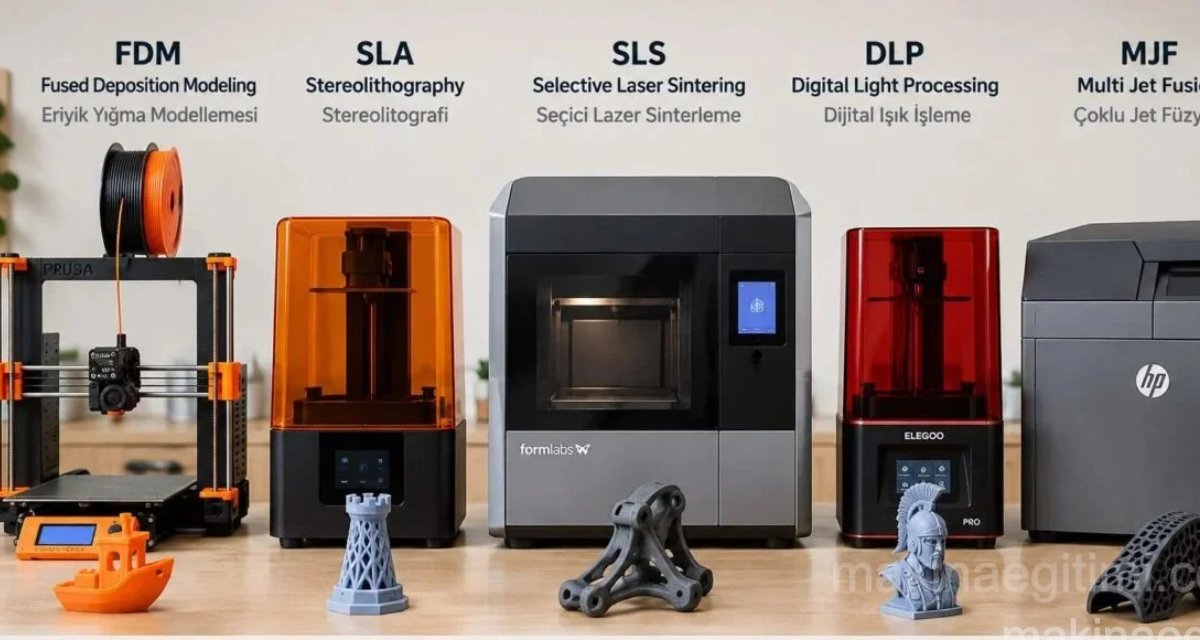
  • Main Additive Manufacturing Methods
    • 1. FDM (Fused Deposition Modeling)
    • 2. SLA (Stereolithography)
    • 3. SLS (Selective Laser Sintering)
    • 4. SLM / DMLS (Metal Powder Melting Methods)
  • Advantages of Additive Manufacturing
  • Limitations of Additive Manufacturing
  • Industrial Applications
  • Conclusion

What Is Additive Manufacturing?

Additive manufacturing, commonly known as “3D printing,” is the process of turning a digital 3D model into a physical part by adding material in thin layers, one on top of another. Unlike traditional machining (subtractive manufacturing), additive manufacturing produces very little material waste and can create parts with complex internal geometries that are impossible or very difficult to produce with traditional methods.

How Does Additive Manufacturing Work?

  • 1. 3D Modeling: A three-dimensional model of the part is created in CAD software.
  • 2. Slicing: The model is divided into thin horizontal layers using special software.
  • 3. Layer-by-Layer Production: The printer/machine builds each layer in sequence by adding material (through melting, curing, or bonding).
  • 4. Post-Processing: Finishing steps such as removing support structures, surface finishing, or heat treatment are applied.

Main Additive Manufacturing Methods

1. FDM (Fused Deposition Modeling)

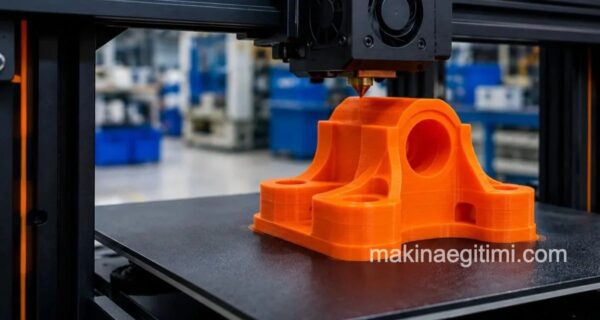
Based on melting a thermoplastic filament (PLA, ABS, PETG, etc.) and depositing it layer by layer through a nozzle. It is the most common and most economical desktop 3D printing method, widely used for prototyping and hobbyist purposes.

2. SLA (Stereolithography)

Works by curing liquid photopolymer resin layer by layer with a laser or UV light source. Because it offers very high surface quality and detail precision, it is preferred for jewelry, dentistry, and precision prototype production.

3. SLS (Selective Laser Sintering)

Works by selectively sintering (fusing together without fully melting) powdered plastic or metal material with a laser. Complex geometries can be produced without needing support structures; it is suitable for functional parts and low-to-medium volume production.

4. SLM / DMLS (Metal Powder Melting Methods)

Works by fully melting metal powder with a high-power laser and fusing it layer by layer. Light and complex parts made of metals such as titanium, aluminum, and stainless steel, which are very difficult to produce with traditional methods, can be manufactured this way. It is increasingly used in the aerospace and medical implant sectors.

Advantages of Additive Manufacturing

  • Design freedom: Parts with complex internal cavities and lattice structures, which cannot be produced with traditional methods, can be manufactured.
  • Rapid prototyping: An idea can be turned into a physical part within hours.
  • Low material waste: Material is added only where needed, with no chip loss.
  • Customization: Each part can be designed differently without mold or tooling costs (for example, patient-specific implants).

Limitations of Additive Manufacturing

  • Production speed: Slower than traditional methods (casting, injection molding) for high-volume production.
  • Material variety and cost: Metal powders in particular are more expensive than traditional raw materials.
  • Surface quality: Due to the layered structure, some methods may require additional surface finishing.

Industrial Applications

Additive manufacturing is now widely used in the aerospace sector for lightweight engine and structural parts, in automotive for prototyping and spare part production, in the medical sector for patient-specific implants and prosthetics, in mold-making for injection molds with conformal cooling channels, and in engineering education for design verification. With Industry 4.0, additive manufacturing has begun to take its place not just in prototyping, but directly in the production of functional parts.

Conclusion

Additive manufacturing has brought new design freedom to the manufacturing world by working on the logic of “adding material” instead of “removing material.” Rather than replacing traditional machining, it is increasingly preferred as a complementary method, particularly for producing parts with complex geometries, low volumes, and customization needs. Anyone following modern manufacturing technologies needs to be closely familiar with these methods.

Related Posts
How 3D printers work What Is 3D Printing – How Do 3D Printers Work? Advantages and Disadvantages of 3D Printers Advantages and Disadvantages of 3D Printers En İyi 3D Tarayıcılar Satın alma rehberi The Best 3D Scanners of 2022 – Buying Guide motion capture technology Motion Capture Technology Stages of Manufacturing with 3D Printers Stages of Manufacturing with 3D Printers Waterjet Cutting Basics Waterjet Cutting Basics Electrical Discharge Machining (EDM) Machines Electrical Discharge Machining (EDM) Machines Properties of Laser Beams and Their Working Principle Properties of Laser Beams and Their Working Principle

3D Printing
Share. Facebook Twitter WhatsApp Tumblr Email Telegram Copy Link

Leave A Reply Cancel Reply

Removing Stains from a Leather Couch
Blue Smoke from the Exhaust and Its Causes
  • Contact
  • Terms of Service
  • Privacy & Cookie Policy

Type above and press Enter to search. Press Esc to cancel.