

In this article, we’ll talk about a technology used in vehicles known as Drive By Wire. What are the drive-by-wire systems used in vehicles? What do they do? We’ll look at their advantages and disadvantages. Related Topics:
What Is Drive By Wire?
Drive by wire technology aims to manage a vehicle’s control systems, such as gear shifting, steering, braking, and acceleration, using an electronic system. It’s also known as X-by-Wire, or in short, ‘DbW’. It’s a semi-automatic, computer-controlled technology used predominantly in automobiles. It’s quite similar to the Ride by Wire technology used in motorcycles.
Many automakers, such as Mercedes-Benz, BMW, Land Rover, GM, Toyota, Volkswagen, and Nissan, have implemented ‘X by Wire’ systems in their vehicles. However, this technology is still in development. And for this reason, it requires rigorous testing and validation. However, the future of the automobile will largely rely on this technology for better fuel efficiency and controlling emissions.
Advantages and Disadvantages of Drive by Wire Technology
Advantages
- Reduces weight.
- Increases operational precision.
- Eliminates losses caused by mechanical linkages.
- Longer service intervals, meaning fewer visits for routine maintenance and other adjustments.
- Maintenance-free operation.
- Better precision. And as a result, this leads to better fuel efficiency and lower emissions.
Disadvantages:
- The design and manufacturing of the wire-based drive system is costly.
- A software error can cause these systems to malfunction.
- An error in calculating the required data can cause an accident.
- It’s vulnerable to hacking, which could compromise control of the vehicle.
What Does Drive By Wire Technology Do
DbW controls a motor vehicle’s systems such as acceleration, propulsion, braking, steering, and other functions. It does this without any physical/mechanical connection. A traditional vehicle performs these functions using mechanical, hydraulic, or pneumatic components, depending on the case. These components are prone to wear. For this reason, their performance and efficiency deteriorate over time. And thus they become inefficient.
Thanks to this technology, a vehicle’s mechanical systems, such as the throttle, brakes, and gears, can be controlled electronically. For example, when the driver presses the gas pedal, this movement is sensed as an electronic signal and sent to the vehicle’s engine. Thanks to this technology, the vehicle’s performance can be controlled more precisely, and the vehicle’s response time can become faster. Additionally, thanks to drive by wire technology, the vehicle’s driving experience can become more comfortable, since the driver’s hand and foot movements are reduced.
Removing the Mechanical Link
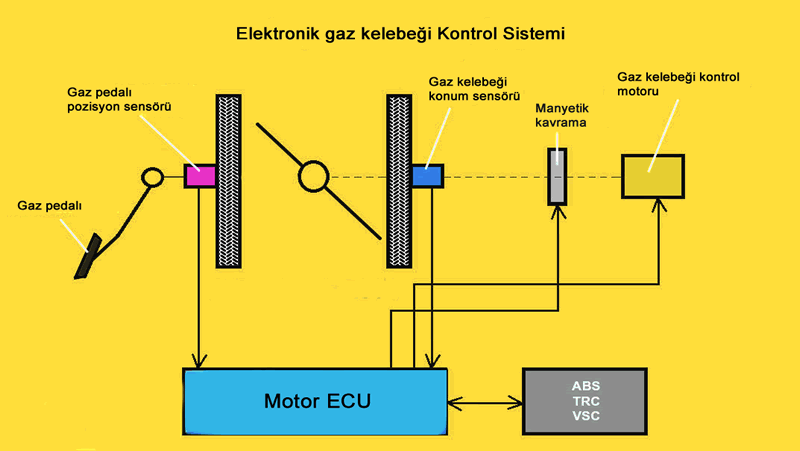
In drive-by-wire systems, the gas pedal is connected to the engine through electronic sensors instead of a mechanical cable.
Sensor Precision
Pedal position sensors transmit the driver’s input to the electronic control unit within milliseconds.
Redundancy System
For safety, many drive-by-wire systems include redundant sensor and circuit designs that engage in case of failure.
How Does Drive-by-Wire Work?
Drive by wire technology mainly uses electrical/electronic components, such as sensors and/or actuators, to control vehicle systems. This technology eliminates the need for traditional components such as drive belts, drive shafts, pumps, vacuum boosters, and master cylinders.
Drive by Wire Systems Used by Vehicles
Throttle By Wire
Electronic throttle control means using an electronic system, instead of a mechanical linkage, to control an engine’s throttle. In this type of vehicle, the driver’s input on the gas pedal is sent to a computer, which then controls the opening of the throttle valve in the engine. This allows the engine to be controlled more precisely, and can also enable features like cruise control and traction control to be implemented.
Brake-by-Wire
Electronic brake control means using an electronic system, instead of a mechanical linkage, to control a vehicle’s brakes. In a wire-by-wire vehicle, the driver’s input on the brake pedal is sent to a computer, which then controls the application of the brakes. This can allow for more precise braking, and can also enable features like anti-lock brakes (ABS) and electronic stability control to be implemented.
Steer By Wire
Electronic steering control means using an electronic system, instead of a mechanical linkage, to control a vehicle’s steering. In a wire-by-wire vehicle, the driver’s input on the steering wheel is sent to a computer, which then controls the movement of the wheels. This can allow for more precise steering, and can also enable features like lane-keeping assist and adaptive cruise control to be implemented. Steer-by-wire systems are still relatively rare in production vehicles, but have been demonstrated in prototype vehicles and are being developed for potential future use.
Watch Nissan’s ‘Steer by Wire’ in Action:
Shift By Wire
Electronic shift control means using an electronic system, instead of a mechanical linkage, to control gear shifts in a vehicle. In a shift-by-wire vehicle, the driver’s input on the gear lever is sent to a computer, which then controls the movement of the gears. This can allow for more precise gear shifts, and can also enable features like automatic gear shifting and rev matching to be implemented. Widely used in modern automatic-transmission vehicles, shift-by-wire systems are also being developed for use in manual-transmission vehicles.
Park By Wire
Park-by-wire, or electronic park control, means using an electronic system, rather than a mechanical linkage, to control a vehicle’s movement into and out of the “park” position. In a park-by-wire vehicle, the driver’s input on the gear lever, or a separate control, is sent to a computer, which then controls the movement of the gears or the application of the parking brake to hold the vehicle in place. This can allow the vehicle to be controlled more precisely while parking, and can also enable features like self-parking to be implemented. Park-by-wire systems are becoming more common in modern vehicles, particularly in vehicles with automatic transmissions.
Additionally, these subsystems have a dedicated ECU to control the sensors and their associated actuators. The related systems operate without any mechanical linkage. As a result, this technology is becoming popular. It’s thus finding a place in the luxury segment or high-end vehicle models.
Related Questions
In traditional systems, components like the gas pedal and steering are physically connected via cables or hydraulic lines. When electronic wiring and sensors are used instead of this system, the need for heavy mechanical parts decreases.
Relying entirely on electronics without a physical connection means a sensor or software error could directly affect driving. This is why the system’s reliability requires very rigorous testing and validation before it can be widely adopted.
Related Posts
 What Is TCS in Vehicles? What Does It Do? How Does It Work?
  MBUX Hyperscreen: A Dashboard Beyond Imagination
  What Is Active Park Assist? How Does It Work?
  Lane Departure Warning System in Vehicles
  What Is EBD? What Does It Do? How Does It Work?
  What Is Reverse Assist, How Does It Work?
  What Is Bosch Remote Park Assist, How Does It Work?
  Toyota Safety Sense Active Safety System