
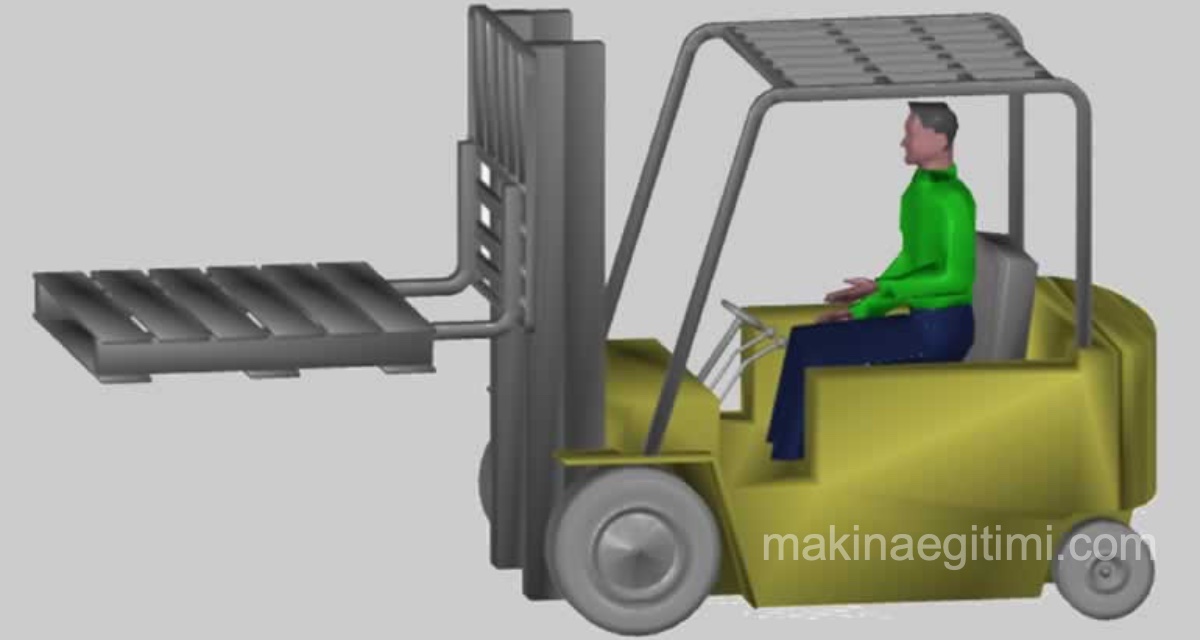
A forklift is a machine used for loading, unloading, and stacking various materials. A forklift (stacking machine) is a mobile lifting machine, driven by an electric motor and/or an internal combustion engine, that picks up a load with its forked arms and lifts, carries, loads, or stacks it over a certain distance.
Types of Forklifts

Forklift Types by Power Source
Forklifts can be classified by power source as diesel, electric, LPG, and battery-powered forklifts.
Diesel forklifts

These are forklifts whose power source is a two- or four-stroke diesel engine. These forklifts are mostly used for heavy-duty work and outdoors.
Electric forklifts
These are forklifts whose power source is an electric motor. They are used for light to medium-weight jobs. They are mostly used indoors and in places where noise is undesirable.
LPG forklifts

Their power source is an LPG engine, and they are used outdoors as an alternative to diesel forklifts. Using them indoors is hazardous and dangerous due to the LPG.
Battery-Powered Forklifts

These are driven by electric motors powered by a rechargeable battery. Their lifting capacities are smaller. They run quietly, and since they do not emit exhaust gas, they are especially preferred indoors, in places where people work, and in food-industry facilities. However, they are not used in dusty or rainy outdoor environments. Their lifting capacities range from 500 kg to 5000 kg. Thanks to the capabilities provided by semiconductor electronics, these forklifts can be run continuously for 18 hours without charging. Their working duration is generally 8-10 hours.
Forklift Types by Drive System
Forklifts are also classified by their motion-transmission system as clutch-type, torque-converter, hydrostatic, and electric-motor forklifts.
Clutch-type forklifts

The drive system of these forklifts consists of transmitting the rotary motion from the engine to the wheels via a clutch gearbox (transmission), driveshaft, differential, and axle. Because clutch problems occur very frequently while these machines operate, manufacturers no longer produce this type of forklift.
Torque-converter forklifts
The drive system of these forklifts consists of transmitting the rotary motion from the engine to the wheels via a torque converter, transmission, driveshaft, differential, and axle. It is widely used in diesel, gasoline, and LPG forklifts. The torque-converter clutch system is generally used in almost all construction/work machinery. It offers ease of operation for the operator compared to clutch-type forklifts. These forklifts also have hydraulic transmissions.
Hydrostatic forklifts

There is no classical drive system in these forklifts. That is, motion-transmission elements such as the clutch (torque converter or clutch), transmission, driveshaft, and differential have been removed, and a hydrostatic pump and hydrostatic motor have been installed in their place. Hydrostatic motors, rotated by pressurized hydraulic oil, directly turn the wheels. The hydrostatic oil pump that generates the pressure is driven from the main engine. In electric models, the pump rotation is provided by an electric motor. The operator controls the valves that direct the hydraulics to move the vehicle forward and backward.
Electric-motor-driven forklifts
In electric forklifts, drive is achieved by coupling electric motors, fed from the battery pack, directly to the wheels. In this way, the machine moves through the rotary motion of the electric motors.
Forklift Types by Place of Use

By place of use, forklifts are divided into two groups: general-purpose forklifts and narrow-aisle storage forklifts.
General-purpose forklifts
This is the classic forklift type. They are also called counterbalanced forklifts, because they are balanced by the weight of the load.
Narrow-aisle storage forklifts
These are intended for working in places where goods must be stacked as high as possible in order to save floor space. They are narrow-aisle forklifts. Narrow-aisle storage forklifts are forklifts with a small wheel width. There is a variant with a lifting mast that can be retracted into the vehicle body to save space. This type of forklift is called a high stacker (reach truck). It can maneuver in a very narrow space. The operator mostly sits sideways.
Special-purpose forklifts:
These forklifts are manufactured to perform a specific task. They are used for stacking and transporting containers. There are types that can pick up a container by gripping it from the side or from above.
Pallet Truck

A pallet truck is an auxiliary work machine used for lifting and carrying small loads indoors; it has forks like a forklift, but no walking/drive system, only lifting equipment. It can be easily moved by human power using the wheel sets fitted under the forks. Some have foot-pump lifting systems, while others have electro-hydraulic equipment powered by a battery.
Related Posts
 Definitions Related to Traffic, Highways, and Vehicles
 How to Drive a Manual Transmission Car
 Traffic Signs and Their Meanings. Warning Signs
 Safe Forklift Use. Forklift Safety Rules
 Vehicle Dashboard Panel Symbols and Their Meanings
 How Is a Tire Changed? Changing a Vehicle Tire
 Steering Wheel Grip and Turning Techniques
 Why Is It Dangerous to Rest Your Feet on the Dashboard?