

The most commonly used tool type on machines like shapers and lathes is the roughing tool. This tool has all the necessary angles. Other tools may have fewer angles. Tool angles on a lathe can be examined below on a roughing tool.
Rake angle (γ): Determines the tool’s sharpness and chip flow.
Wedge angle (β): Gives the cross-section of the tool’s cutting edge.
Clearance angle (α): Reduces friction on the tool.
Nose angle (ε): Gives the degree of sharpness of the tool tip.
Inclination angle (λ): Facilitates cutting.
Approach angle (κ): Determines the tool’s mounting position.
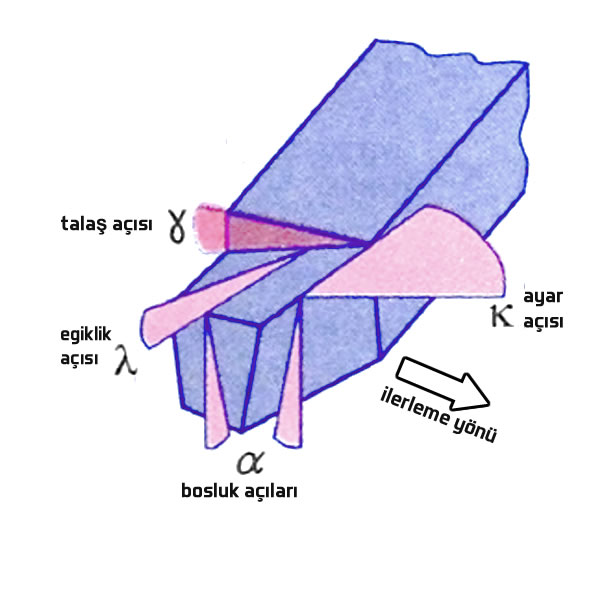

If a tool’s angles are not at the appropriate values, the machined surface quality decreases. Depending on surface quality, it becomes harder for the workpiece to perform its intended function, and its service life decreases.
On a tool, the rake angle (γ) in particular varies inversely with the hardness of the material being machined. That is, the rake angle is reduced for harder materials.
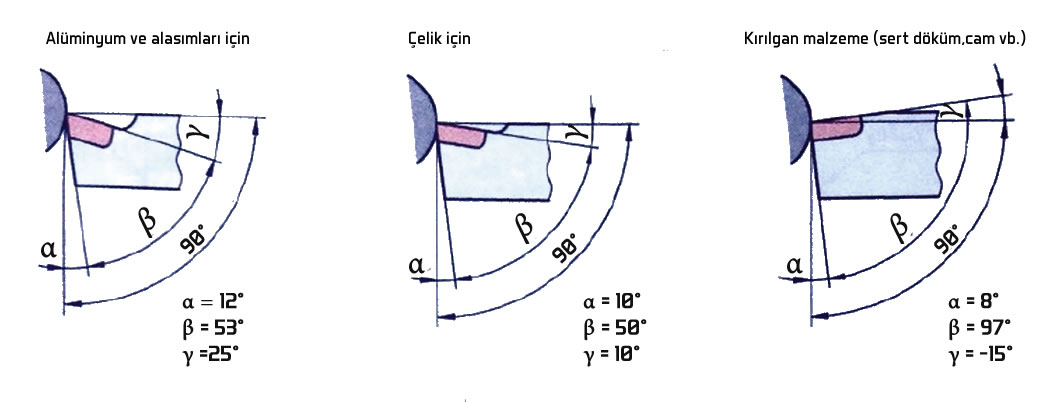
Lathe tool angles by material to be machined (above)
Definition of a Tool Holder
A tool holder is an auxiliary element used to mark or check the center of rotation of a workpiece mounted on a lathe.
Centering Precision
Proper use of a tool holder increases machining precision by minimizing the axial runout of the turned part.
Different Tip Types
Tool holder tips are manufactured in different angles and shapes depending on the workpiece’s material and diameter.
Related Questions
A large rake angle makes the tool’s cutting edge thinner and sharper, but this also weakens the edge. For hard materials, the angle is reduced so the tool stays sturdier, which makes it more durable even though it slightly dulls the edge.
The clearance angle prevents the tool’s non-cutting lower surface from rubbing against the workpiece. Without this angle, the base of the tool would continuously rub against the part, increasing heat buildup and degrading surface quality.
Related Posts
 Johnson Gauge Blocks (Johansson Gauge Blocks) and Their Use
 How to Calculate Cutting Speed, Feed and Spindle RPM: A Practical Guide With Worked Examples
 Countersinking and Countersink Drill
 Micrometer Reading Examples
 How to Read a Micrometer
 Milling and Slotting with an End Mill
 How Is Filing Done? Filing Techniques
 Milling and Cutting with a Slitting Saw