
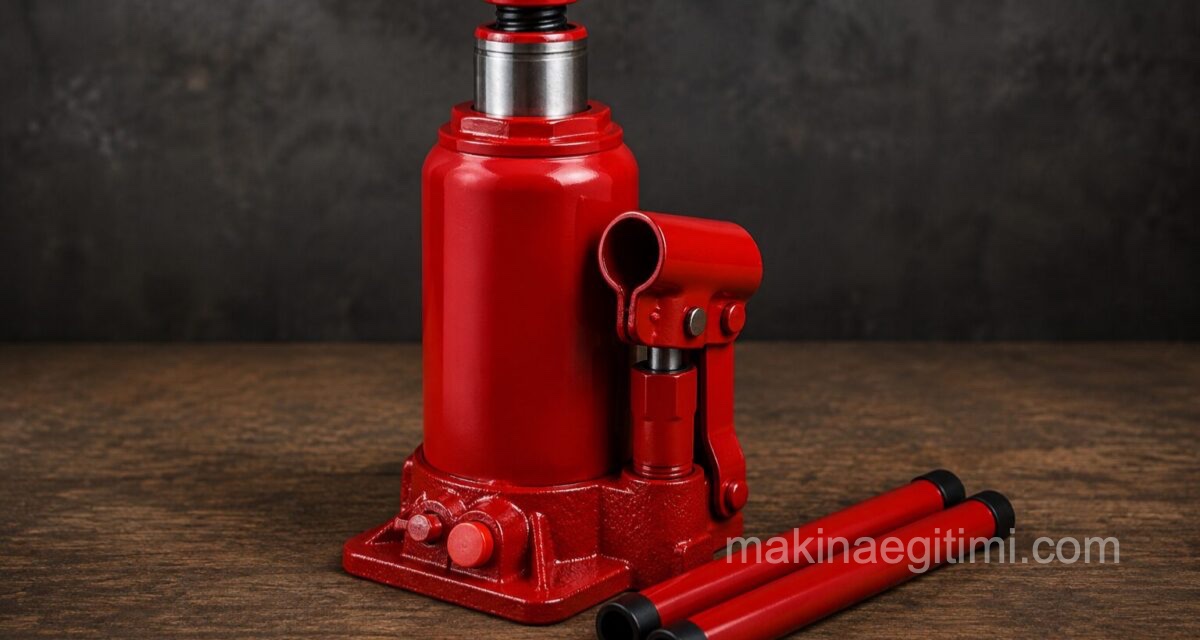
How do hydraulic jacks, which let us lift huge cars and different kinds of loads without expending much force, actually work?
Hydraulic jacks are machines that let us lift huge loads with small forces, by taking advantage of the incompressibility of hydraulic fluid and Pascal’s principle.

All a jack needs is about 750 ml of oil, a handle, and a bit of effort. This lets an ordinary person lift something 350 times heavier than they normally could. That’s 18 tons, or the combined weight of 8 mid-size cars.
Thanks to the properties of hydraulics, force can be spread out over an area, and this allows for astonishing results in lifting weight.
A hydraulic jack is made up of parts such as a handle, a pump piston, valves, an oil reservoir, and a ram (lifting) piston.
Once the hydraulic pump is placed under the car and the handle is pumped, the lever’s motion transfers force into the fluid. This gives some motion to the jack’s pump piston, and then a smaller amount of motion is transferred to the ram piston. The motion may be small, but the force gained from the process is large enough to lift the car.
How Does It Work?
When the jack handle is raised, it pushes the pump piston up. As the piston rises, some oil from the reservoir passes through a one-way valve into the piston chamber. When the handle is pushed down, it pulls the piston down, and thanks to the handle’s mechanical advantage, this is done easily.
The handle is a simple mechanism that multiplies force without requiring extra effort. Since the handle is 45 cm long, the end of the handle moves over a much greater distance than the pump piston, which increases the force pulling the piston down.

When the handle goes down, it pulls the piston down. And this draws the hydraulic oil downward. And like all fluids, since it’s incompressible, the oil continues to move, effectively transmitting the force coming from the pump piston to everything around it, and everywhere it goes.
The first one-way valve (check valve) prevents the oil from flowing back into the reservoir.
The second one-way valve (check valve) lets the oil flow into the section below the large chamber, which does the heavy lifting in the jack. The oil applies a force equal to the unit area of the reservoir it’s inside. This way, it sends the force it received from the pump piston, distributed equally over the unit area of the ram piston, pushing the piston upward.

But since the surface area of the ram piston is 23 times larger, the force is also multiplied by 23. And a small trade-off happens. The distance the ram piston travels each time also changes. If the force increases by 23 times, the distance traveled decreases by 23 times. In other words, for every 2 cm of motion of the pump piston, the hydraulic jack’s ram piston rises by 1 mm. That’s exactly 23 times less.
This means the handle has to be pumped many times for the hydraulic jack to complete the lifting operation.
Application of Pascal’s Principle
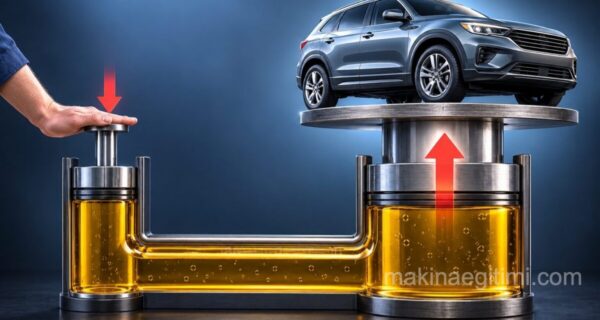
Hydraulic jacks lift heavy loads by transferring the force applied to a small piston to a large piston via Pascal’s principle.
One-Way Valve System
The one-way valves inside the jack keep the load steady by preventing fluid from flowing back during pumping.
High Lifting Ratio
Hydraulic jacks can lift a load hundreds of times their own weight with just a small amount of handle force.
Related Questions
Hydraulic jacks lift heavy loads by transferring the force applied to a small piston to a large piston via Pascal’s principle.
The one-way valves inside the jack keep the load steady by preventing fluid from flowing back during pumping.
Hydraulic jacks can lift a load hundreds of times their own weight with just a small amount of handle force.
Related Posts
 What Is Pascal’s Principle? Where It Is Used
 Cushioning in Pneumatic Cylinders
 Hydraulic Applications – Feed Speed Adjustment on a Lathe
 Hydraulic Pump Maintenance
 AND Valve Explanation and Applications
 Pneumatic Directional Control Valves
 Pneumatic Conditioners (FRL Units)
 Directional Control Valves