
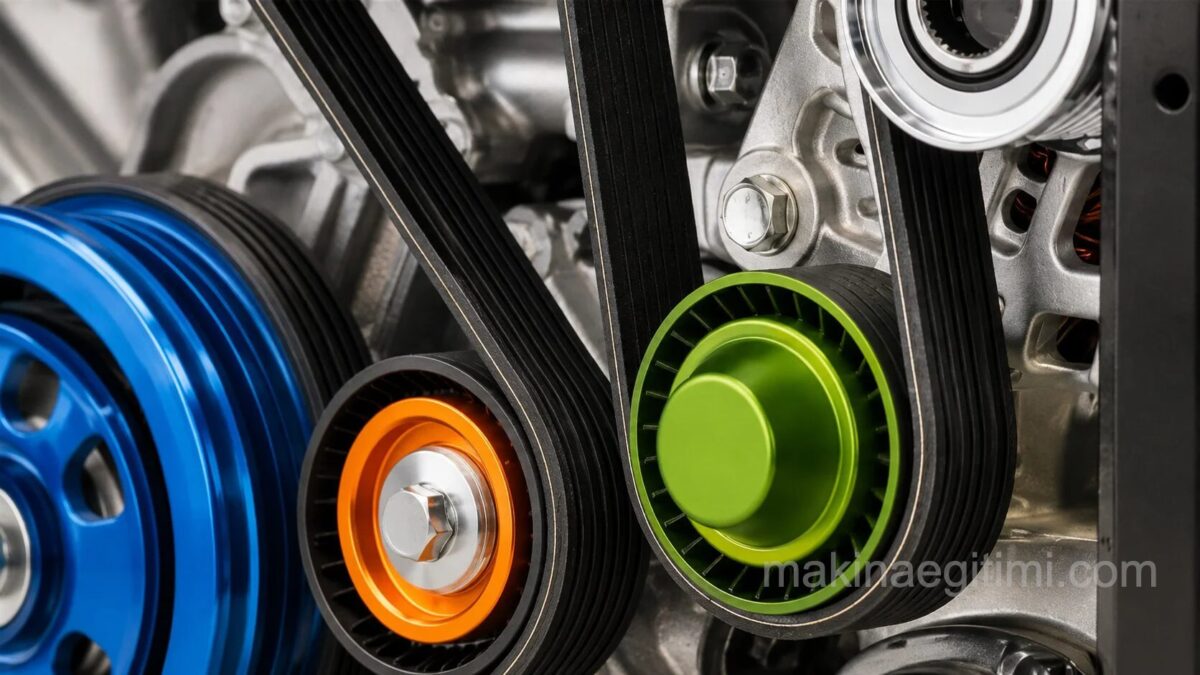
Belt types can be named by their material or by their cross-sectional shape, let’s look at these two groups separately. Belt types can be classified as follows:
Belt Types by Material
Leather Belts
The skin of cattle, particularly from the back, is tanned with oak-gall (vegetable) or chromium salts, then layers are glued on top of each other. The desired belt thickness is achieved by pressing the material between two parts that move back and forth, and it’s put on the market after drying.
Leather belts tanned with chromium salts are also far more resistant to moisture, heat, acids, and alkaline substances than those tanned with oak gall.
To increase the belt’s flexibility, during manufacturing they’re impregnated with tallow (animal fat) equal to about 15% of their weight.
For the belt to last long, depending on operating conditions, it should be cleaned and re-greased with tallow every 2-3 years. Vegetable oils, and especially mineral oils, are harmful to leather belts.
Textile Belts
Textile belts are obtained by weaving or knitting various materials. They’re made from materials like cotton, hair, and silk.
Since cotton belts have lower strength than leather belts, they’re suited to transmitting small amounts of power at low speeds. Their tensile strength is 500-600 kg/cm³.
Camel/goat hair belts are resistant to heat, weather effects, dust, and even acids, and remain flexible. Their tensile strength is high. They’re used a lot in cement and chemical plants and in mines.
Silk belts are made from raw silk. Their tensile strength is high, and since they’re very flexible, they’re suited to running at high speed on small-diameter pulleys.
Rubber Belts:
If rubber belts are run in wet, steamy, or acidic environments, they’ll have a short service life.
The figure alongside shows a V-belt cross-section. These have a protective layer (C) that extends the belt’s life. Ribbed belts can run smoothly even at high speeds and have high flexibility.
Rubber belts are damaged by heat and mineral oils. For this reason, rubber belts should not be used in such environments. (Rubber belts can be used between -25°C and +60°C.)
Rubber belts resistant to the effects of oil and that conduct static electricity have started being made. (With the production of static-conducting rubber belts, the fire risk from positive static charge that can build up due to friction has been eliminated.)

A thin copper wire is embedded along the entire length of the belt. This wire’s job isn’t to increase the belt’s strength, but to conduct static electricity.
Balata (Gutta-Percha) Belts
What is balata?
Balata is a rubber-like material obtained from a South American plant called the “mimusops” (balata tree).
Balata belts are used successfully in damp and dusty environments. Balata belts are more durable than rubber belts. Their main drawback is being sensitive to heat, gasoline, and machine oils. Balata belts should not be heated above +35°C. Otherwise they soften and become sticky. They’re used a lot in paper and sugar mills, and in the chemical industry.
BELT TYPES BY CROSS-SECTIONAL SHAPE
What are the types of belts by shape? Let’s look at them in order.
Flat Belt
Regardless of material, a flat belt’s cross-section is rectangular.
In principle, unless there’s no other option, a belt with greater width and less thickness should be used. This increases the belt’s contact area with the pulley and improves the belt’s flexibility. There’s a relationship between the belt’s thickness (h) and the small pulley’s diameter (D) as follows: D/h > 40.
Since wide, thin belts have weak edges, strips of belt material should be stitched onto both sides of the belt to prevent tearing.
In general, a flat belt should be used if the distance between shafts is large, or if one of the pulleys has a very small diameter.
If the belt drive is crossed, a flat belt must be used.
V-Belts
Also called trapezoidal belts, this type of belt is more commonly referred to in industry as a “V-belt,” since the sides that contact the pulley form a V shape.
V-belt material is often rubber, and sometimes textile (cotton weave), leather, or balata. Rubber V-belts (the non-perforated kind) are made as an endless loop.
When ordering a rubber V-belt, we need to specify the belt’s width (b) and its endless length. For example:
1 — V-belt 10 X 1000 TS 198,
2 — V-belt 17 X 950 TS 198 …
and so on.
Since a new rubber V-belt can stretch by as much as 3% of its length when first used, having a tensioning mechanism is important in this regard.


Construction of Rubber V-Belts
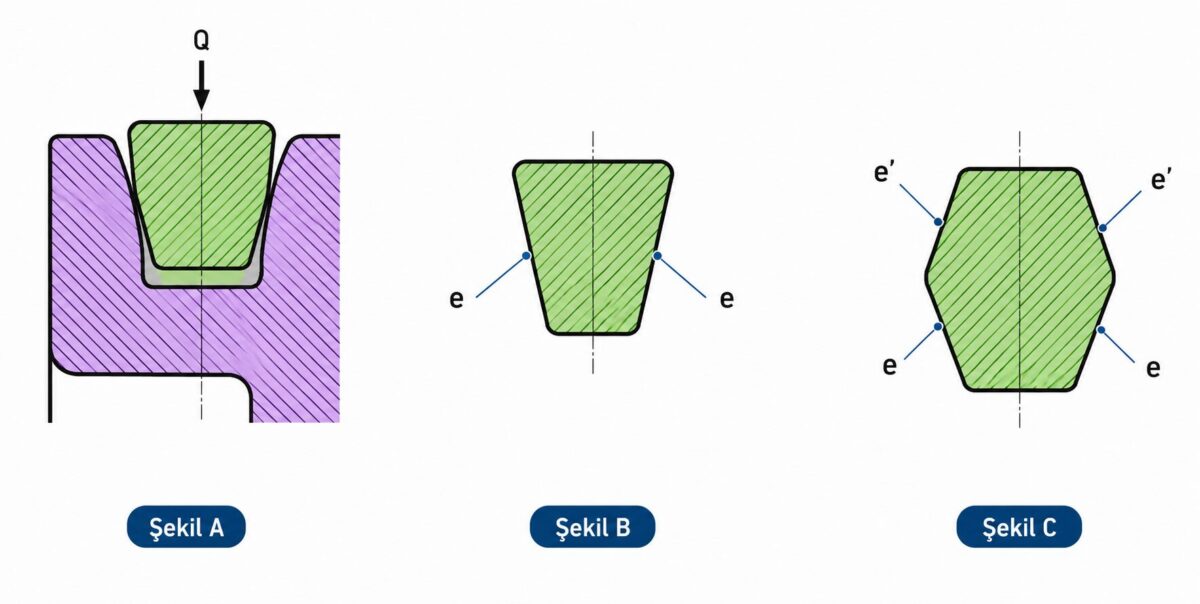
The side faces of rubber V-belts are made either flat or concave (Figure: B). When belts with flat sides are fitted on the pulleys and tensioned, the belt’s shape changes and the sides bulge outward (Figure: A). A V-belt with bulging sides won’t seat properly in its groove, so it wears and ages quickly. Some manufacturers make rubber V-belts with concave sides. This type seats better in its groove when tensioned.
A rubber V-belt’s speed can be V < 25 m/s. If the belt width is small and the pulley groove is smooth, the belt speed can be raised to up to 30 m/s.
Double-sided V-belts are also made (Figure: C), which makes it possible to use V-belts in crossed drives and on idler/tensioner pulleys.
Wide V-belts are used in stepless speed adjustment systems (for example, in variators).
Multi-Rib V-Belts:
Multi-rib V-belts are also called POLY-V belts. Multi-rib V-belts look like a flat belt with several V-belts attached to it. The load on the belt is carried by the corded section shown in the image below, and it’s this section that gives the belt its strength.
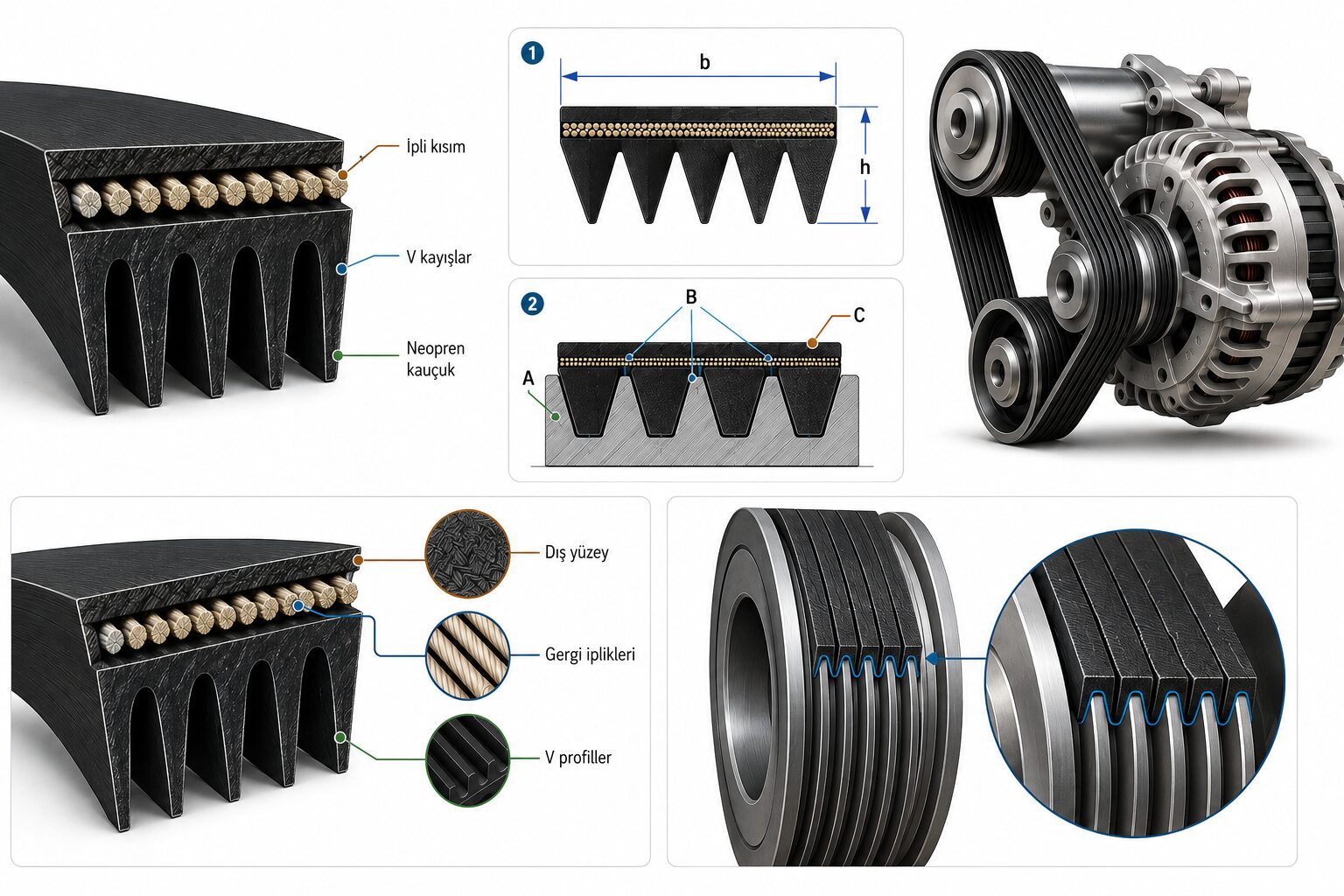
Multi-rib belts can transmit very large amounts of power (up to 1700 hp); they’re highly flexible and don’t have the rotation-in-groove problems that single V-belts have.
When a strip of neoprene (synthetic rubber) is bonded onto multi-rib V-belts, the belt’s sensitivity to machine oils is eliminated. This neoprene strip, even when the V-belts are single strands, can be bonded across several of them lined up together on a pulley (as long as they’re mounted on the pulley), making them oil-resistant.


POLY-V Belt
There are also link-type perforated V-belts. (TS 198/3). Even though the evenly spaced holes on this belt weaken it, since they let the belt be joined/adjusted, they can be used for a long time. The endless V-belts we saw earlier are discarded as soon as they break, even if the belt is new.
Cotton and leather V-belts, unlike rubber V-belts, aren’t made as a single piece. The belt is obtained by joining many links together with pins. Since these links can be added or removed, we can make the belt to whatever length we want.
(A) is a three-link, and (B) a four-link, V-belt. Three-link belts are less suited to heavy loads than four-link V-belts.
For this reason, three-link V-belts are used for transmitting small amounts of power, and four-link ones for transmitting large amounts of power.
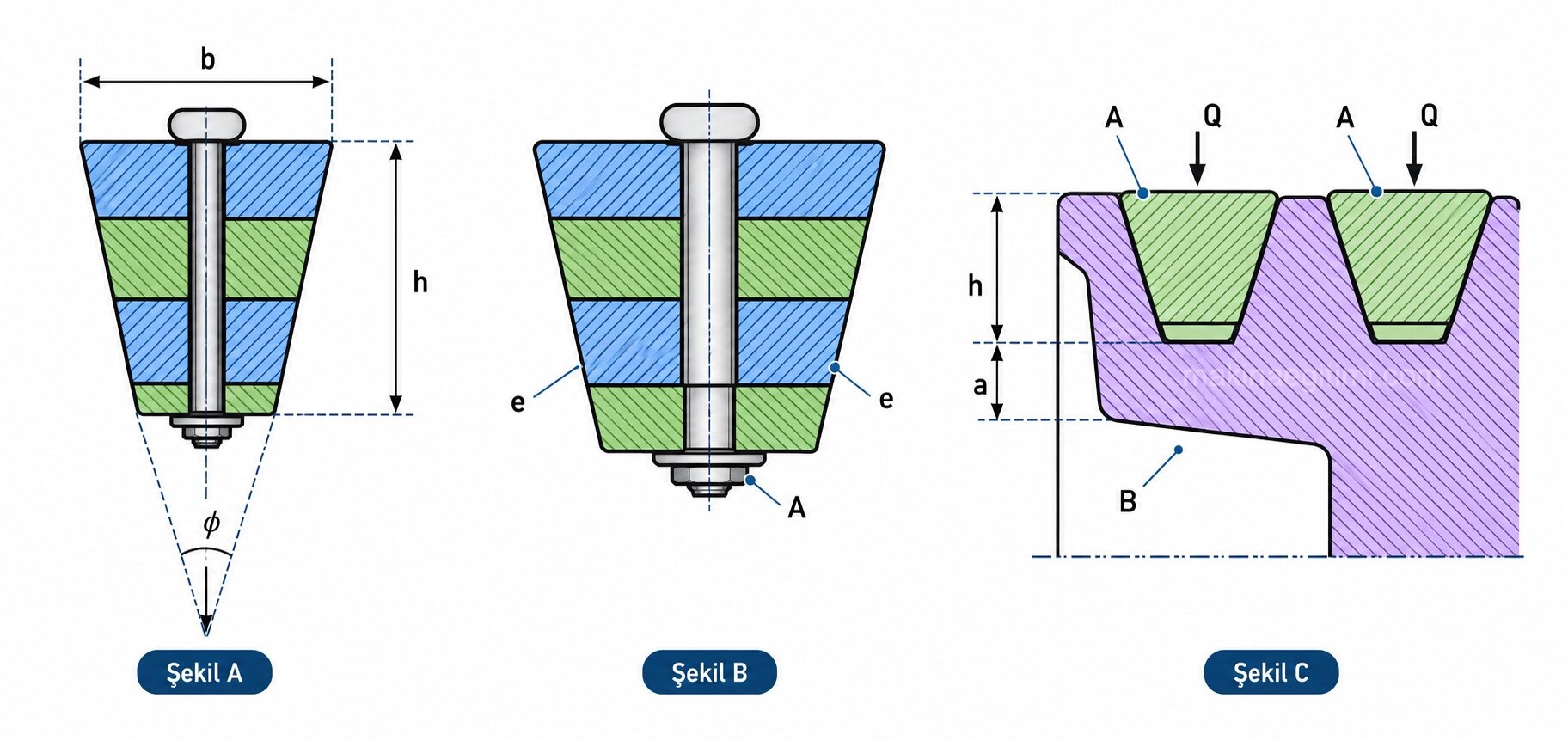
(Figure: A) shows the cross-section of a three-link V-belt, and (Figure: B) that of a four-link one, viewed through the pin.
When V-belts are fitted onto a pulley, they should only touch the groove with their side faces.
The bottom surface of the belt should not touch the base of the groove, and there should be a clearance (a) here (Figure: C).
Round Belts
Round belts have a circular cross-section and are made of leather. Round belts are made either by cutting round stock or by twisting strips together. To increase the belt’s contact area with the pulley, a semi-circular groove is cut around the rim of the pulley.
Where they’re used:
Round belts are used in lightly loaded, small applications. We can see this type of belt in sewing machines, and in the oil and coolant pumps of machine tools.

Related Posts
 Pins and Pinned Joint Technical Drawings
 Shafts. Types of Shafts and Their Properties
 Metric-Whitworth Thread Tables
 What Is a Washer. What Does It Do
 Maintenance of Belts and Pulleys
 Bevel Gear Strength Calculations
 What Is a Splined Shaft. Where Is a Splined Shaft Used?
 Standard Representation and Dimensions of a Washer