
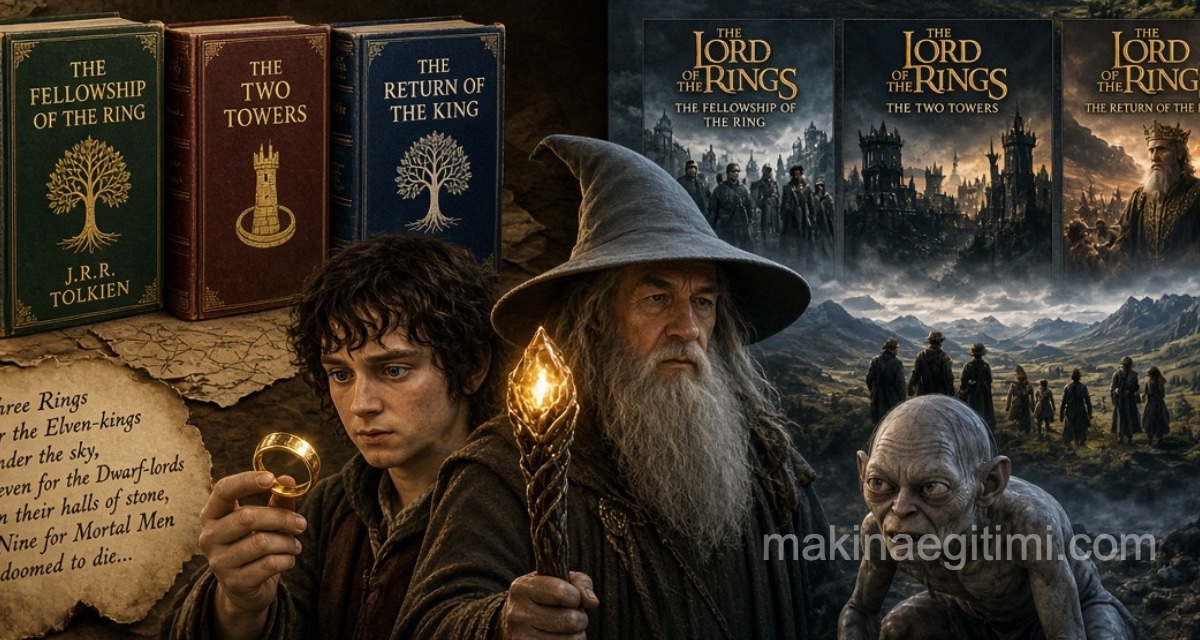
What are the differences between the Lord of the Rings novel and Peter Jackson’s film trilogy? The scenes cut from the book, and the characters that were changed. That’s what we’ll be covering in this article.
Today, we’ll tell you the story of one of the most ambitious film adaptations in literary history: how J.R.R. Tolkien‘s “The Lord of the Rings” was brought to the big screen by Peter Jackson. Whether you’ve read the book and seen the film, or you’re only familiar with the movies, seeing the differences and similarities between these two works side by side helps us better appreciate just how much effort went into this adaptation.
A Philologist’s Fifty Years of Work
Tolkien wrote “The Lord of the Rings” between 1937 and 1949, over a span of more than twelve years. Tolkien, a professor of linguistics at Oxford University, had built his own alphabets, languages, and thousands of years of history for Middle-earth before he ever wrote the book; the novel itself really only told a small part of that vast world. The novel was published in three volumes in 1954-1955 and, over time, became the most influential work in fantasy literature.
New Zealand director Peter Jackson brought the idea of bringing this massive work to the screen to life in the late 1990s. The three films were released one after another between 2001 and 2003, and together they were nominated for seventeen Academy Awards, winning all seventeen; “The Return of the King” became one of the rare productions in Academy history to win an award in every category it was nominated for.
Cutting Tom Bombadil From the Film
One of the omissions that book readers wonder about most in the film is the character Tom Bombadil. In the first book of the novel, as Frodo and his companions pass through the Old Forest, they encounter Tom Bombadil, a mysterious and cheerful spirit of the woods.
This character is so ancient and powerful that even the Ring’s influence has no effect on him. Jackson felt this section didn’t directly contribute to the main story and would unnecessarily lengthen the film, so he cut it entirely. For book readers, Tom Bombadil was an important figure who deepened the mystery of Middle-earth, but for the film, he became a character sacrificed for the sake of pacing.
Arwen’s Expanded Role
In the book, Arwen plays a fairly limited role throughout the story; she remains mostly in the background, referred to as Aragorn’s love interest. In the film, however, Jackson significantly expanded Arwen’s role.
One of the most notable changes is that in the book, it’s Glorfindel, one of Elrond’s sons, who takes Frodo to Rivendell, whereas in the film this task falls to Arwen. This change was intended to add a stronger female character to the film and to make the Aragorn-Arwen love story more visually compelling.
The Change Made to Faramir’s Character
In the book, Faramir, unlike his brother Boromir, is portrayed as a virtuous character who is never tempted by the Ring’s allure.
When he captures Frodo and Sam, he refuses to take the Ring. In the film, however, Jackson turned Faramir into a character who is briefly seduced by the Ring’s power and tries to take Frodo to Gondor.
This change became one of the most debated adaptation decisions among book fans; many readers felt it undermined Faramir’s noble character. Jackson explained the change as a way to keep the Ring’s power constantly felt throughout the film and to heighten dramatic tension.
The Complete Removal of “The Scouring of the Shire”
One of the book’s most important sections, entirely skipped in the film, is the final chapter titled “The Scouring of the Shire.” In the book, when the hobbits finish their adventures in Middle-earth and return home, they find that the Shire has been occupied and devastated by Saruman and his men.
Our heroes must fight one last time to reclaim their homeland. For Tolkien, this chapter was a thematically important conclusion, showing that even winning the war doesn’t guarantee peace, and that the struggle isn’t over even when the heroes return home.
Since the film was already long, Jackson cut this section entirely; instead, Saruman’s fate was summarized in a different scene in the extended edition.
Character Ages and Timeline
In the book, Frodo is fifty years old when he sets out on his adventure, which is a mature age for hobbits; the story also unfolds over a span of several years.
Jackson largely disregarded this detail in the film, portraying Frodo as a young character and compressing events into a much tighter timeline. While this was a practical choice made for the flow of cinematic storytelling, it created a difference for book readers that changed the story’s sense of time.
Frequently Asked Questions
While the film largely stays true to the main plot, it includes significant changes such as cutting Tom Bombadil, expanding Arwen’s role, and skipping the Scouring of the Shire chapter.
Tom Bombadil, an important character in the book, was never included in the film.
The trilogy won a total of seventeen Academy Awards; “The Return of the King” alone won awards in eleven categories.
Yes, the novel has been translated into Turkish by Metis Publishing and has a large readership in Turkey.
There’s no hard rule, but reading the book first lets you discover characters that never made it into the film, like Tom Bombadil, and the much broader background of Middle-earth. Watching the film first makes it easier to grasp the story’s main outline quickly and avoid getting lost in the book’s dense geography and abundance of names.
This depends entirely on the reader’s expectations. The book presents Middle-earth’s history, languages, and side stories in a much richer way; the film, through Jackson’s visual interpretation, brings the epic scenes and character dynamics to life more strikingly. Many readers feel the two offer different, complementary experiences.
Yes, in fact having watched the film first can make it easier to picture the characters and locations while reading the book. Since the book contains many details, side characters, and background information not found in the film, it holds plenty of new discoveries even for those who have already seen the movie.
Yes, the novel won the International Fantasy Award in 1957. Tolkien was also posthumously honored with the first Gandalf Award in 1974, shortly after his death, for his contributions to fantasy literature.
Related Posts
 Dostoevsky: A Life From a Death Sentence to the Summit of Russian Literature
  How to Start Writing a Book? Advice Backed by Science
  Master of the Short Sentence: The Life Story of Ernest Hemingway
  When Fiction Becomes Reality: 6 Novels That Predicted the Future
  In the Shadow of Revolution: 5 Books About the French Revolution
  From a Novel to a Number One: The Story of the Song Wuthering Heights
  Two Poets Who Lived the Fate They Wrote: Pushkin and Lermontov
  What Is Editing? What Does a Book Editor Actually Look At?