Close Menu
  • MAKİNELER ve İMALAT
    • Tools & Equipment
    • Computer-Aided Drawing
    • CAD/CAM Education
    • CNC Machine Programming
    • Casting Technologies
    • Electrical & Electronics Technologies
    • Hydraulics & Pneumatics
    • Manufacturing Processes
    • Manufacturing Technologies
    • Occupational Safety
    • Mold & Die Design
    • Solid Modeling
    • Welding Technology
    • Machine Elements
    • Mechanical Trade Drawing
    • Materials Science
    • Automotive & Vehicle Technologies
    • Robotics Technologies
    • Health Technologies
    • Defense & Aerospace Technologies
    • Descriptive Geometry
    • Technical Drawing
    • Software & Hardware Technologies
    • Innovative Manufacturing Methods
  • TEKNOLOJİ ve YAŞAM
    • OTOMOBİLLER ve TAŞIT
      • Vehicle & Engine Knowledge
      • Safe Driving
      • Sürüş Destek Sistemleri
    • Genel Kültür
      • Movies & TV Shows
      • Görsel ve Grafik Sanat
      • Books & Literature
      • Music
      • Sports
      • History
      • History of Technology
    • GÜNDELİK YAŞAM TEKNOLOJİLERİ
    • Hobbies & Entertainment
    • Internet Technologies
    • Health
    • Mobile Technologies
Makine Eğitimi
  • Machines & Manufacturing
    Machine Elements
    Hydraulics & Pneumatics
    Technical Drawing
    Computer-Aided Design & Manufacturing
    Basic Manufacturing Processes
    Manufacturing Processes
    Industry Technologies
    Other Technical Courses
    Motion & Power Transmission
    Simple Machines
    Chains & Sprockets
    Shafts & Journals
    Gears
    Cams
    Couplings
    Belts & Pulleys
    Springs
    Bearings
    Keys
    Fastening Joining
    Retaining Rings
    Screws, Bolts & Nuts
    Cotter Pins
    Flanges
    Welding
    Rivets
    Pins & Bolts
    Washers
    Calculators
    Gear Ratio Calculator
    Spring Constant Calculator
    Belt Pulley Ratio Calculator
    Other Machine Elements
    Slides & Linear Guides
    Brakes
    Flywheels
    Clamps
    Shock Absorbers
    Gaskets & O-Rings
    Seals & Sealing Elements
    Hydraulics
    Introduction to Hydraulics & Principles
    Hydraulic Systems & Applications
    Accumulators
    Filters
    Motors
    Pumps
    Valves
    Pneumatics
    Introduction to Pneumatics & Principles
    Pneumatic Systems & Applications
    Pneumatic Circuit Components
    Valves
    Cylinders
    Silencers
    Motors
    Compressors
    Dryers
    Conditioning Units
    Common Topics & Maintenance
    Hydraulic & Pneumatic Maintenance
    Study Notes, Exams & Tests
    Technical Drawing
    Introduction to Technical Drawing
    Geometric Drawings
    Perspective & Projection
    Orthographic Views
    Dimensioning
    Sectioning
    Assembly & Detail Drawings
    Tolerances
    Surface Finish Symbols
    Mechanical Engineering Drawing
    Screws, Bolts & Nuts
    Pulley Drawings
    Gear Drawings
    Shafts & Journals
    Bearing Drawings
    Pins & Bolts
    Spring Drawings
    Welds in Technical Drawing
    Washers
    Cotter Pins
    Technical Drawing Exercises
    Mechanical Drawing Exercises
    Gear Exercises
    View Extraction Exercises
    Pulley Exercises
    Pin & Bolt Exercises
    Threaded Fastening Exercises
    Descriptive Geometry
    Computer-Aided Drawing
    AutoCAD Drawing Lessons
    Solid Modeling & Animation
    Solid Model Drawing Files
    Solid Model Assembly Examples
    Solid Model Drawing Lessons
    3D CAD Software Reviews
    Solid Modeling Exercises
    CNC Programming
    CAM
    Measurement & Inspection
    Dial Indicators
    Calipers
    Gauges
    Micrometers
    Materials Science
    Steels
    Cast Iron
    Aluminum
    Plastics
    Material Testing & Hardness Measurement
    Occupational Safety
    Workshop Safety
    Safety When Working With Electricity
    Machine Safety Rules
    Hand Operations
    Filing
    Marking
    Cutting Operations
    Reaming
    Tapping
    Threading With a Die
    Drill Bit Sharpening
    Working With Machines
    Basic Turning Operations
    Basic Milling Operations
    Shaper Machine
    Machining
    Turning
    Milling
    Grinding
    Innovative Manufacturing Methods
    EDM (Electrical Discharge Machining)
    Laser Machining
    Waterjet Machining
    3D Printing
    3D Scanners
    Welding
    Rolling
    Casting
    Mold & Die Design
    Mechanical & Hydraulic Presses
    Blanking & Piercing Dies
    Bending Dies
    Drawing Dies
    Plastic Injection Molds
    Extrusion Dies
    Compound Dies
    Progressive Dies
    Blow Molds
    Spinning Dies
    Spray Molds
    Manufacturing of Machine Parts
    Automotive & Vehicle Technologies
    Motor Vehicle Manufacturing
    Raw Material Production
    History of Technology
    Health & Medical Technologies
    Defense & Aerospace
    Robotics Technologies
    Software & Hardware Technologies
    Mechanics - Strength of Materials
    Physics Topics
  • Technology & Life
    Hobbies & Entertainment
    Sports
    Music
    Vehicle & Engine Knowledge
    Vehicle Maintenance & Repair
    Safe Driving
    Driver Assistance Systems
    History
    Movies & TV Shows
    Books & Literature
    Computers & Internet
    Computer Tips
    Software Reviews
    Hardware & Peripherals
    Practical & Safe Internet Use
    Visual & Graphic Art
    Mobile Technologies
    Travel
    Science
    Health
    First Aid Knowledge
    Everyday Technologies
Makine Eğitimi
Home»Machine Elements»Plain (Sliding-Contact) Bearings
26 September 2026

Plain (Sliding-Contact) Bearings

Kaymalı (Kayma Dirençli) Yataklar

Machine elements that support shafts, carry the loads and weights acting on them and guide their rotation are known collectively as bearings. Bearings fall into two main groups according to how they work: sliding-contact (plain) bearings and rolling-contact bearings. This article looks at the structure, the parts and the working characteristics of plain bearings.

  • What Is a Plain Bearing?
  • Classification of Plain Bearings
    • Classification by Type of Load
    • Classification by Construction and Material
  • Parts of a Plain Bearing
    • Bush Materials
  • What Is Expected of a Plain Bearing
  • Advantages and Disadvantages of Plain Bearings

What Is a Plain Bearing?

While shafts transmit motion through gears, pulleys or other elements, they are supported by bearings. In a plain bearing, the part of the shaft that moves inside the bearing is called the journal. The two surfaces slide against each other.

In plain bearings, friction arises between the journal and the bearing surface because of the weight of the shaft and everything mounted on it. That friction can cause power loss, heat, wear and even seizure of the bearing. To keep it to a minimum, the contacting surfaces must be machined to a smooth finish and lubricated regularly.

Ideally, a pressurised oil film forms between the shaft and the bearing and prevents metal-to-metal contact. The coefficient of friction then drops to very low values (0.002–0.01) and wear becomes almost nil.

There are three main friction regimes:

  • Hydrodynamic lubrication: the oil film builds up on its own as the shaft rotates (the ideal condition).
  • Hydrostatic lubrication: pressurised oil is supplied by an external pump.
  • Boundary / mixed friction: where the oil film is too thin, partial metal contact occurs (wear risk rises).
  • Dry friction: no lubricant at all (rarely chosen; used for example in the food industry with special materials).

Lubricants include mineral oils, grease, solid lubricants (MoS₂, graphite) and special high-performance oils. In hydrodynamic bearings the oil film is typically 0.008–0.02 mm thick. Thermal balance and oil viscosity are critical design parameters.

Classification of Plain Bearings

Classification by Type of Load

Plain bearings are divided into two groups according to the type of load they carry:

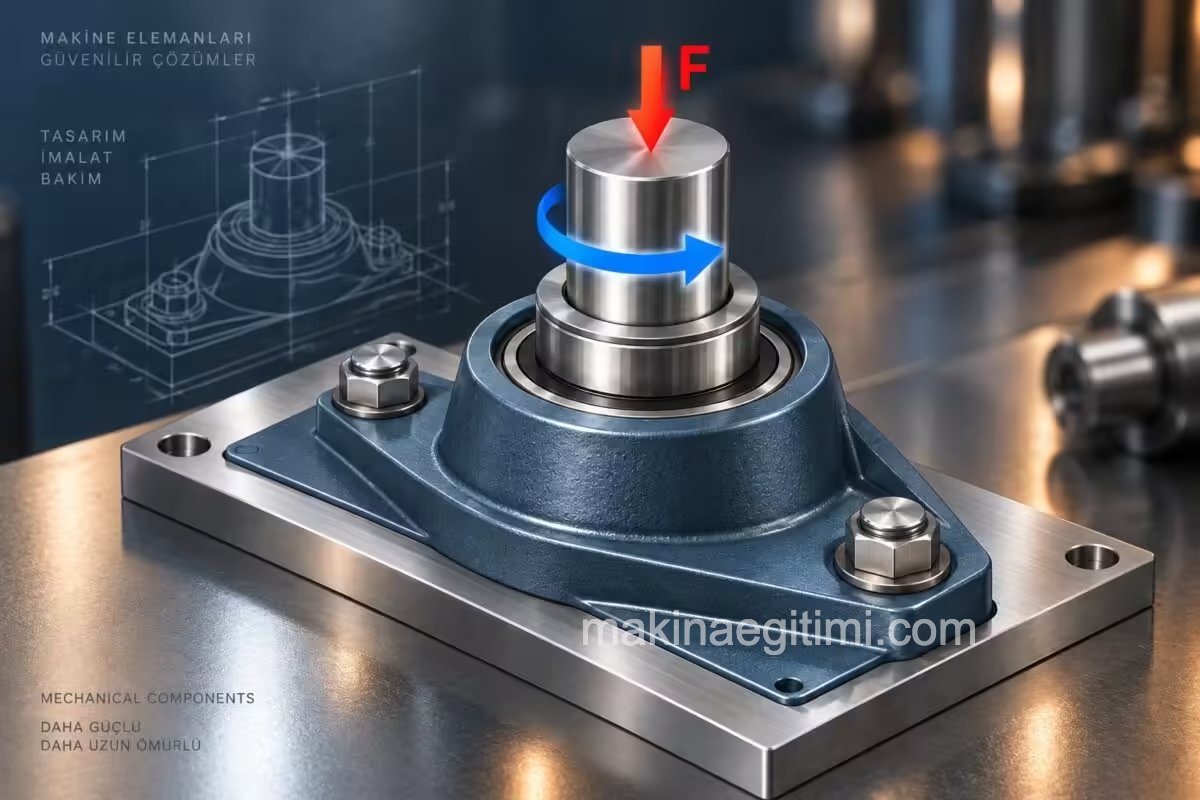
  • Radial bearings: the force acting on them is perpendicular to the axis of rotation.
  • Axial (thrust) bearings: the force acting on them is parallel to the axis of rotation.
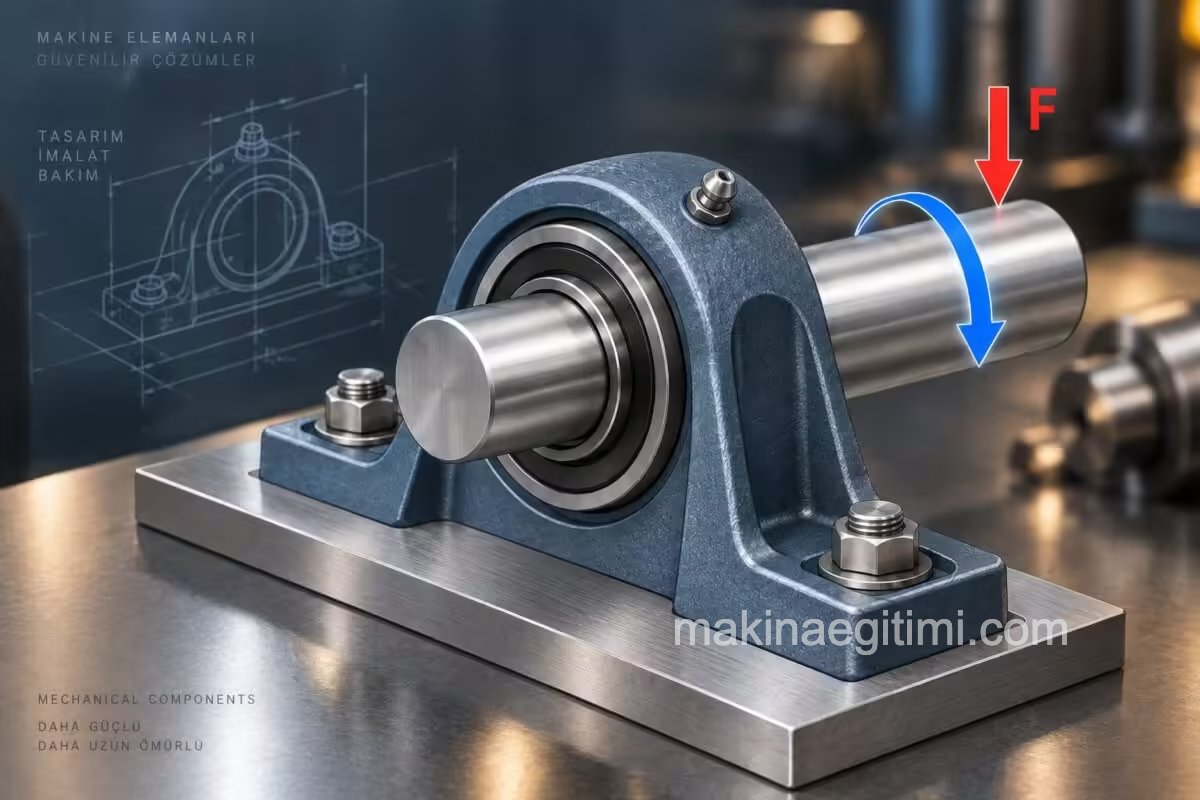
Radial plain bearing
Radial bearing
Axial (thrust) plain bearing
Axial (thrust) bearing

Classification by Construction and Material

  • One-piece (bush / sleeve) or two-piece (split, with a cap).
  • Metal (bronze, babbitt / tin-lead alloys, aluminium, copper), sintered (porous, self-lubricating), polymer/plastic or composite.
  • Maintenance-free (self-lubricating, with PTFE or graphite) or regularly lubricated.

Parts of a Plain Bearing

Plain bearings are generally built from several parts.
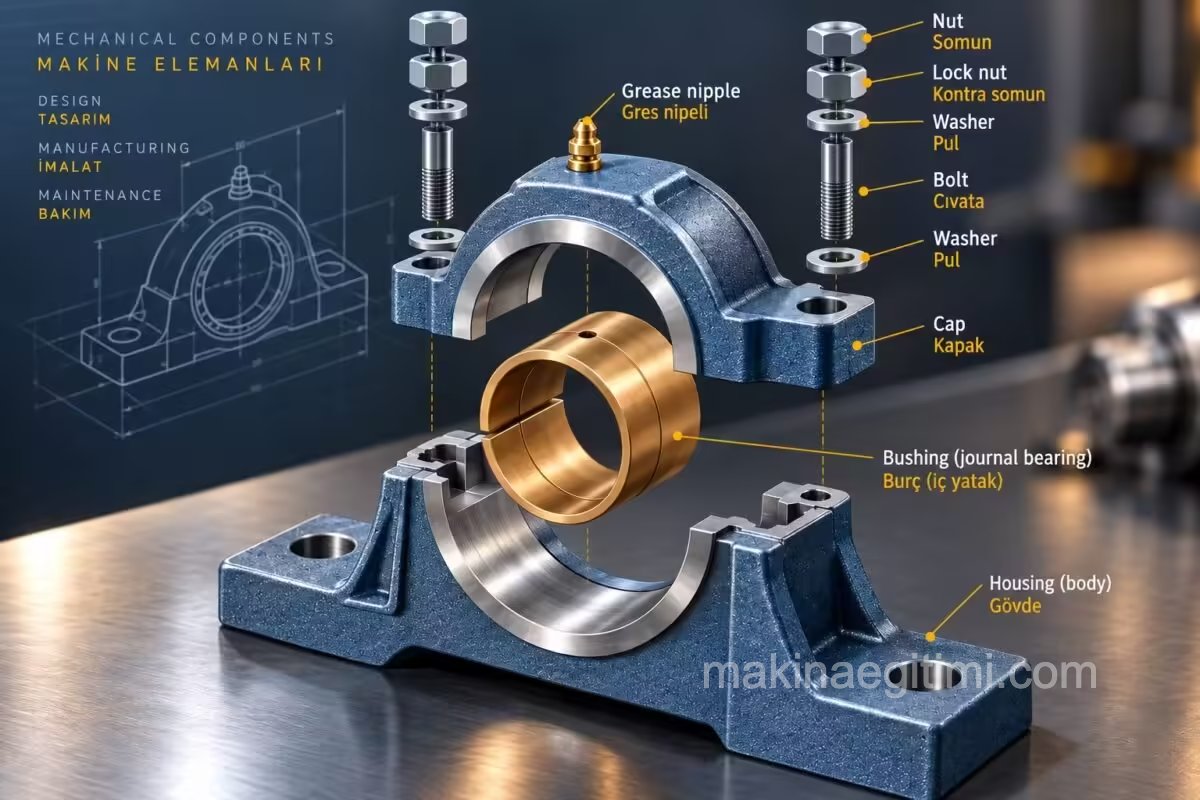
Exploded view of a plain bearing showing housing, cap, bush and fasteners
Exploded view of a plain bearing
  • Housing: the lower part of the bearing. It is made of cast iron.
  • Cap: the upper part of the bearing, again produced from cast iron. It clamps the liner firmly in place together with the fasteners.
  • Bush (liner): the bush is one of the most important parts of the bearing and is fitted so that it seats exactly in the space between the housing and the cap. It is usually recommended to make it in two halves. The bush must not turn with the shaft. Its edges are produced with flanges so that the shaft cannot move axially. The joint face between the two halves is machined finely and accurately so that oil cannot leak out. When the bush wears in time, it is removed and replaced with a new one.
  • Fasteners: used to attach the cap to the housing. These are bolts, studs, washers and nuts. They are secured with lock nuts so that they cannot work loose.
Related Post Securing Bolts and Nuts

Bush Materials

Bushes are usually produced from bronze, red brass (gunmetal) or white metal.
Bronze is a material that resists impact and heat well.
Red brass is suited to low speeds and shock loading.
White metal is the most widely used bush material, because it stands up well to shock loads.

What Is Expected of a Plain Bearing

  • The bearing should wrap the journal along its full length.
  • It should reduce friction and wear.
  • It should be easy to dismantle and reassemble.
  • It should lubricate well and hold the lubricant.
  • The bearing clearance should be of the correct size.
  • The liner should be easy to replace.
  • It should be able to carry the loads applied to it.

Advantages and Disadvantages of Plain Bearings

✅ Advantages
  • Simple, inexpensive and compact construction (takes up little space in the radial direction).
  • High resistance to shock, impact and vibration (there is no delicate part inside that can break).
  • Quiet running.
  • Suitable for transmitting large loads and high power.
  • Can be made in two halves (easy to assemble and dismantle).
  • With proper lubrication, very high speeds and almost zero wear can be reached.
  • Some types (polymer ones in particular) are more resistant to contamination and corrosion.
❌ Disadvantages
  • Risk of rapid damage if lubrication is inadequate.
  • Some applications require a complex and costly lubrication system.
  • Oil consumption can be high.
  • Time is needed for the oil film to build up at start-up (start-up wear).
  • The surface quality of the shaft is critically important.
  • Temperature control is needed (keeping the oil around 70–90 °C is ideal); overheating degrades the properties of the oil.

Related Posts

Securing Bolts and Nuts Securing Bolts and Nuts Shafts, Types and Properties Shafts. Types of Shafts and Their Properties Types of Couplings by Control Type Types of Couplings by Control Type Dimensional Tolerances Annotated Example Drawings Dimensional Tolerances – Annotated Example Drawings friction materials in clutches - sintered bronze Friction Materials Used in Clutches What Is a Piston Ring, What Does It Do? What Is a Piston Ring, What Does It Do? Its Job and Installation. Number of Starts on Screws and What It Means Number of Starts on Screws and What It Means Spring Constant Calculator Spring Constant Calculator
Bearings
Share. Facebook Twitter WhatsApp Tumblr Email Telegram Copy Link

Leave A Reply Cancel Reply

Changing Spark Plugs. How Is a Spark Plug Change Done?
If the Engine Won’t Start, the Reason. Reasons the Engine Won’t Start
  • Contact
  • Terms of Service
  • Privacy & Cookie Policy

Type above and press Enter to search. Press Esc to cancel.