
How well a vehicle absorbs impacts from the road largely depends on the type of spring used in its suspension system. The two most common spring types in the automotive world are leaf springs and coil springs. Both serve the same basic purpose: absorbing and releasing energy from the road so the vehicle can move without being jolted.
However, their structure, working principles, and areas of use differ quite a bit. In this article, we’ll cover the differences between leaf spring suspension and coil spring suspension, along with their advantages and disadvantages.

Even seasoned car hobbyists can sometimes struggle to tell them apart. That’s why in this article, we’ll show you the difference between the two suspension types so you can easily choose the right one for your vehicle.
Leaf spring
A leaf spring is a type of spring made from curved metal strips stacked on top of each other. These strips are connected in the middle with a bolt or clamp and mounted to the vehicle’s axle. It stores energy by flattening under load, and releases that energy by returning to its curved shape once the load is lifted.
Leaf springs are typically used in the rear suspension of commercial vehicles that carry heavy loads, such as trucks, buses, pickups, and trailers. The main reason for this is that a leaf spring doesn’t just handle springing — it also fixes the position of the axle. In other words, a leaf spring works as a structural element that both carries and locates the axle.
Advantages of Leaf Springs
- Offers high load-carrying capacity.
- Simple structure means lower manufacturing and maintenance costs.
- Since it also locates the axle, it doesn’t need a separate control arm or linkage.
- Resistant to overloading.
Disadvantages of Leaf Springs
- Not suitable for independent suspension.
- Ride comfort is lower compared to coil springs.
- Heavier, which can negatively affect fuel consumption.
- Friction between the leaves can develop over time, causing squeaking.
Coil spring
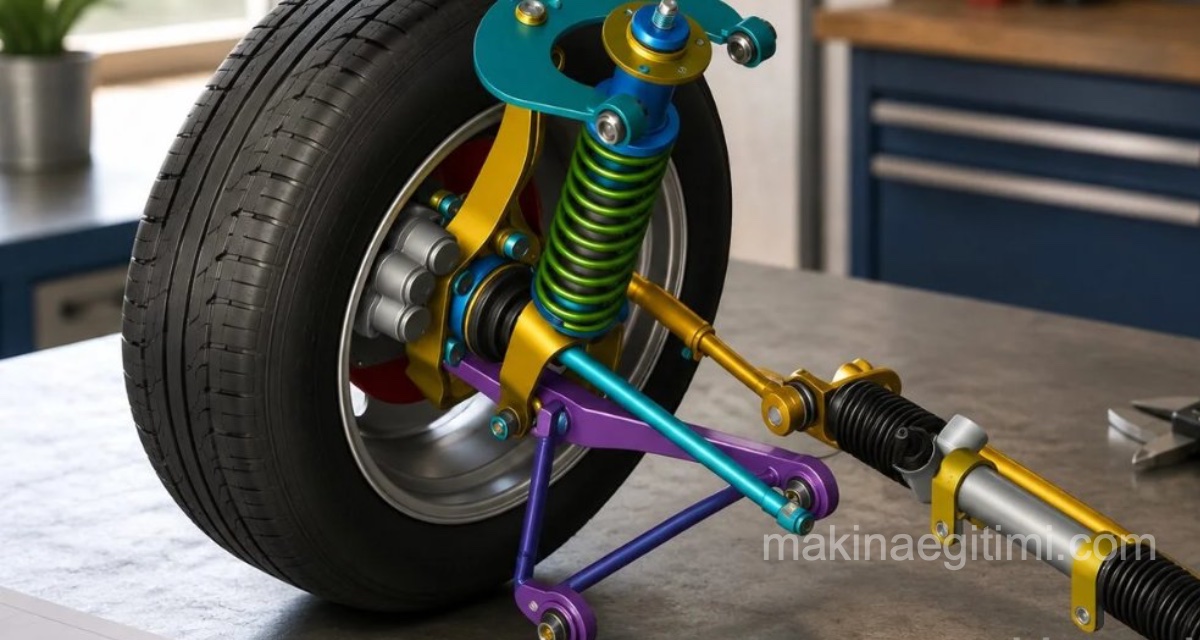
As the name suggests, a coil spring is a type of spring made by winding a wire into a spiral shape. It stores energy by compressing under load, and releases that energy by expanding once the load is lifted. Today, the vast majority of passenger cars use coil springs in both the front and rear suspension.
A coil spring can’t locate the axle on its own. Because of this, it works together with additional components such as control arms, linkages, and sway bars. This also allows the suspension geometry to be far more flexible and adjustable.
Advantages of Coil Springs
- Ride comfort is noticeably better than leaf springs.
- Lighter, which contributes positively to the vehicle’s total weight and fuel efficiency.
- Suitable for independent suspension systems, meaning each wheel can move independently of the other.
- Better handling and cornering stability.
Disadvantages of Coil Springs
- Load-carrying capacity is more limited than leaf springs.
- Since it can’t locate the axle, it needs additional components, which increases system complexity and cost.
- Not as resistant to overloading as leaf springs.
Key Differences Between Leaf Springs and Coil Springs
Comparing the two spring types is usually done under the following headings.
Structure: A leaf spring consists of stacked metal strips, while a coil spring is made by winding a single wire into a spiral shape.
Comfort: Coil springs dampen impacts more smoothly, giving them the edge over leaf springs in ride comfort.
Load capacity: Leaf springs perform more stably under heavy loads. That’s why they’re preferred in vehicles like trucks and trailers.
Axle location: A leaf spring both carries and locates the axle. A coil spring, on the other hand, only handles springing — the axle’s position is maintained by control arms and linkages.
Weight: Coil springs are lighter than leaf springs.
Which Vehicles Use Which Spring?
Use case: Leaf springs are common in commercial vehicles, while coil springs are common in passenger cars.
Leaf springs are preferred in the rear suspension of vehicles that carry heavy loads, such as trucks, buses, pickup beds, and trailers. This is because a leaf spring can maintain the axle’s position even under load and offers high durability.
Coil springs are used in almost all passenger vehicles, such as sedans, hatchbacks, and SUVs. Since ride comfort and handling are the priority, manufacturers pair coil springs with independent suspension systems in these vehicles.
Some SUV and pickup models take a hybrid approach. A coil spring may be used in the front suspension, while a leaf spring is used in the rear to increase load-carrying capacity.
Leaf Spring and Coil Spring: FAQ
Leaf spring-type suspension systems are better for carrying heavy loads.
Coil springs generally offer a more comfortable ride because they dampen impacts more smoothly. This is because leaf springs are stiffer than coil spring suspensions and have less range of movement.
Leaf springs are preferred in heavy commercial vehicles because they offer both high load-carrying capacity and the ability to locate the axle.
Coil springs are lighter, suitable for independent suspension systems, and provide better ride comfort.
Yes, friction between the leaves can cause squeaking or noise over time. Regular lubrication and maintenance can reduce this issue.
Yes, especially in some SUV and pickup models, a coil spring may be used in the front suspension while a leaf spring is used in the rear for load-carrying purposes.
The choice between a leaf spring and a coil spring depends on the vehicle’s intended use. Leaf springs are preferred for commercial vehicles where load capacity is the priority, while coil springs are preferred for passenger vehicles where comfort and handling come first. Both systems have their own advantages and disadvantages, so there’s no single correct answer to which suspension type is better. What matters is that the system suits the vehicle type and its intended use conditions.
After this comparison, we’re sure you can now tell the difference between leaf spring and coil spring suspension. Which one is better? We can’t give a final verdict, because every type of suspension has its own benefits.
We could say the best suspension is the one that best suits the rear of your vehicle and gives you comfort while driving.
Related Posts
 Meanings of the Abbreviations in Honda Vehicle Models
  Disc Hydraulic Brakes and Their Working System
  What Is an Alternator? What Does It Do?
  Engine Noises and What They Mean
  What Does the Noise from the Valves Mean?
  Properties and Advantages of Alloy Wheels
  What Is ESP in Vehicles? What Does It Do? How Does It Work?
  10 Basic Things Every Driver Should Know