

A car body enters the production line as bare sheet metal parts and within minutes turns into a rigid structure that behaves as a single piece, locked together by thousands of weld points. Behind this transformation are giant robotic welding cells known as the “body shop,” where dozens of robots work in sync down to fractions of a second. In this article we take a detailed look at how these cells are set up, how the robots coordinate with each other, and how automotive manufacturers make it possible to build more than one model on the same line.
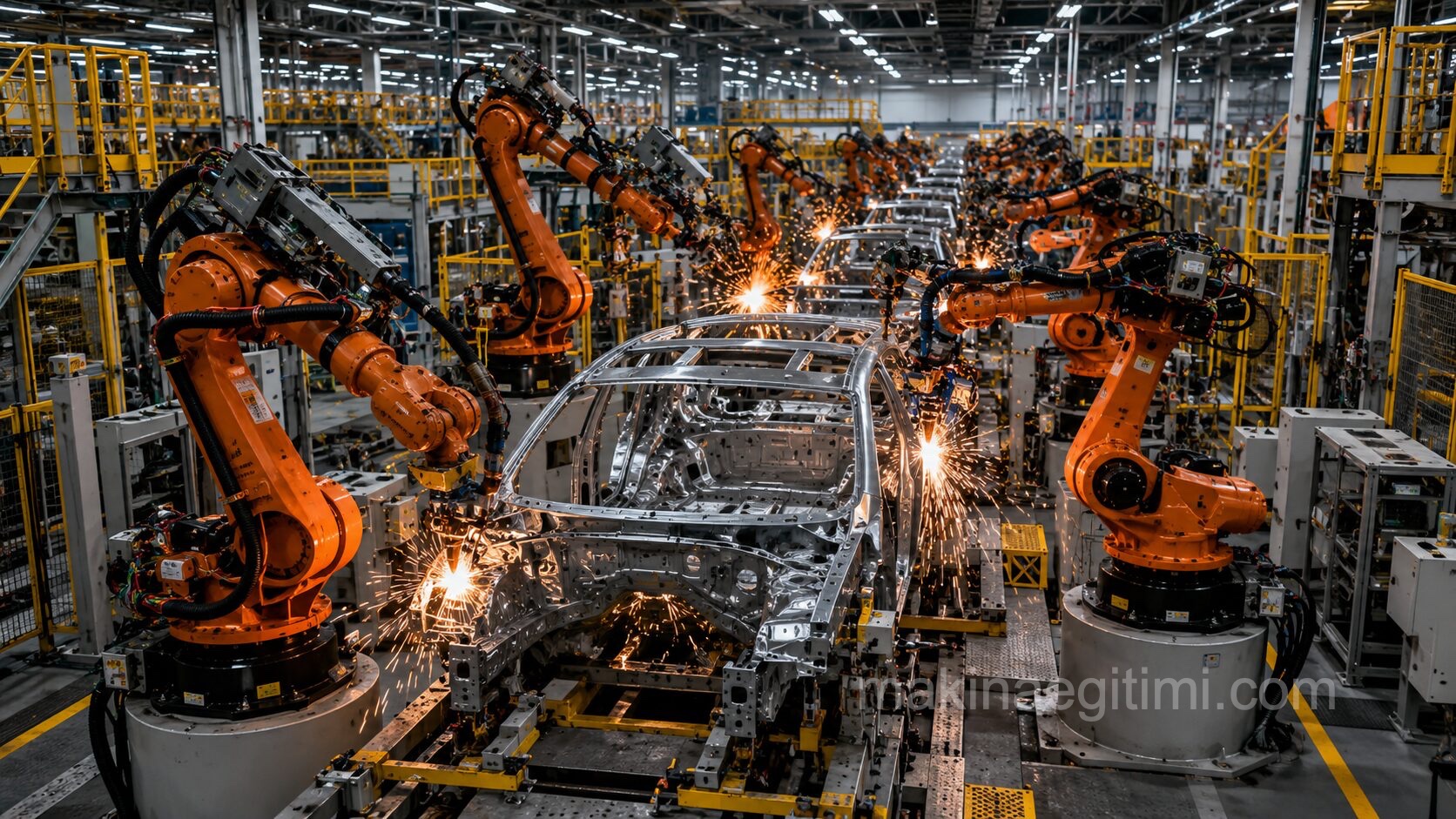
The Scale and Challenges of Automotive Body Welding
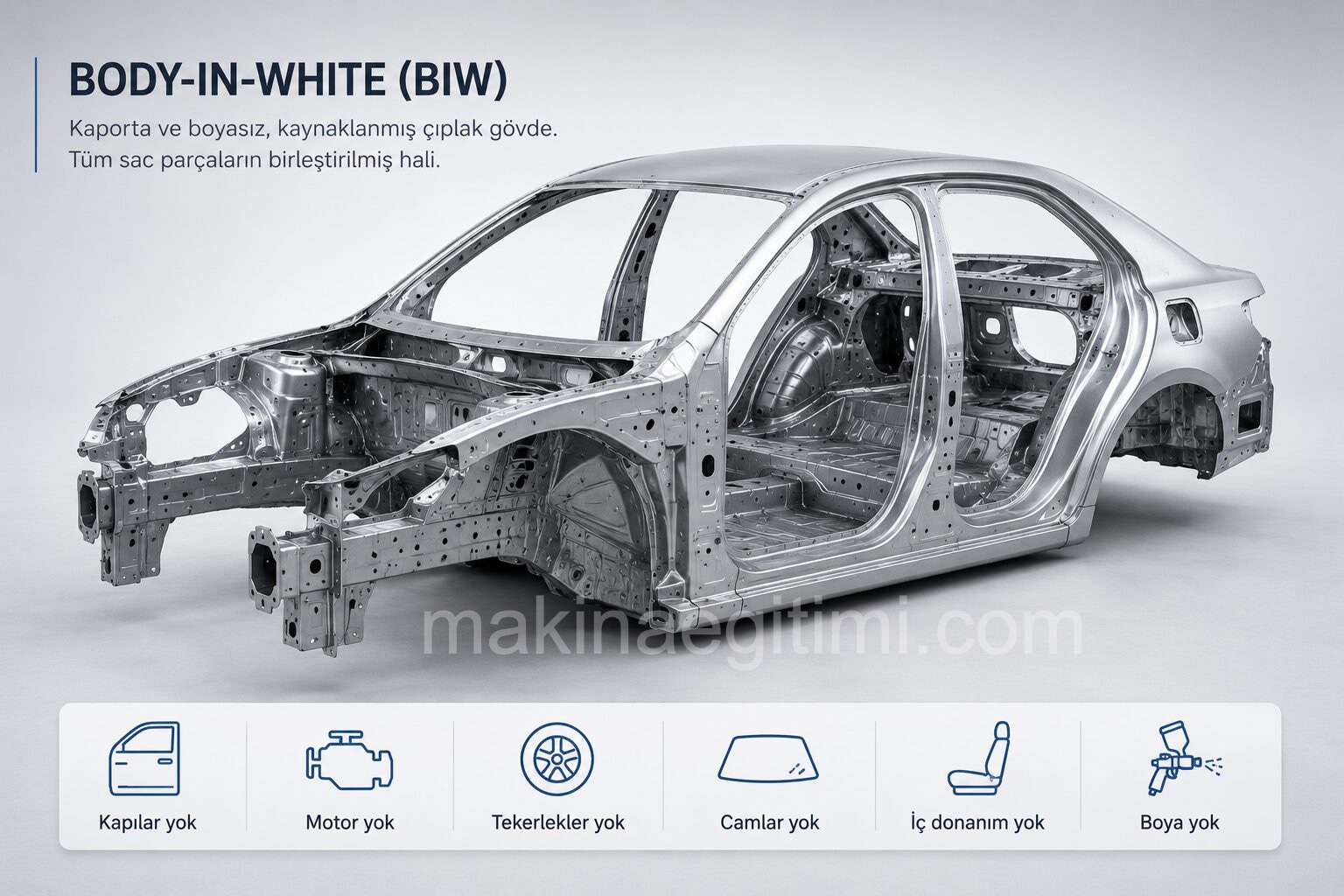
A typical passenger car body (body-in-white, the bare unpainted shell) is formed by joining more than 300 separate sheet metal parts, with 3,000 to 5,000 spot welds between them. In addition, laser weld seams are used in visible areas and structural adhesives in certain zones. Doing work at this scale with consistent speed and quality by hand is practically impossible; the number of welds a single robot can complete in an hour exceeds what a human welder could do in a day.
For automotive manufacturers, body welding is one of the most capital-intensive and least flexible stages of production; setting up a line typically requires an investment of tens of millions of dollars, and once a line is commissioned, making major changes to it is both costly and time-consuming. This is why line design accounts from the very start for both the current model and possible future model updates.
Components of a Robotic Welding Cell
A body welding cell is not made up of robots alone; robots are simply the most visible part of the system. A typical cell consists of:
Welding robots: usually 6-axis articulated robots; each carries its own welding tool (spot gun or laser welding head).
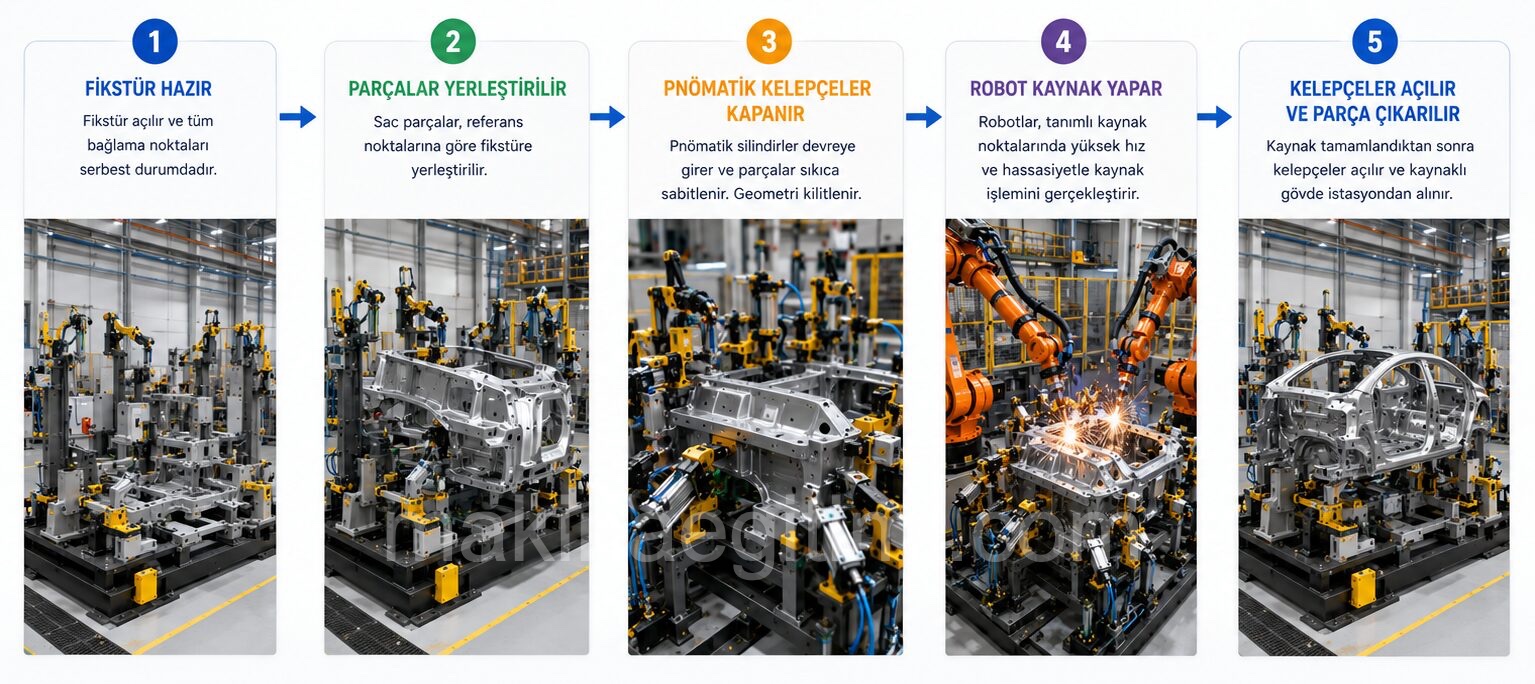
Fixtures (geometry control devices): special devices, typically driven by pneumatic clamps, that hold body panels in a precise, fixed geometry during welding; the final dimensional accuracy of the body depends heavily on fixture precision.

Material handling system: conveyors, shuttle carriers, or autonomous mobile robots (AGV/AMR) that move parts between stations.
Safety systems: light curtains, safety barriers, and emergency stop circuits; these control human access to areas where robots operate at high speed and force.
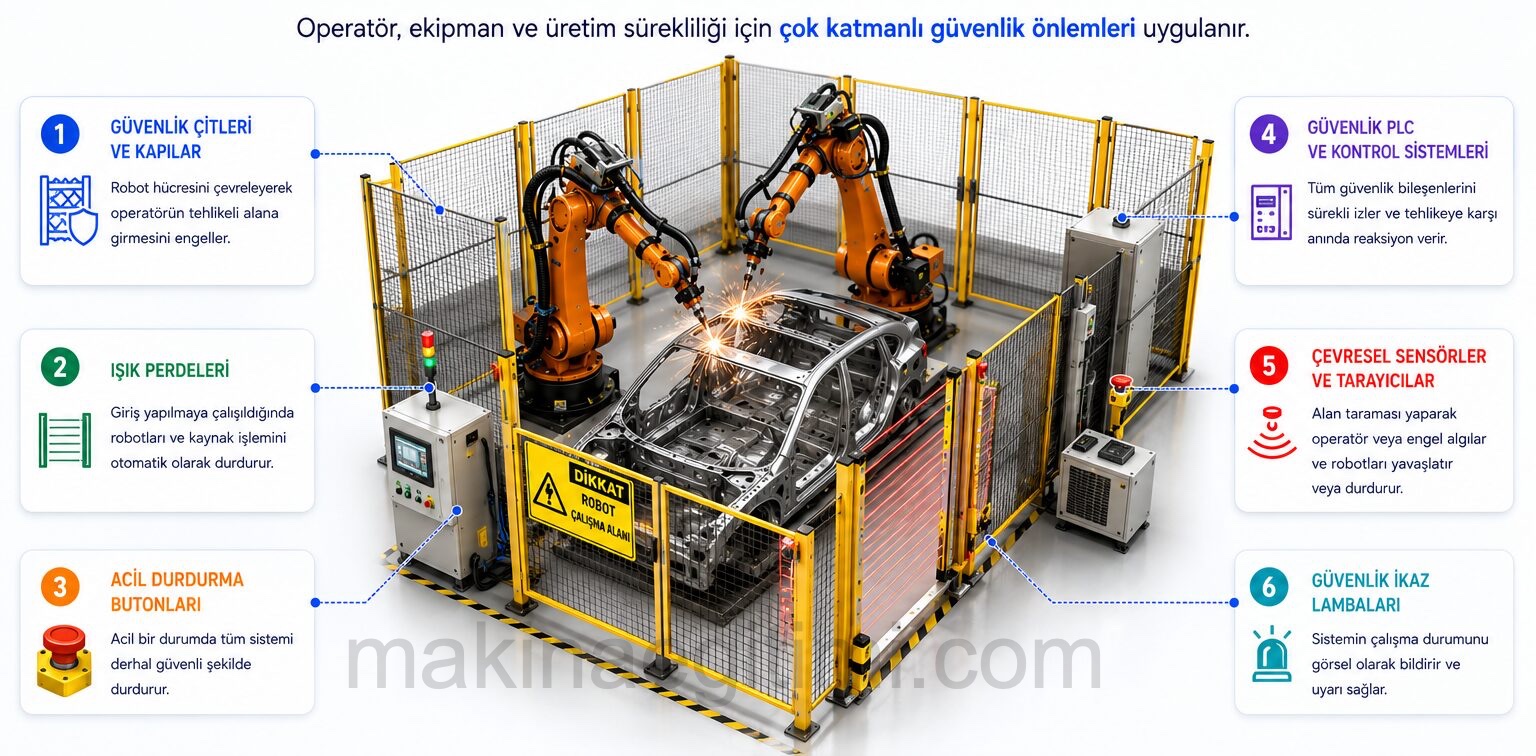
Central line control system (PLC/SCADA): the top-level control layer that manages the synchronized operation of all stations, robots, and the transport system.
Structure and Workflow of the Body Welding Line
A body welding line is generally designed as a series of sequential stations, and the process roughly proceeds in this order:
1. Underbody Welding

At the first stations, the vehicle’s floor platform (engine bay, passenger cabin floor, trunk area) is welded together, forming the structural skeleton onto which other sections will be built. This stage requires particularly high precision, since it sets the dimensional reference for the entire body.
2. Side Panel and Main Body Joining (Framing)
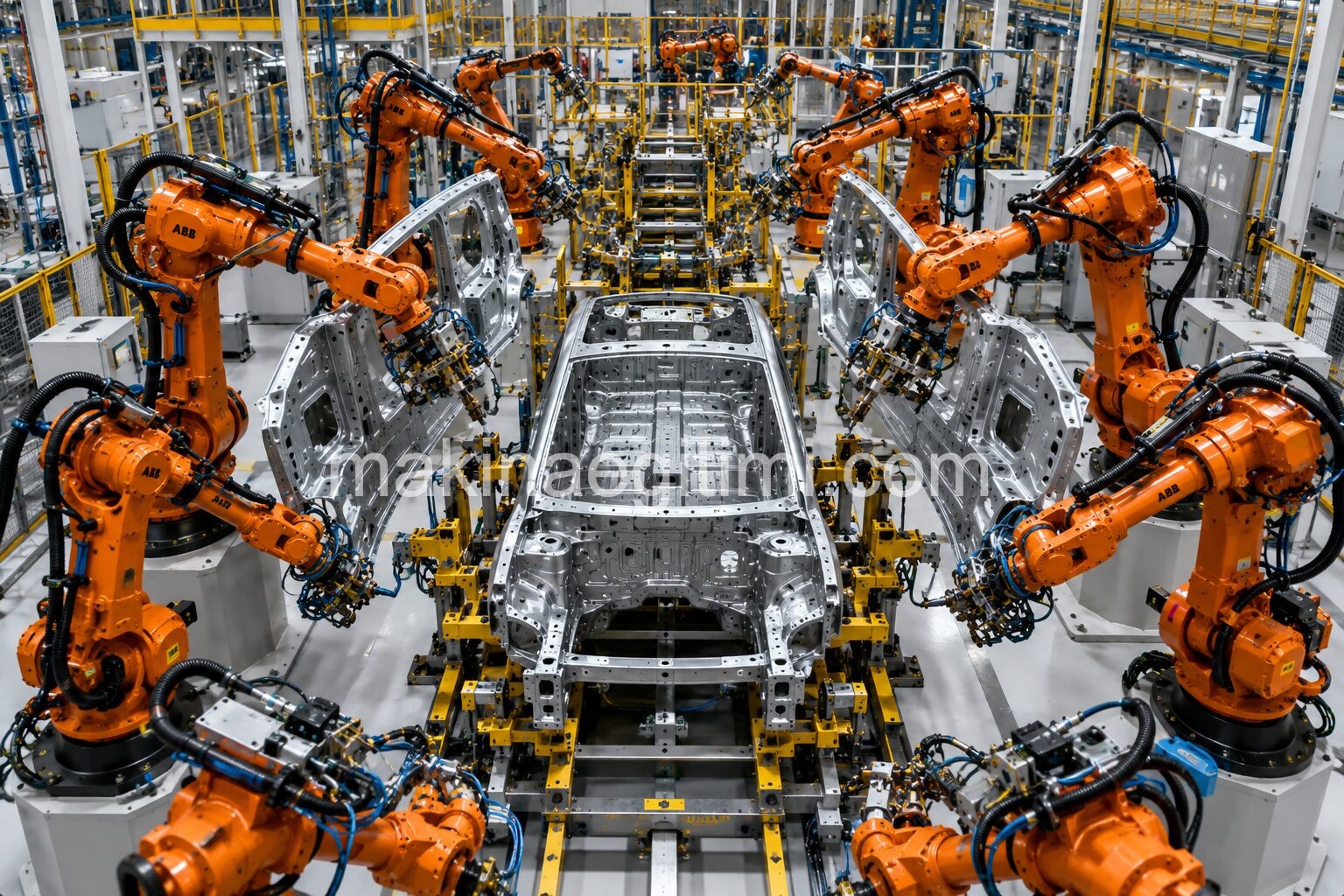
At the next stations, the left and right side panels (typically arriving as large sub-assemblies already prepared on their own sub-lines) are welded to the underbody. This stage typically takes place at what’s called the “geometry station” or “framer,” a busy station where many robots access different points of the body simultaneously.
3. Roof, Door Frame, and Detail Welds
Once the main structure is formed, the roof panel, front/rear panels, and numerous small support/bracket parts are welded at subsequent stations to complete the body. Laser weld seams typically come into play at this stage as well; especially in visible, aesthetically sensitive areas such as the roof-to-side-panel joint, they provide a much smoother and more watertight seam than spot welding.
Multi-Robot Coordination and Collision Avoidance

At a busy framing station, 8-12 robots can be trying to access different weld points at the same time, in very close proximity to one another. Before actual production begins, these robots’ movements are fully simulated in a virtual environment using offline programming software (such as RobotStudio or Process Simulate); each robot’s trajectory is verified to millimeter precision for possible collisions with both the body and neighboring robots.
During production, the central line control system operates on “interlock zone” logic: a shared volume where two robots’ arms could potentially intersect is defined, and only one robot is allowed to enter that zone at a time. The other robot waits until the first exits the zone; no matter how carefully this is planned at the design stage, this provides an additional layer of safety against small timing deviations during actual production.
How many spot welds are there in a car body?
3000-5000 on average
How many spot welds can a robot make per minute?
Roughly 15-40 spot welds, depending on the robot and application.
Why use robots?
Consistent quality
Consistent speed
Consistent positioning precision
24/7 operation
Operator safety
Flexibility and Multi-Model Production
Because of economy-of-scale requirements, most modern automotive plants have to build more than one model — sometimes even entirely different platforms — on the same line. Several approaches are combined to enable this flexibility:

- Interchangeable/multi-position fixtures: a single fixture set can be pneumatically repositioned to hold different model bodies.
- Model recognition: the incoming part is automatically identified via a barcode, RFID tag, or machine vision system; the line control system then automatically selects the correct robot program and fixture configuration.
- Modular robot programs: a separate, pre-tested welding program for each model is stored in a library; a model changeover requires only calling up the correct program, not reprogramming the robots.
This flexibility allows a manufacturer to build, say, a hatchback and its SUV version — and in some cases even electric and internal-combustion versions — on the same line in a mixed sequence based on demand; this makes much more efficient use of the plant investment.
Quality Control and Traceability
The current, voltage, and electrode force data for every spot weld is generally recorded automatically; this enables both real-time quality control (a weld whose parameters fall outside the normal range is automatically flagged) and long-term traceability (if an issue is discovered in a vehicle years later, the exact weld parameters used to build that vehicle can be looked up retroactively). On some lines, critical weld points are also subjected to automated inspection via ultrasonic testing or machine vision.
Frequently Asked Questions
Frequently Asked Questions
A typical car body can have between 3,000 and 5,000 spot welds; this number varies with vehicle size and body design. In addition, laser weld seams several meters long are typically used in visible areas.
On high-volume production lines, a car body typically moves to the next station with a “takt time” of under a minute; completing the entire line from start to finish (since it passes through multiple stations) can take several minutes.
Through a two-layer approach: first, all trajectories are verified virtually for collisions in offline programming software, and then during production the line control system provides an extra layer of safety through “interlock zone” logic, allowing only one robot into a shared work area at a time.
Thanks to interchangeable/multi-position fixtures, automatic model recognition (via barcode, RFID, or machine vision), and pre-built modular robot programs for each model, the line control system automatically recognizes each incoming body and selects the correct fixture and welding program, allowing different models to be built in a mixed sequence.
Related Posts
 Anti-Pinch Electric Vehicle Windows
 What Is the ABS Braking System, What Does It Do, How Does It Work
 MEGA MACHINES – 4100 AC Walkthrough
 State-of-the-Art High-Efficiency Agricultural Machinery
 Hyundai IVT – Intelligent Variable Transmission Technology
 Robotic Welding Applications on the Automotive Assembly Line
 What Is the Adaptive Braking System. How Does It Work
 Bi-Xenon Headlights and Their Advantages