

What Is iVT or Intelligent Variable Transmission?
iVT stands for Intelligent Variable Transmission. It’s Hyundai’s proprietary technology. It’s currently found in the Hyundai Avante and Venue, as well as the Kia K3. This is an advanced type of transmission that’s part of Hyundai’s lineup. As the name suggests, it shifts speed more intelligently compared to the ‘step-by-step’ way a conventional automatic does.
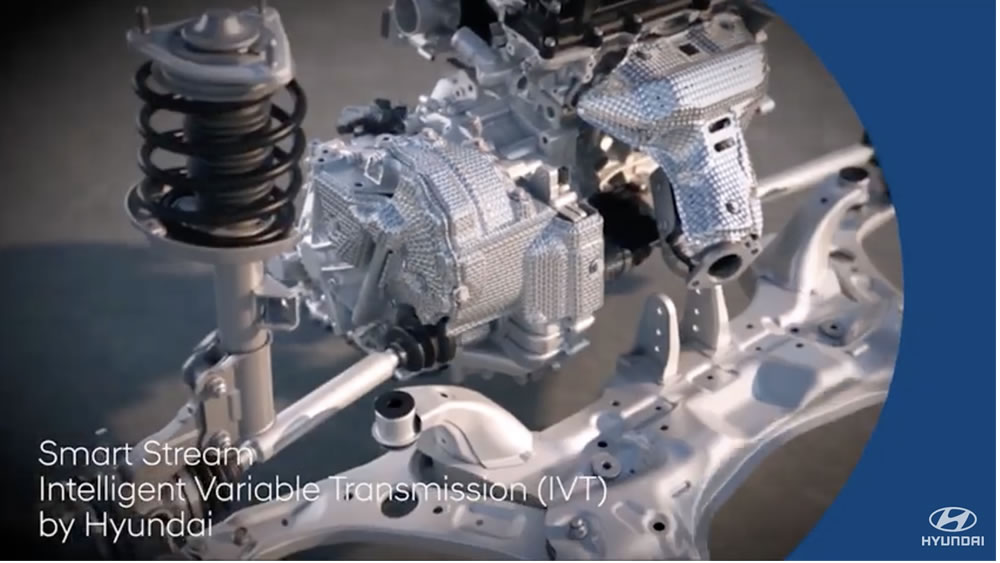
Stepless Ratio Change
IVT (Intelligent Variable Transmission), like a CVT, provides a continuously variable drive ratio with no fixed gear steps.
Fuel Efficiency
Stepless transmissions optimize fuel consumption by keeping the engine within its most efficient RPM range at all times.
Chain/Belt Mechanism
In CVT/IVT systems, power is typically transferred via a special steel belt or chain stretched between variable-diameter pulleys.
What Does IVT Do?
Intelligent Variable Transmission makes driving smoother and more responsive compared to other transmission types. iVT also allows the engine to run within a sweet spot of efficiency, more so than other automatic transmissions. As a result, it helps deliver good performance and better fuel economy.
How Does Intelligent Variable Transmission Work?
Basically, Intelligent Variable Transmission is a type of automatic transmission. It works the same way as an automatic transmission. It automatically converts the engine’s limited speed range into various ratios and sends it to the driven wheels using several different gears. A conventional automatic transmission must make several changes to the gear ratio during acceleration. To do this, it temporarily disconnects the engine from the drivetrain while engaging a gear shift. Once complete, the engine re-engages. Passengers may feel this as a slight interruption in the vehicle’s forward motion.
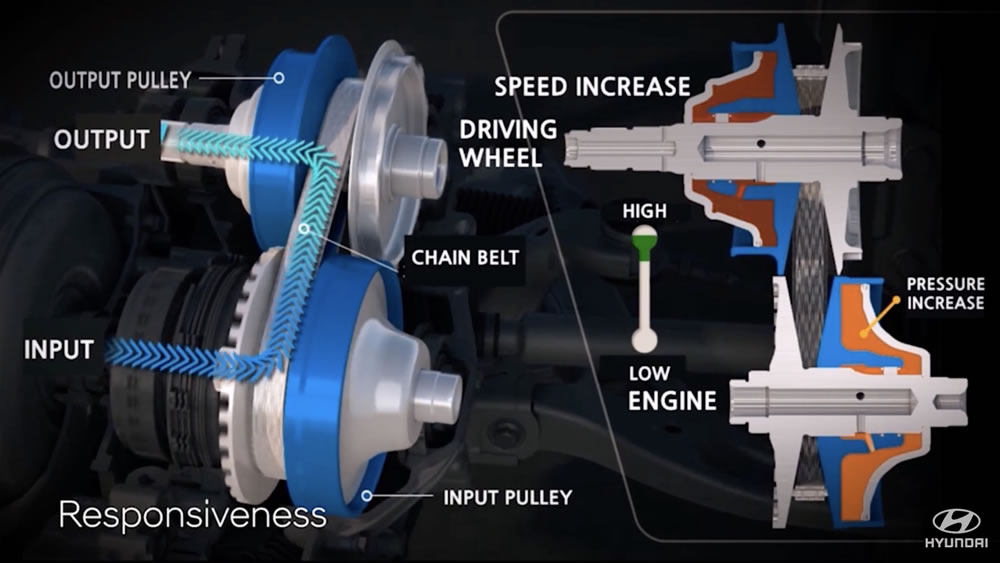
Hyundai’s Smartstream iVT uses a chain-belt drive system. It’s a first-of-its-kind in the segment while preserving the advantages of a CVT. The main advantage of the chain belt is that it uses belt tension to adjust the pulley diameter. This eliminates slip conditions while also improving economy. According to Hyundai, cars with the Smartstream Intelligent Variable Transmission showed a 4.2% improvement in fuel economy and a 5-8% reduction in engine power loss.
Driving with iVT:
That said, while using a Hyundai iVT, the transmission will still shift through various ratios. Passengers will notice these changes but won’t feel them. This is because there is very little to no loss of momentum. This means more comfort for passengers, especially in city driving and traffic where gear changes are frequent. This state-of-the-art transmission is more responsive than conventional ones.
A Hyundai car with an Intelligent Variable Transmission changes gear ratios faster than a conventional automatic transmission. As a result, engine power gets to the wheels faster, with less lag and/or delay. This is because iVT keeps the engine in its optimum power band. So you’re ready to go the moment you are.
Also, CVTs normally keep the engine speed constant while increasing vehicle speed. This makes drivers feel like the engine is idling. Smartstream iVT solves this issue by mimicking a manual transmission’s shift pattern and better accounting for the driver’s intent and driving conditions. Alternatively, without a set gear speed (as with CVTs), the driver can also make the best use of the virtual gear speeds produced by the iVT when needed. This gives it a feel reminiscent of a manual transmission.
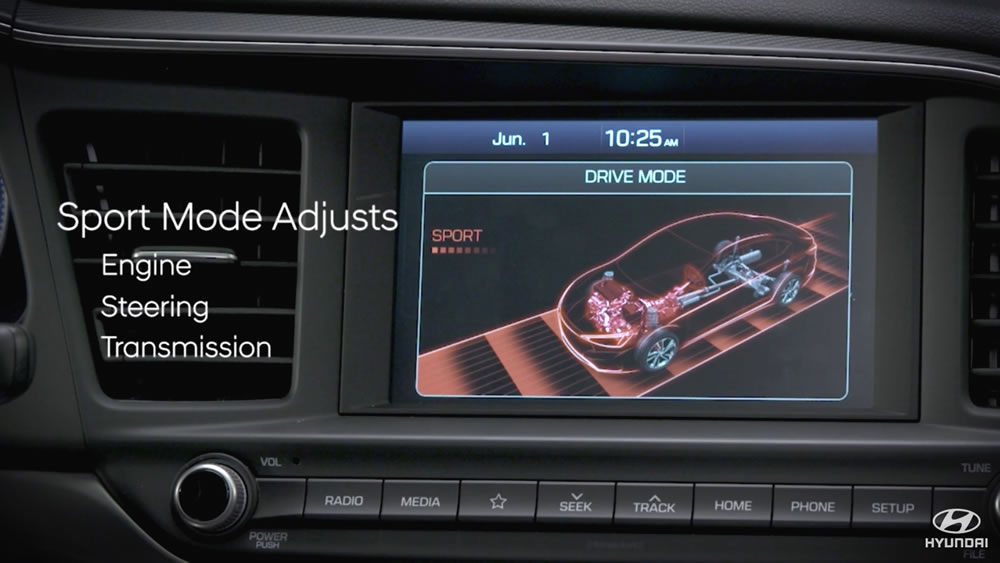
If you want to further enhance the sporty driving feel, simply select Sport mode. It adjusts engine, steering, and transmission settings all at once for maximum responsiveness. Since Hyundai is focused on improving the driving experience, this is where the Intelligent Variable Transmission comes into play.
Advantages of Intelligent Variable Transmission
Intelligent Variable Transmissions provide better fuel economy by allowing the engine to run at its most efficient RPM within any given engine speed range. Vehicles with iVT move smoothly since passengers don’t feel any jolts from gear changes. Improved fuel economy and a smoother ride for passengers are the main benefits of this.
- Smooth driving.
- Excellent fuel efficiency in both city and highway driving compared to a conventional automatic transmission.
- No power loss.
Related Questions
A classic automatic transmission shifts between specific, fixed gear steps. An IVT, on the other hand, changes the drive ratio continuously and steplessly, with no fixed steps.
This system can continuously keep the engine within the RPM range where it runs most efficiently. Since the engine isn’t unnecessarily forced to run at too high or too low an RPM, fuel is used more efficiently.
Related Posts
 Bi-Xenon Headlights and Their Advantages
  MEGA MACHINES – 4100 AC Walkthrough
  Features and Advantages of LED Headlights
  State-of-the-Art High-Efficiency Agricultural Machinery
  Fuel Cell Electric Vehicles (FCEV)
  Robotic Welding Applications on the Automotive Assembly Line
  What Is the ABS Braking System, What Does It Do, How Does It Work
  How Are Robotic Welding Cells Used in Automotive Production?