
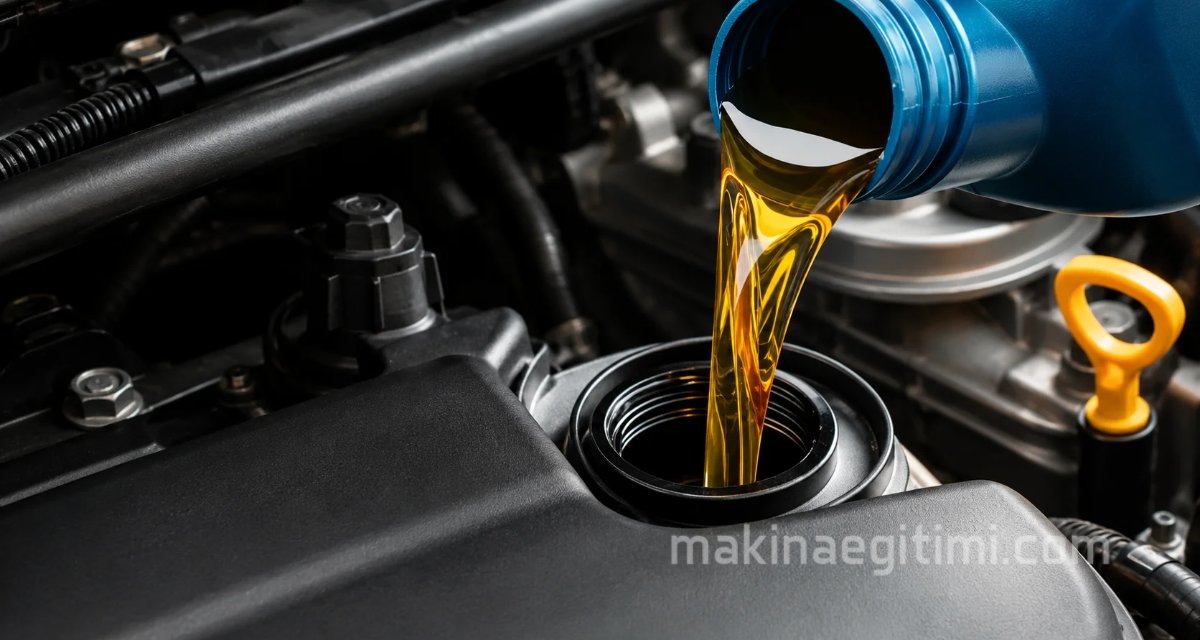
In this article, we’ll cover the importance of engine oil for a vehicle’s engine. What are the functions and benefits of engine oil? What’s the difference between engine oil and machine oil? We’ll also cover what the additives in engine oil do.
The Functions and Benefits of Engine Oil
1- Reducing Friction
Engine oil’s greatest benefit is reducing friction between parts. It’s the sliding effect between the liquid and metal that keeps two metal surfaces from touching each other. Just as a stone thrown flat across the sea skips and skims along the surface, the oil trapped between two metal surfaces forms a film that keeps them from touching each other.
In internal combustion engines, heat continuously rises due to both combustion and friction. Engine oil’s main purpose is to help lower this heat by reducing friction.

However, the distance between the two metal surfaces matters for the oil film to form. If this distance increases over time due to wear, the oil film can’t sustain itself and tears under pressure. At that point, you’ll hear a knocking sound while the engine is running that gets louder as RPM increases.
For the related topic, see: Knocking sound from the engine
2- Cooling Engine Parts
Another benefit of engine oil is that it takes heat from heated parts and carries it to cooler areas. During lubrication, it carries the heat it absorbs from the parts to the relatively cooler crankcase, cooling the parts somewhat.
3- Increasing Engine Power
The engine oil that the piston rings scrape off the cylinder surface fills the gap between the ring and its groove, acting almost like a liquid gasket. This way, it improves the compression performance in the cylinders and, in turn, increases engine power.

4- Keeping Engine Parts Clean
Engine oil collects the wear debris and combustion soot formed on the parts it lubricates and carries them into the crankcase. Thanks to the oil filter, it filters out harmful particles forming inside the engine, keeping the system clean. This way, it keeps engine parts continuously clean.
Viscosity Classification
Engine oils indicate flow performance at different temperatures through a viscosity classification, such as SAE 5W-30.
Additive Content
Engine oils contain detergent and anti-wear additives to keep the engine clean and reduce wear.
Synthetic Oil Life
Full synthetic engine oils can allow longer change intervals (15,000 km and beyond) compared to mineral oils.
What’s the Difference Between Engine Oil and Machine Oil?
Oils obtained from crude petroleum are called mineral oil or machine oil. This type of oil isn’t suitable for the engine’s operating conditions. The superior properties desired in engine oils are achieved through additives mixed into the mineral oil.
The Purpose of Additives in Engine Oil
They prevent the engine oil from thickening too much at low temperatures, letting the engine start easily in cold weather.
Additives ensure the engine oil doesn’t lose its lubricating properties at high temperatures. This way, waste buildup on parts that run very hot, like pistons, rings, and valves, is minimized. By preventing water, ash, carbon, and other chemical substances formed by combustion during operation from forming acid in the oil, they extend the life of engine parts.
They improve lubrication quality by preventing the engine oil from foaming.
Related Questions
As engine parts wear, the distance between them increases, and the protective film formed by the oil can no longer close that gap and can tear. When the film tears, the metal surfaces start making direct contact with each other, which leads to a knocking sound.
The oil circulates continuously, picking up heat from the engine’s hot areas and carrying it to cooler areas. This circulation acts as an additional cooling mechanism, helping prevent the engine from overheating.
Related Posts
 What Is a Vehicle Ignition System, How Does It Work? What Are Its Failures?
 What Is an Alternator? What Does It Do?
 Why Does an Engine Misfire? Engine Misfire Problem
 How Hydraulic Brakes Work
 How to Choose Engine Oil
 Vehicle Fuel System Components and Their Functions
 Mercedes-Benz AMG 63 V8 Engine Manufacturing
 Disc Brake & Drum Brake. Which Is Better?