
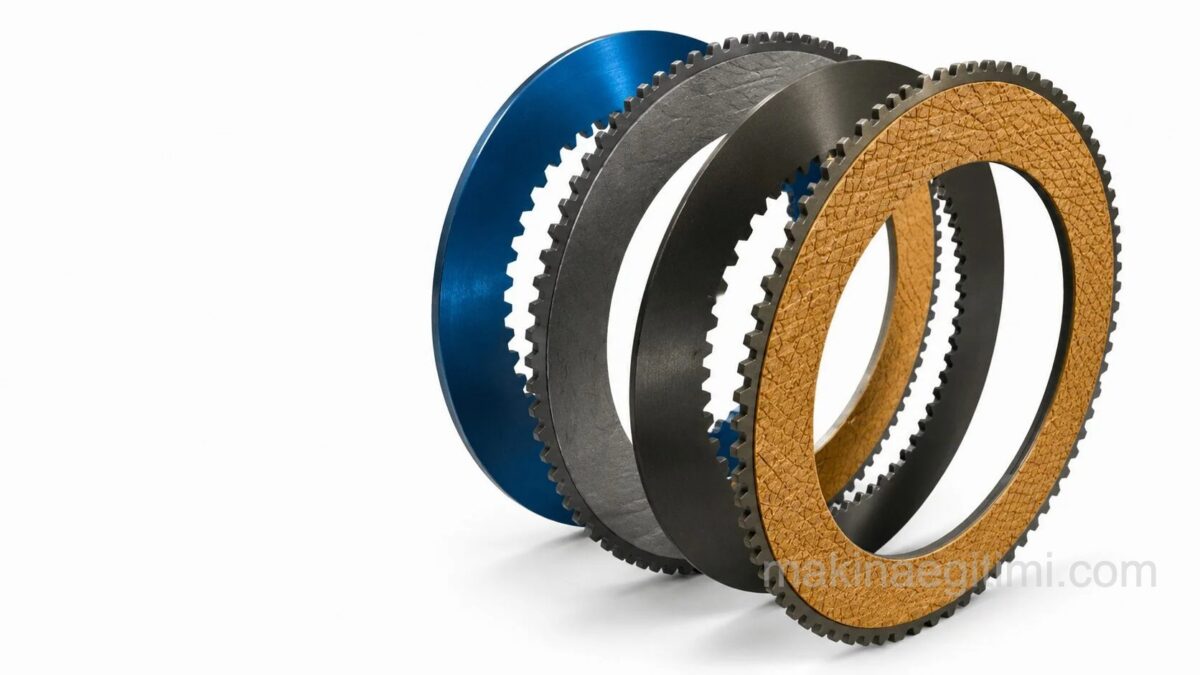
Friction Materials Used in Clutches
When we say friction materials used in clutches, the first thing that comes to mind is sintered bronze.
So what is sintered bronze?
Sintered Bronze (Friction Lining)
Woven friction lining is a non-metallic friction material obtained by mixing glass fiber with a binder resin, pressing it, and baking it. In Turkish this material is commonly, but incorrectly, referred to as “balata”. So here’s the answer to questions like what a friction lining is made of and what its material composition is.
Sintered bronze has for quite a long time been the most widely used friction material in clutches and brakes operating in oil-immersed environments.
Steel-against-steel was also a material used quite extensively in the past. This pairing was used in many multi-plate clutches operating in oiled environments. Today it has largely given way to sintered bronze.
Special ceramic-based friction materials containing a certain amount of metal in their structure have also been developed and have found use in some clutches in recent years.
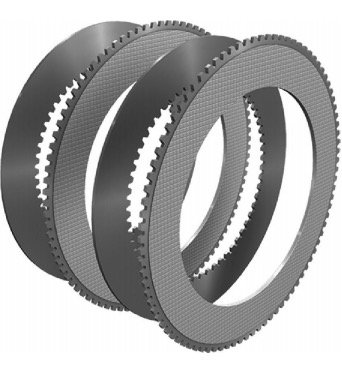
Although not yet applied in clutches, pressed carbon or carbon-graphite mixtures are also used as a friction material in aircraft and racecar brakes.
Friction Materials
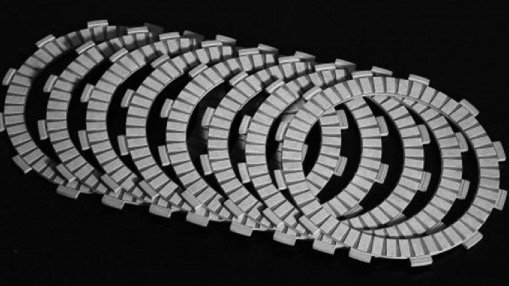
Plates made of paper-based material (grooved/patterned)

Friction materials used in clutches must be heat-resistant. The figure shows plates made from a heat-resistant material
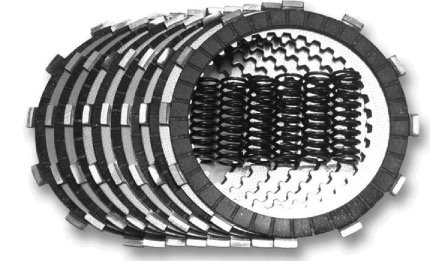
Organic-based fiber plates
For the clutch to remain compact in size, a high friction coefficient is expected from this material pair.
• It must likewise be able to operate under high contact pressures.
• Another requirement is that the friction coefficient not be affected by sliding speed or pressure. • Requirements can also include not being significantly affected by the temperatures generated at the contact surface and throughout the clutch during engagement, high wear resistance, and good heat conduction.
• A material pair that fully meets all of these requirements well doesn’t yet exist.
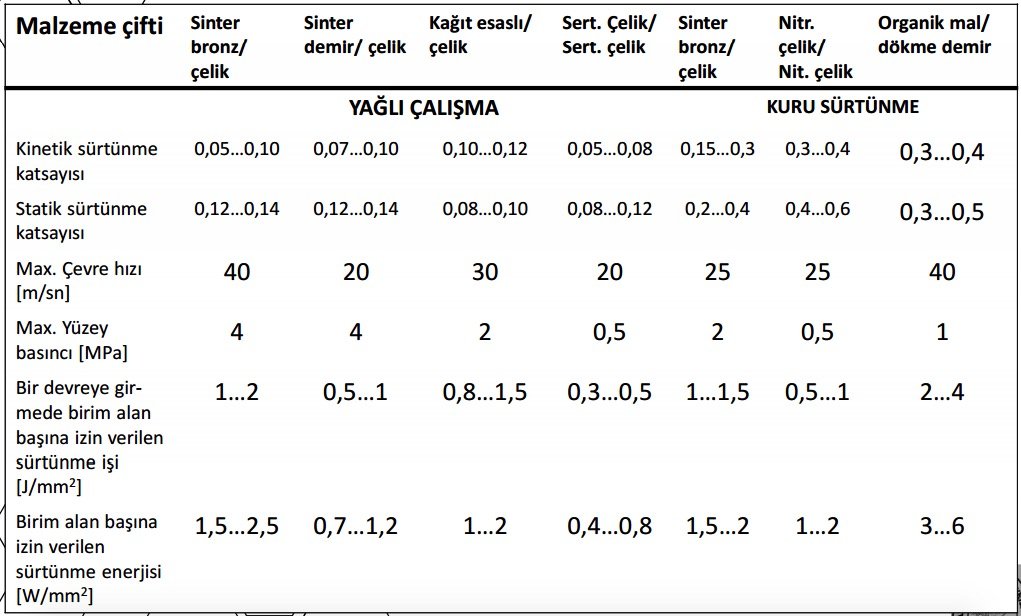
Properties table of friction materials used in clutches
High Friction Coefficient
Clutch friction materials are designed to have a high coefficient of friction in order to maximize power transmission.
Heat Resistance
These materials are specially formulated to withstand the high temperatures generated during friction.
Asbestos-Free Modern Materials
Today, due to health risks, organic or ceramic-based friction materials are preferred over asbestos.
Related Questions
This material can maintain adequate friction, and therefore sustain power transmission, even in an oil-immersed environment. While some other materials become slippery in the presence of oil and lose their effectiveness, sintered bronze delivers reliable performance in this environment.
Although this term is widely used in Turkey, the actual friction lining is a different friction material made from glass fiber and resin. Sintered bronze, on the other hand, is metal-based, with a completely different composition; in everyday usage these two materials are commonly confused with each other.
Related Posts
 Couplings and Types of Couplings
  Metric-Whitworth Thread Tables
  Differences Between Leaf Spring and Coil Spring Suspension
  Dowel Pin Drawings – AutoCAD DWG and PDF
  Bevel Gears and Their Types
  What Is a Cotter Pin. Where Is It Used?
  What Is a Key? Where Is It Used?
  Formulas for Gear Drawing and Manufacturing