
Topics covered under Cushioning in Pneumatic Cylinders:
The Purpose of Cushioning in Pneumatic Cylinders
In cylinders, especially when moving heavy loads, the piston strikes the end of its stroke at high speed. This damages the cylinder’s bearing and sealing elements, and can also cause connecting elements to loosen. Cushioning is used to prevent this.
This section is usually adjustable. Using a cushioning mechanism reduces cylinder failures and improves performance. Cushioning can be applied to all cylinder types and extends their service life. However, cushioned cylinders are more costly than others.

How Cushioning Is Done in Pneumatic Cylinders
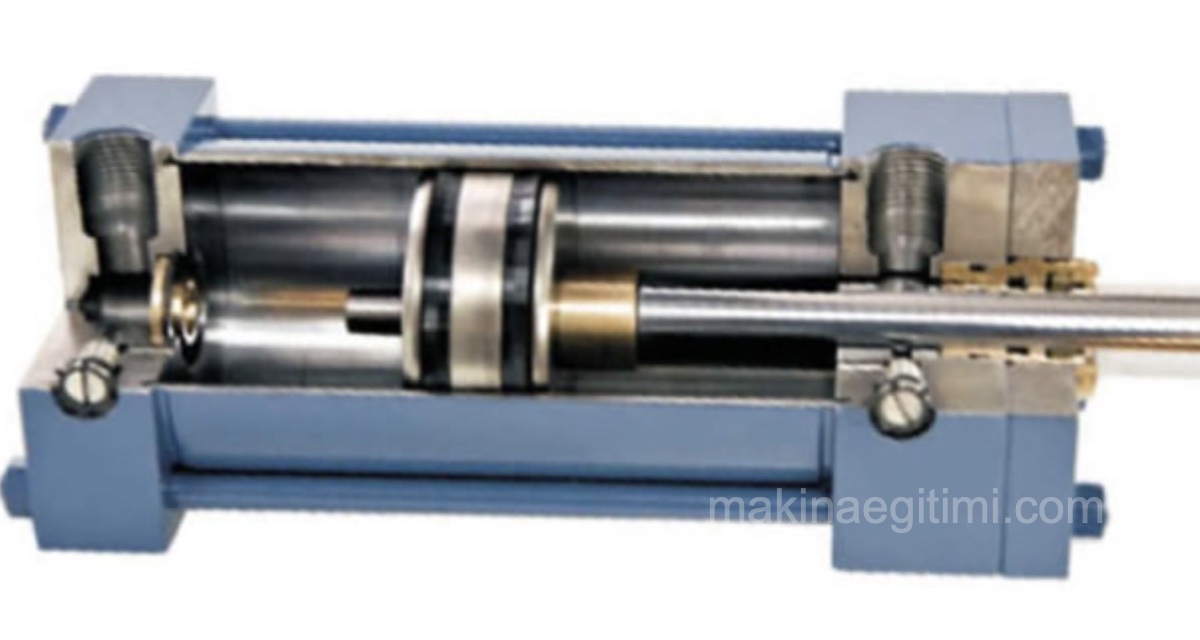
Cushioning in cylinders is generally done as follows: as the piston approaches the end of its stroke, the cushioning spigot enters the cushioning seal and blocks the passage of air.
The air remaining inside the cylinder is expelled through the cushioning screw. Since the trapped air must exit through a narrower opening, the piston is slowed near the end of its stroke. The cushioning can be adjusted with the adjustment screw.

Purpose of Cushioning
Cushioning extends cylinder life by reducing the impact and noise caused by the piston stopping suddenly at the end of its stroke.
Fixed Cushioning
In fixed cushioning, as the stroke end approaches, the air exit passes through a narrowing channel, slowing the piston.
Adjustable Cushioning
In adjustable cushioning, the deceleration effect can be fine-tuned by the user via a screw.
Types of Pneumatic Cylinder Cushioning
Depending on the application’s needs, there are 4 different types of cushioning options available for pneumatic cylinders:
1. Non-Cushioned Cylinder.
There is no special element on the body for braking purposes, and the cylinder operates without any stopping effect. It makes a loud noise with a sharp impact at the end of the stroke. This type of cylinder is generally small in diameter and can be preferred for applications that need to operate at low loads and speeds.
2. Impact-Cushioned Cylinder.
Cushioning rings that provide impact cushioning are fitted onto the piston, mainly to reduce noise levels. Impact cushioning provides effective cushioning especially in single-acting cylinders. The braking distance ranges between 0.2-2 mm.
Noise results obtained in impact tests show that cylinders using cushioning rings reduce noise levels by 20-30 dBa, and mechanical vibrations by a factor of 3-10.

This means the machine or system is exposed to less stress, has a longer service life, and lower operating costs. Lower noise levels mean a more comfortable environment for operators or employees, and less servicing.
3. Pneumatically Cushioned Cylinder
Cylinders used for larger loads and higher kinetic energy levels have adjustable pneumatic cushioning elements integrated into the end caps on the body. In this type of cylinder, the effective cushioning distance is around 10-30 mm.
4. Pneumatically and Impact-Cushioned Cylinder
Many modern cylinders manufactured today by various companies are produced with a combination of pneumatic and impact cushioning. The load, decelerated and effectively braked by the adjustable cushioning, comes to a full stop by hitting the impact cushioning rings rather than the end caps when it reaches the end of the stroke. When a properly sized cylinder is used and the cushioning is adjusted correctly, no metallic impact sound is heard.
Alternative Cushioning Options
Cushioning inside the cylinder is one of the sensible solutions. However, when very large loads or high speeds are involved, internal cushioning may not be sufficient. For these cases, alternative cushioning options have been developed and are used in most industrial applications:
- Using springs, rubber, or plastic bumpers.
- Cushioning by creating a flow and speed difference.
- Using a pneumatic shock absorber.
- Cushioning with the help of hydraulic shock absorbers.
Detailed Scientific Source on This Topic:
Pnömatik silindirlerde yastıklama dinamiğinin incelenmesi / Necip Çayan (Turkish document)
Related Questions
The piston strikes the end of its stroke at high speed; over time this impact wears down the bearing and sealing elements, and can even cause connecting parts to loosen. Cushioning softens this sudden impact and extends the cylinder’s life.
As the piston nears the end of its stroke, the air inside it is forced to pass through a narrow opening. This restriction makes it harder for the air to escape, and the piston slows down as it encounters this resistance.
Related Posts
 Calculating the Moisture Content of Compressed Air
 What Is Pascal’s Principle? Where It Is Used
 Hydraulic Applications – Pressure Reducing Valve
 What Is a Pneumatic Muffler, What Does It Do?
 Pneumatic Dryers and Air Drying Methods
 Maintenance of Pneumatic Systems
 The Importance and Applications of Hydraulics and Pneumatics
 What Is a Pneumatic Compressor, What Does It Do?