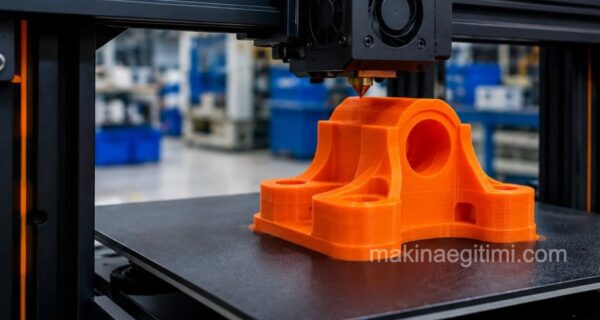
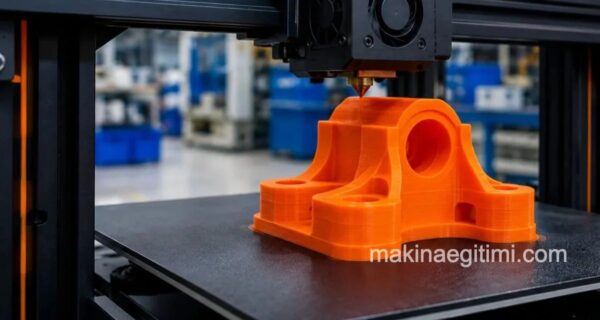
Manufacturing done with 3D printers has strengths and weaknesses compared to traditional manufacturing methods (casting, die-making, machining, etc.). Here are the advantages and disadvantages of 3D printers, whose use is becoming increasingly widespread across different fields:
Advantages of 3D Printers
- Fast production of custom designs and prototypes. Since 3D printers don’t require stages like die and tool design that other manufacturing methods need, an overall faster product turnaround can be achieved.
- Objects with complex surface geometry can be easily turned into physical objects.
- Flexible Production Model: They allow for easier and faster accommodation of design changes. Especially in manufacturing methods that use dies, when the design changes, the die must also change. However, since production with 3D printers goes directly from design to production, a design change can easily be reflected in the product.
- Easy Raw Material Supply: The consumable filament materials used are easy to source and affordably priced.
- More Affordable Production Cost: The machinery, equipment, and labor costs needed for production with traditional methods are reduced. In addition, the filaments used as consumables are affordably priced.
- They eliminate many operations (milling, turning, post-production deburring, etc.).
- They can be used for design work in engineering education.
- Being Eco-Friendly: They don’t release toxic gases into the environment while melting. Since many consumable materials are bioplastic, they have no properties that would negatively affect health, and they’re easier to recycle.
- Small production runs are possible
FDM Print Speed
FDM (fused deposition modeling) 3D printers can deposit 20-100 cm³ of material per hour, depending on layer thickness.
Resin-Based Precision
SLA/DLP resin printers offer far higher surface precision (25-100 microns) than FDM.
Material Variety
Today, hundreds of different materials can be used in 3D printing, from plastic to metal, and ceramics to biocompatible materials.
Disadvantages of 3D Printers
- Production speed is slow: 3D printers are slower than other techniques for mass production.
- Surface roughness: Surface roughness is a problem in all 3D printers, from the most professional machines to the most amateur DIY machines. Even when the layers are very small, they can be observed on close inspection.
- Material limitations; although material options have increased considerably with recent technological advances, material variety is still quite limited compared to traditional manufacturing methods.
- Low Dimensional Precision: Compared to casting and machining, precision is quite a significant problem.
- Regarding size, producing large machine parts using 3D printing technique is quite problematic.
- As volume increases, the problems mentioned above increase exponentially.
In this article, we covered the strengths and weaknesses of 3D printers. As with many manufacturing methods, production done with 3D printers also has its own advantages and disadvantages. When evaluating these, the decision on whether to manufacture with a 3D printer is made by considering factors such as the type of product to be manufactured, its dimensions, precision, quantity, the product’s market, financial resources, and cost.
Related Questions
In die-based manufacturing, when the design changes, the die must also be remade, which costs both time and money. In 3D printing, the design file can simply be updated and printed directly, with no need for a separate die-making step.
In traditional methods, manufacturing parts with complex internal cavities or intricate shapes can require special tooling and multi-stage processes. Since 3D printing builds the part layer by layer, it can manufacture such complex shapes in a single pass.
Related Posts