
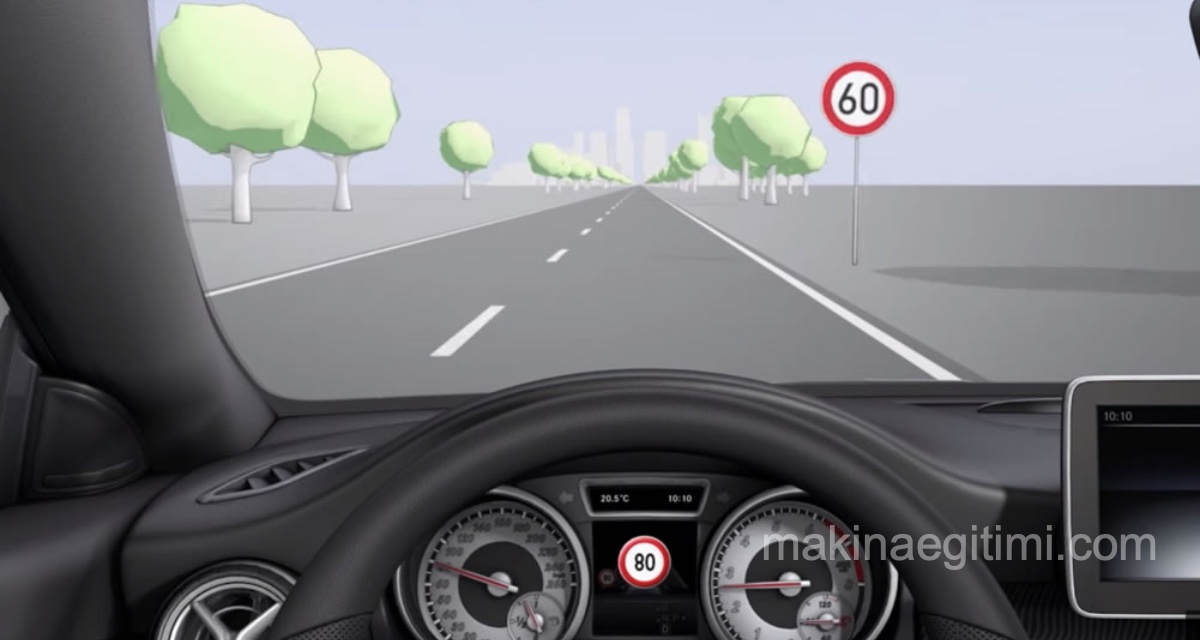
In this article, in our defensive driving education section, we’ll go over definitions related to traffic, highways, and vehicles that are among the subjects covered by questions in the driver’s license exam. This has been specially prepared for prospective drivers looking for driving school lecture notes.
TRAFFIC: The condition and movement of pedestrians, animals, and vehicles on highways.
HIGHWAY (ROAD): A strip of land, along with bridges and areas, open for public use for traffic.
VEHICLE: The general name for motorized, non-motorized, and special-purpose conveyances, along with construction machinery and rubber-tired tractors, that can be used on highways.
CONVEYANCE: Vehicles used on highways for carrying people, animals, and loads. Those powered by an engine are called a “motorized conveyance,” and those powered by human or animal effort are called a “non-motorized conveyance.”
In addition, those used without a profit motive are called a “private conveyance,” those used for various forms of profit are called a “commercial conveyance,” those falling under the Conveyances Act are called an “official conveyance,” and those that are official but also carry a commercial character are called an “official commercial conveyance.”
DRIVER: The person who operates and controls a motorized or non-motorized vehicle or conveyance on the highway.
OPERATOR: The person who owns the vehicle, or who is registered as the buyer under a retention-of-title sale, or who has leased the vehicle for an extended period, or who holds it as a pledge. However, if it’s proven that another person is operating someone else’s vehicle for their own account and at their own risk, and has actual control over the vehicle, that person is considered the operator.
TRAFFIC SIGNS: Signage used for the purpose of regulating traffic; illuminated and audible signals, road markings, and the actions taken by traffic police or other authorities to direct traffic.
RIGHT OF PRIORITY (EMERGENCY PRIORITY): The exemption of certain vehicle drivers, while on duty, from traffic restrictions or prohibitions, provided they don’t endanger life or property.
RIGHT OF WAY: The priority right of pedestrians and drivers over other pedestrians and drivers when using the road.
STOPPING: Bringing a vehicle to a halt due to any kind of traffic requirement, such as a red light, an official’s stop signal, or a road closure.
STANDING (BRIEF STOP): Halting a vehicle for a short time, outside of traffic requirements, for the purpose of dropping off or picking up people, loading or unloading goods, or waiting. This period is a maximum of 5 minutes.
PARKING: Leaving a vehicle unattended other than in cases of stopping or standing.
TRAFFIC ACCIDENT: An event involving one or more vehicles moving on a highway that results in death, injury, and/or damage.
SETTLEMENT (UNIT): Places such as a province, district, village, or hamlet, where the start and end of the boundary along the connecting highways is marked with a sign, where buildings and facilities used by people for settlement, work, and shelter are found together, whose effects on highway traffic have been determined, and which are defined by administrative division.
PEDESTRIAN: A person not inside a vehicle, whether stationary or moving, on the highway.
REMOVAL FROM TRAFFIC: The confiscation of a vehicle’s documents by traffic police or authorities in cases specified by law, and the towing and holding of the vehicle at a designated location, removing it from traffic.
Definitions Related to Roads
HIGHWAY BOUNDARY LINE: On a highway that has been expropriated or dedicated/allocated for public use by law, this is the boundary line with private property; on other highways, in a cut section, it’s the outer edge of the ditch if there is one after the slope, or the top edge of the slope if there’s no ditch; in a fill section, it’s the line at the foot of the slope; and on a highway with a separated footpath, it’s the line where the footpath meets private property.

ONE-WAY HIGHWAY: A highway whose carriageway is used for vehicle traffic in only one direction.

TWO-WAY HIGHWAY: A highway whose carriageway is used for vehicle traffic in both directions.

DIVIDED HIGHWAY: A highway created when the carriageway for one direction of traffic is separated in a defined manner from the other carriageway by a median.
CONNECTOR ROAD: The section of highway near an intersection that connects highway carriageways to each other, lies outside the intersection area, and is allocated for one-way traffic.
Motorway (Highway): A highway specifically allocated for through traffic, where entry and exit are prohibited except at designated points and under certain conditions, which pedestrians, animals, and non-motorized vehicles cannot enter, which is only used by permitted motor vehicles, and where traffic is subject to special control.

EXPRESSWAY: A divided main highway with limited access control, where major intersection points are constructed as grade-separated (flyover) junctions.

ACCESS ROAD: The section of a road built for vehicles to enter and exit a property that connects to the highway and lies within the highway’s boundary line.

FOOTPATH (Sidewalk): The section of the highway lying between the edge of the carriageway and properties belonging to natural or legal persons, allocated solely for pedestrian use

SHOULDER: On a highway without a separate footpath, the section between the edge of the carriageway and the top of the slope or the inner top edge of the ditch, normally used by pedestrians and animals, and which vehicles may use only in necessary situations.
PLATFORM: The section of the highway made up of the carriageway (pavement) together with the footpath or shoulder.
MAIN ROAD: A highway open to major traffic flow, marked with signs indicating that traffic on the highway that crosses it must yield right of way when crossing or entering this road.

SECONDARY ROAD: Generally, a road of lesser importance, in terms of traffic volume, than the road it connects to. In the figure alongside, roads number 1 and 2 are secondary roads.
DANGEROUS GRADE: A road grade, in terms of length or angle, that requires vehicles to downshift in order to continue safely.

INTERSECTION: The common area formed by the crossing or merging of two or more highways.

PEDESTRIAN CROSSING: Areas on the carriageway marked with traffic signs to ensure pedestrians can cross safely.
SCHOOL CROSSING: Generally, an area around preschools, primary schools, and secondary schools, set apart from the carriageway specifically for students to cross, marked with a traffic sign.
RAILROAD CROSSING (Level Crossing): A crossing, with or without barriers, where a highway and a railway intersect at the same level.

ISLAND: A section or area, marked off with protective barriers and inaccessible to vehicles, built to allow pedestrians to cross and stand, and to allow passengers to get in and out of vehicles, for the purpose of regulating traffic flow and ensuring traffic safety.

MEDIAN (DIVIDER): A highway structure, traffic device, or equipment that separates carriageways or sections of a road from each other, and prevents or restricts vehicles on one side from crossing to the other side.

LANE: The section of the carriageway divided by lines to allow vehicles to travel safely in a row.
Definitions Related to Vehicles
MINIBUS: By its design, a motor vehicle with 8 to 14 seats besides the driver’s, manufactured to carry people.
BUS: By its design, a motor vehicle with at least 15 seats besides the driver’s, manufactured to carry people.
LIGHT TRUCK (PICKUP): A motor vehicle manufactured to carry cargo, with a permissible maximum laden weight not exceeding 3500 kg.
TRUCK: A motor vehicle manufactured to carry cargo, with a permissible maximum laden weight exceeding 3500 kg.
OFF-ROAD VEHICLE: A motor vehicle manufactured in a form capable of carrying passengers or cargo on highways, in which all wheels receive, or can receive, power from the engine.
MOTORCYCLE: A 2- or 3-wheeled motor vehicle, with or without a sidecar. Three-wheeled motorcycles with a box-type or specially built body capable of carrying cargo, and not used for carrying passengers, are called a cargo motorcycle (three-wheeler/triporteur).
MOPED: A bicycle fitted with an internal combustion engine with a displacement not exceeding 50 cubic centimeters, with a manufactured top speed of less than 50 km/h.

TRAILER: A non-motorized conveyance manufactured to carry people or cargo, towed by a motor vehicle.

SEMI-TRAILER: A trailer partly resting on a motor vehicle, where part of its own weight and the load it’s carrying is borne by the motor vehicle.
LIGHT TRAILER: A trailer or semi-trailer with a maximum laden weight not exceeding 750 kg.
VEHICLE COMBINATION (ROAD TRAIN): A conveyance made up of at most 2 trailers joined together to travel as a single unit on the highway.
CLEARANCE (GAUGE): The dimensions that define the length, width, and height of vehicles, loaded or unloaded, for the purpose of ensuring their safe travel on the highway.
SPECIAL-PURPOSE CONVEYANCE: A motor vehicle manufactured for the special purpose of carrying people or goods, used for special tasks such as fire trucks, ambulances, hearses, outside broadcast and recording vehicles (radio, film, television), library and research vehicles, and vehicles for towing, carrying, or lifting broken-down or damaged conveyances and vehicles.
STAFF SHUTTLE VEHICLE: Minibus- and bus-type commercial vehicles belonging to individuals or companies that carry the staff of any public institution or organization, or private or legal entity, under a contract. Vehicles belonging to public institutions and organizations, or private and legal entities, carrying their own staff or passengers, don’t fall under this definition.
MAXIMUM WEIGHT: The weight of the vehicle together with the maximum load it can safely carry.
UNLADEN WEIGHT: The total weight of a vehicle, without any people or goods (cargo) on board, with a full fuel tank, together with its required tools, equipment, and fittings.
LADEN WEIGHT: The total weight of a conveyance’s unladen weight together with the driver, crew, passengers, and goods it’s carrying.
AXLE WEIGHT: The axle weight determined for vehicles to be able to safely pass over highway structures without damaging them.
Related Posts
 What Is a Forklift. What Are the Types of Forklifts
 Safe Forklift Use. Forklift Safety Rules
 Why Is It Dangerous to Rest Your Feet on the Dashboard?
 Steering Wheel Grip and Turning Techniques
 Traffic Signs and Their Meanings. Warning Signs
 Vehicle Dashboard Panel Symbols and Their Meanings
 Traffic Regulatory Signs and Their Meanings. Restriction and Command Signs
 How Is a Tire Changed? Changing a Vehicle Tire