
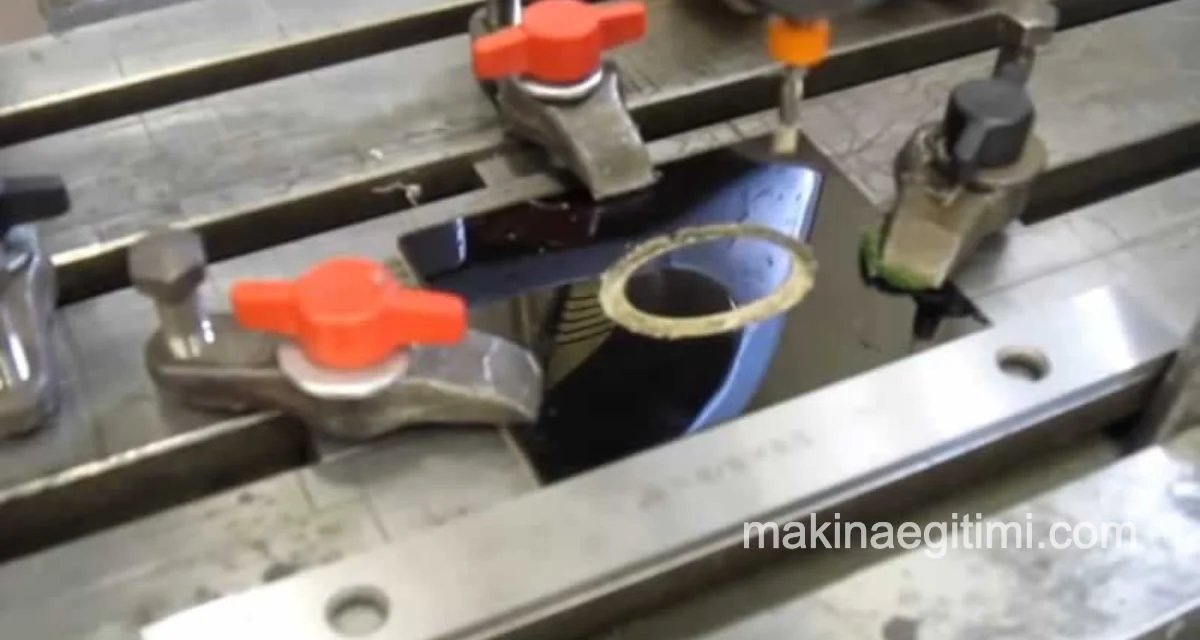
Pantograph machines are made by manufacturers in various types and sizes. With these machines, numbers, letters, shapes of a certain form and size, and similar profiles are transferred from a template onto a workpiece. The transfer can be proportionally enlarged or reduced. Another name for this machine is a copy machine (duplicating machine).

A pantograph machine has a stylus (tracer) tip and a cutting tip that operates dependent on its movement. The stylus (tracer) tip can be made to move by hand, semi-automatically, or fully automatically. Fully automatic pantograph machines are preferred for identical parts requiring mass production. These types of machines are programmed and electronically controlled.

Pantographs are used to engrave numbers, letters, and similar shapes onto the punches used in stamping/embossing operations.
How Does a Pantograph Machine Work
On a manually operated pantograph, the tracer tip is guided by hand around the template. The cutting tip, which moves in tandem with the tracer tip, transfers the shape within the template onto the part.

With this machine, especially widely used in bulk mold-making, the manufacturer producing the mold can write their own logo onto the molding surface for advertising purposes. Names belonging to a person or company are also engraved onto nameplates, plaques, and similar items.
On roughly machined plastic, hot-forged, or die-cast bulk molds, the sections with dimensional discrepancies caused by flashed surfaces can be precisely machined on pantographs. In addition, by fitting shank-mounted profile grinding stones onto the cutting-tip spindle, molding surfaces can be precisely ground.

Pantographs also show up as the machines used for duplicating house, workplace, and car keys. (picture above)
Scaled Copying
A pantograph is a mechanism that can transfer motion from a template to another surface at a different scale using mechanical arms.
Engraving and Tracer Milling
Pantograph machines have traditionally been used for mold engraving and letter/shape copying operations.
Replacement by CNC
Today, most of the functions of pantograph machines have been taken over by more precise, programmable CNC milling machines.
Related Questions
The mechanical linkage between the stylus and the cutting tip transfers motion by enlarging or reducing it at a certain ratio. Since this ratio is adjustable, the same template can be used to produce parts at different sizes.
On manually operated machines, the operator’s hand precision directly affects the outcome, and each part can come out slightly different. An automatic, programmed machine repeats the same motion over and over with identical precision, producing identical parts.
Related Posts
 Laser Cutting Working Principle, Advantages and Disadvantages
  What Is Aluminum Extrusion, How Is It Done?
  What Is Reaming? How Is It Done?
  Aluminum Production. How Is Aluminum Produced
  Professional 3D Scanners and Their Applications
  2018 Skoda Octavia: Footage From the Production Lines
  Properties of Laser Beams and Their Working Principle
  The Best 3D Scanners of 2022 – Buying Guide