
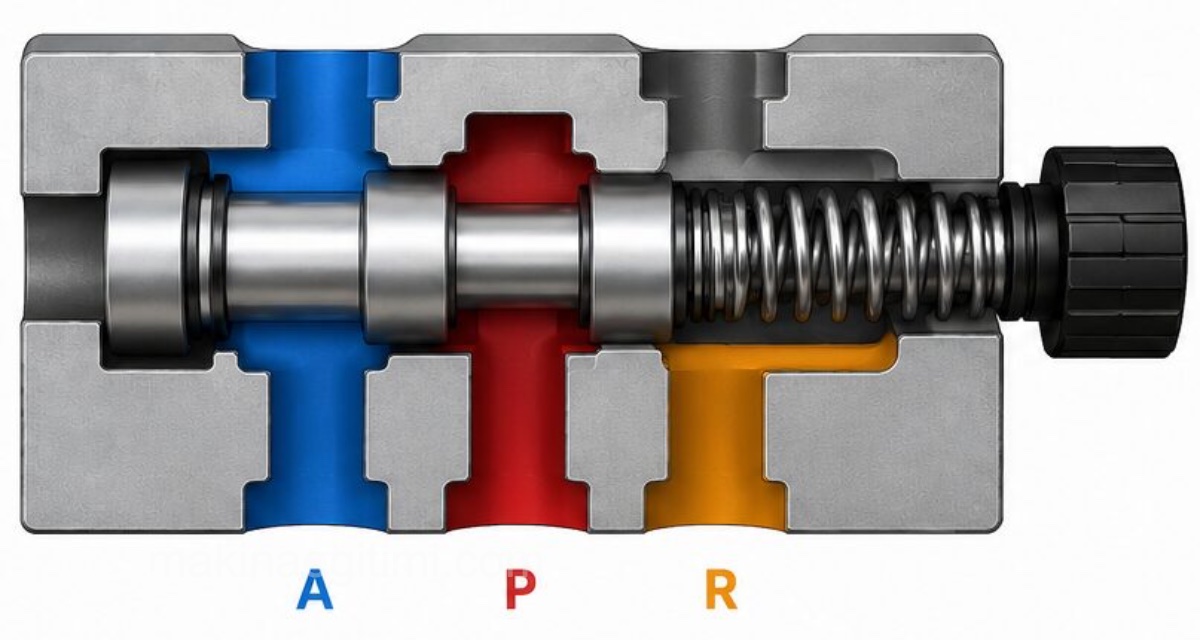
In the Machine Technology Hydraulics-Pneumatics lesson notes section, we’ll cover 3-way, 2-position directional control valves. We’ll go through their operating principle and sample circuit applications with illustrated explanations.
3/2 Directional Control Valves
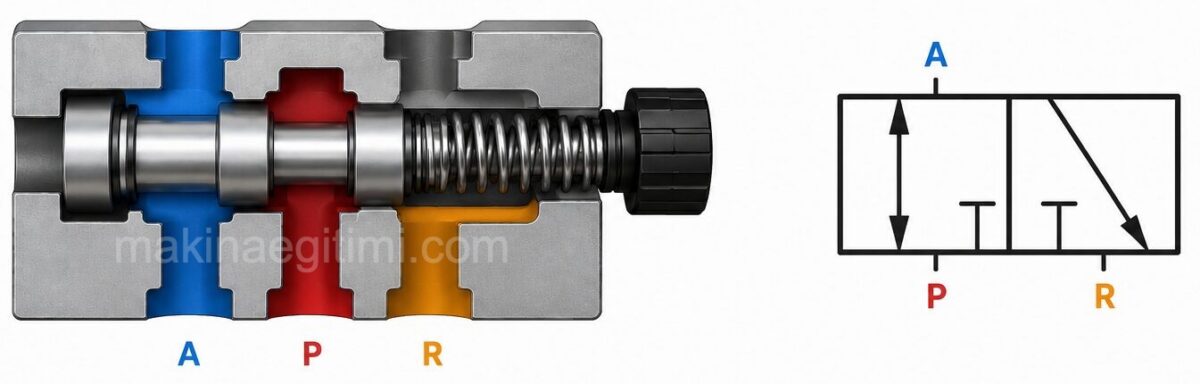
An example of a 3-way, 2-position directional control valve and its symbol (above)
A: Actuator (working) port P: Pressure line R: Return line
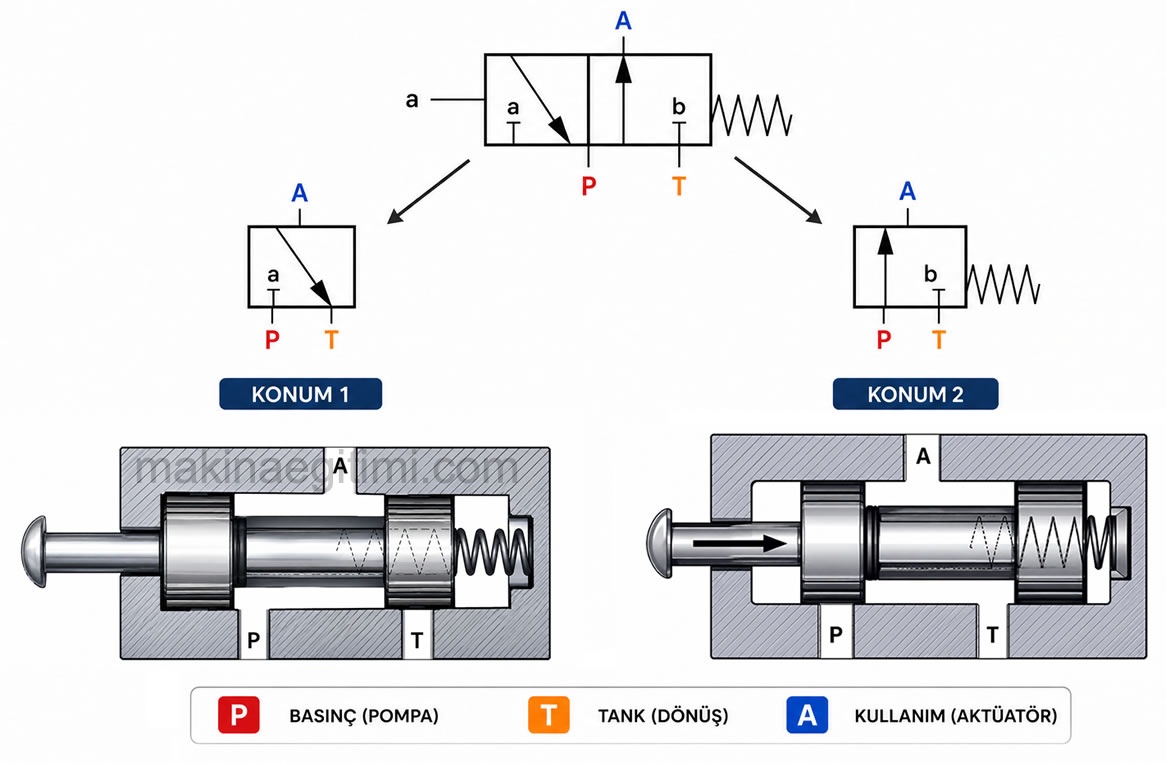
The figure above shows a normally open, push-button operated, spring-return 3/2 directional control valve.
The image on the right shows the valve’s normal (default) position, in which the pressure path is open. In the image on the left, the button has been pressed and the pressure line (P) has closed. If we imagine this valve connected to a piston, the oil in the piston will return to the tank via the A and T lines, and the system pressure will drop to zero.
When we stop pressing the button, the valve will return to its previous position under the force of the spring, and the pressure line will reopen.
Three-Port Structure
3/2 directional control valves combine pressurizing and exhausting functions in a single valve with three connection ports.
Compatibility With Single-Acting Cylinders
3/2 valves are commonly used to control the motion of single-acting pneumatic cylinders.
An Economical Solution
Since they have fewer ports, 3/2 valves offer an economical choice for simple applications.
What Are 3-Way, 2-Position Valves Used For?
If we’re designing a system that stops when we press a button and resumes running when we let go, we can consider using 3/2 directional control valves. Or the reverse — for a system that runs when the button is pressed and stops when it’s released.
A Center Point That Releases When the Pedal Is Pressed and Clamps When Released
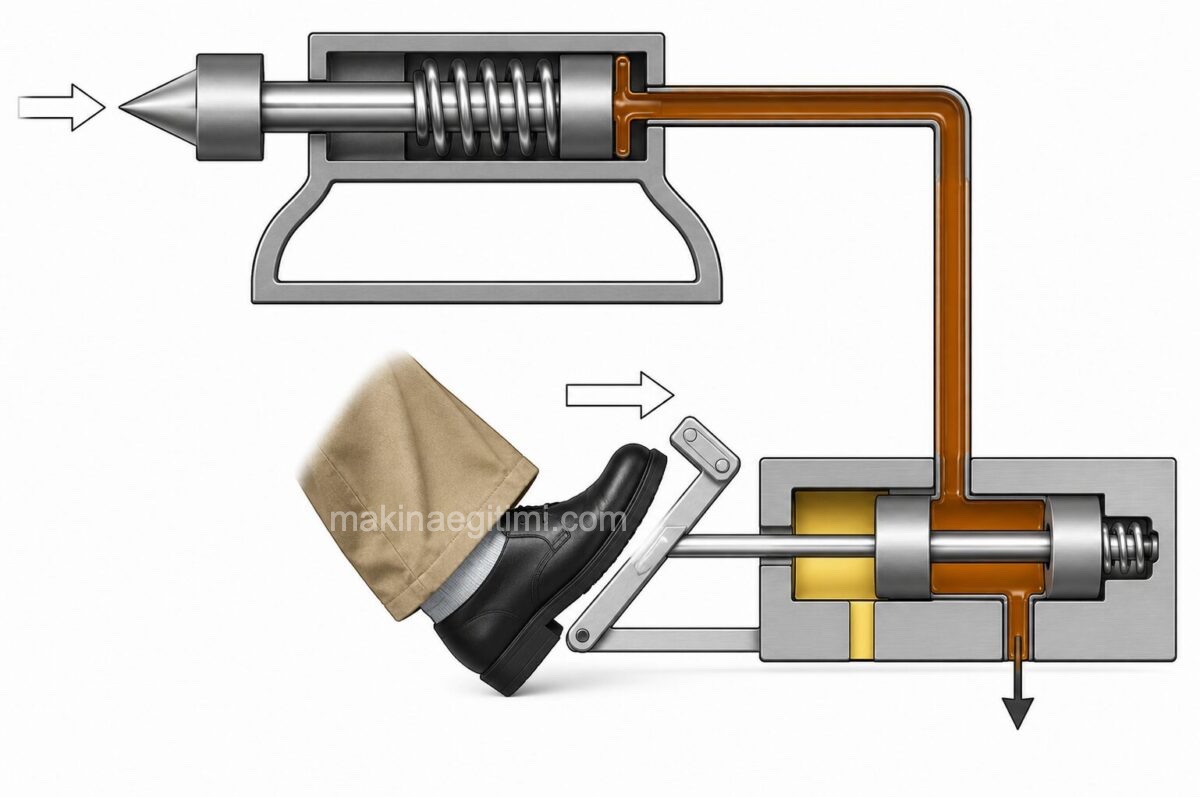
Let’s not picture this system only in linear-motion terms. If we imagine the directional control valve connected to a hydraulic motor instead of a piston, it could also be used to stop a lathe chuck.
A Hydraulic Lift That Rises When the Button Is Pressed and Lowers When Released

In the system above, the valve is normally closed. There is no pressure in the system, and all the oil in the piston has returned to the reservoir. The piston is in the down position.
When the button is pressed, the hydraulic directional control valve switches to its second position, the pressure line opens, and since the bottom of the cylinder fills with oil, the piston moves upward.
Again, since the valve has a spring return, when we release the button the valve returns to its previous position and the piston moves back down.
Video: 3-Way, 2-Position Directional Control Valve
A video covering 3-way, 2-position valves, one of the directional control valves commonly used in hydraulics-pneumatics:
Related Questions
3/2 directional control valves combine pressurizing and exhausting functions in a single valve with three connection ports.
3/2 valves are commonly used to control the motion of single-acting pneumatic cylinders.
Since they have fewer ports, 3/2 valves offer an economical choice for simple applications.
Related Posts
 Pneumatic Dryers and Air Drying Methods
 Force Calculations in Pneumatic Cylinders
 4-Way 2-Position Directional Control Valves
 Calculating the Moisture Content of Compressed Air
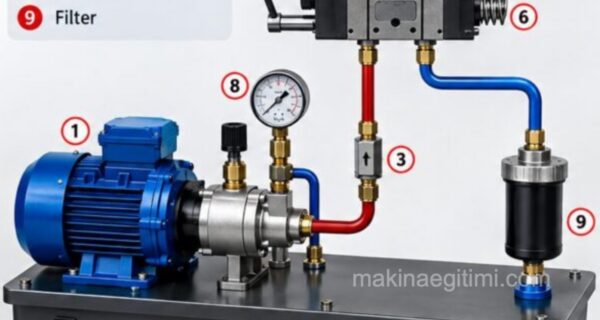 Parts of a Hydraulic Circuit, Illustrated
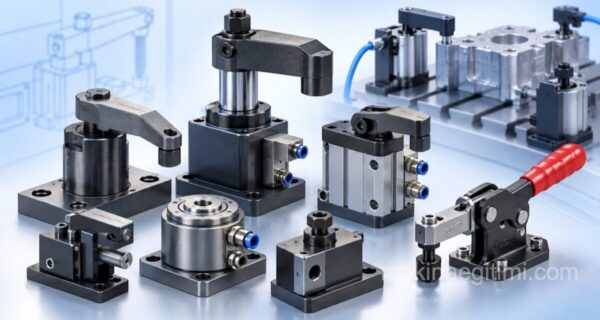 Hydraulic Pneumatic Clamping Elements
 Types of Hydraulic Pumps
 Basic Physics and Laws for Pneumatics