
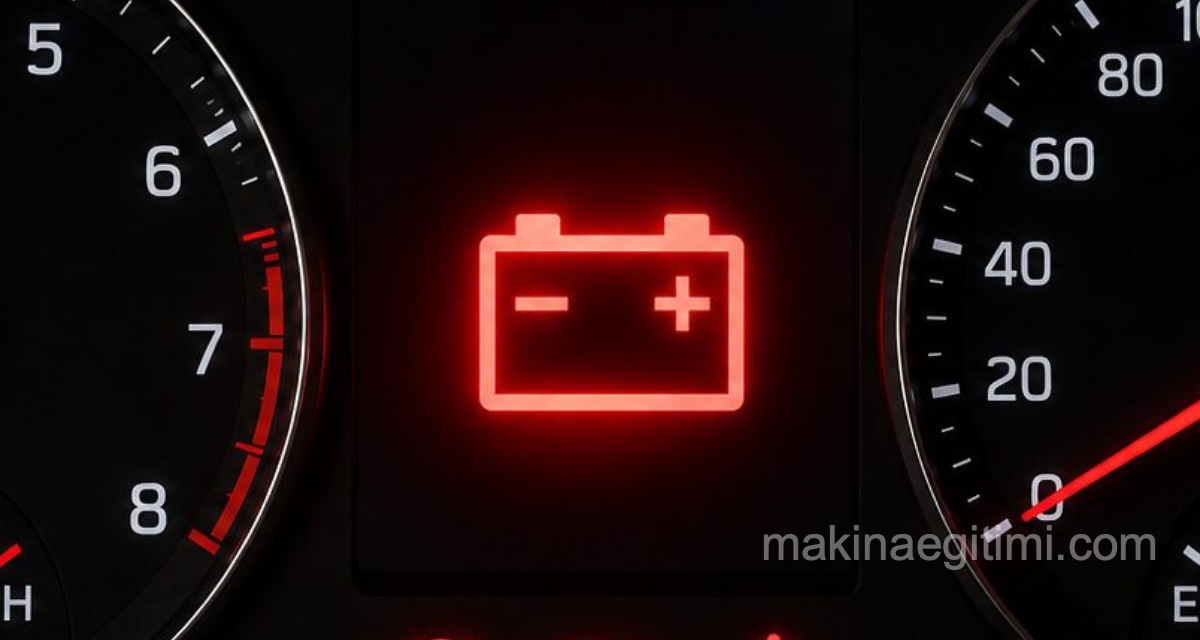
Why Does the Battery Warning Light Come On?
Most people who see this warning think the problem must be directly related to the battery itself, but the battery may not actually be the reason this warning light comes on.
If the battery warning light stays on while the engine is running, there can be several reasons for this. There could be a battery fault. The battery could be completely dead.
There could also be a charging system fault. The alternator could be faulty; the alternator should be removed and all its parts checked, especially the brushes and windings.

The alternator belt could be loose. Since the alternator gets its motion from the drive belt, a loose belt won’t spin fast enough to supply the current needed to charge the battery.
There could be a fault caused by the charging regulator; if there’s no other problem in the circuit and the battery still isn’t charging, the fault is most likely caused by the voltage regulator being set too low.

The battery itself could be faulty; if the battery has sulfated or one of the terminal connections has an open connection, the battery can’t be fully charged even under normal operating conditions.
Here, we’ll focus on topics like diagnosing a battery fault and figuring out whether the battery is dead.
Terminal Corrosion
A white/green layer of corrosion on the battery terminals can block electrical flow and cause the warning light to come on.
Average Battery Life
A standard car battery typically lasts around 3-5 years, depending on usage conditions.
Distinguishing the Charging System
The battery warning light can sometimes point to an alternator fault rather than the battery itself.
Signs of a Battery Fault
You can find out whether the charging system is working, or whether the battery is faulty, by using a voltmeter. We set the voltmeter to DC (20) current for the measurement.
Connect the voltmeter to the battery and start the engine. Watch the voltage reading on the voltmeter — the engine should be idling at around 1000 RPM. If the reading is around 14 volts, we can say the charging system is working.
Turn on the car’s headlights and check again. The voltage shouldn’t drop below around 13.6.

Increase the engine RPM. The voltage shouldn’t rise above 14.2 (depending on the capacity of the charging system, the regulator voltage can run a bit higher — 14.2 to 14.8 is normal).
If the headlights dim when you take your foot off the gas pedal while the engine is running, the battery may be weak.

If there isn’t enough power for the starter to crank the engine, the battery may have reached the end of its life and can no longer accept a charge. To check this, set the voltmeter to DC 20. With the engine off, measuring the battery with the voltmeter should show a value around 12 to 12.6 volts. If the reading is lower — values like 6, 7, 8, 9, or 10 — it means one or more of the battery’s plates has failed. The battery needs to be replaced with a new one.
Why Is the Battery’s Voltage Low?
A battery has 6 cells. Each cell has a voltage of 2.1. If one or more of the cells fails, the voltage reading comes out low.
Is the Problem the Battery or the Alternator?

This electrical fault can originate from either the battery or the alternator. To find out which:
Start your vehicle, then as quickly and safely as possible disconnect the battery cables and wait. If the alternator is struggling to power the system on its own, the vehicle will stall after a while, and the problem is the alternator.
If your vehicle keeps running, the problem is coming from the battery.
Checking Whether the Battery Is Still Good
In some cases, your vehicle’s battery may be completely dead. Is the battery still good, or has it died? We can find out whether the battery has reached the end of its life with this test:

Connect a voltmeter set to DC 20 to a battery that reads 12 volts but doesn’t have enough power to start the car, then crank the starter. If the voltage drops below 9.6, the battery has reached the end of its life. If the voltage stays above 9.6, the battery is still good, but it likely just needs to be charged.
One more thing worth noting: you can tell a battery is about to die when it takes a long time to charge. After this happens, the battery usually becomes completely unusable shortly after.
In this article, we tried to answer the question of why the battery warning light comes on. We covered signs of a battery fault and how to test the battery. What the battery’s voltage should be. Why battery voltage runs low. And how to check whether the battery is still good. See you in our next articles.
Related Questions
This light actually monitors the whole charging system; a fault in a different component, like the alternator, regulator, or belt, can trigger the same light. That’s why, when the light comes on, you need to look at the whole charging system, not just the battery.
When the belt is loose, it starts to slip and can’t spin the alternator at its designed speed. An alternator spinning too slowly can’t produce enough current to charge the battery.
Related Posts
 How Does a Vehicle’s Charging System Work? Components, Jobs, and Failures
 Information About Vehicle AC Maintenance
 Diagnosing and Fixing Shock Absorber Faults
 How to Tell the Fuel Pump Has a Fault? Diagnosis
 Alternator (Charging Dynamo) Faults
 Changing Spark Plugs. How Is a Spark Plug Change Done?
 Spark Plug Oil Fouling: Causes and Symptoms
 The Cause of Bad Smells From a Cars AC and How to Fix It