
In this article we’ll talk about HSS, high-speed steels. The composition of high-speed steels. Heat treatment of high-speed steels. What HSS stands for. We’ll cover details such as the properties of HSS steel and where HSS is used. Our topics are as follows:
High-Speed Steels
What is high-speed steel?
High-speed steel, also known as “seri çelik” in Turkish, is the steel used for making cutting tools that operate at high cutting speeds. Unlike air-hardening steel, it retains its cutting ability. Cutting operations at speeds of 50 m/min can be done with these steels. The cutting edge continues to cut even if it’s heated up to annealing temperature.

This material is also known as air-hardening steel and is used in knife manufacturing. After processing it’s called “speed steel,” but it’s also widely known on the market as “high-speed steel.”
Composition of High-Speed Steels
The composition of high-speed steels generally consists of 0.6-0.8% carbon, 3-5% chromium, and 14-20% tungsten.
Besides these, the structure may also contain vanadium, cobalt, and molybdenum.
Vanadium is added to improve and enhance the cutting properties of speed steels, and to increase their ability to air-harden. Even though molybdenum makes the steel more brittle, the steel’s carbon content is preserved. This element is successful in cutting highly abrasive materials. Cobalt is added to superior-grade speed steels.
High-Speed Steels – Heat Treatment
Heat treatment of high-speed steels is done at quite high temperatures, around 1150-1350°C. Parts are heated up to 850 degrees. This way, oxidation is prevented while they’re brought up to annealing temperature. Then cooling and hardening operations are carried out. Cooling can continue in air or in oil.
High Temperature Resistance
HSS (High Speed Steel) is a special alloy steel type that can retain its hardness despite the heat generated at high cutting speeds.
Tungsten and Molybdenum Content
HSS steels generally contain tungsten, molybdenum, and vanadium to increase hardness and wear resistance.
Flexibility Compared to Carbide Tools
Because HSS tools are less brittle than carbide tools, they’re preferred for interrupted cuts and operations with vibration.
HSS
HSS is short for the English term “High Speed Steel.” It means “yüksek hız çeliği” in Turkish.
HSS Cutting Tools
HSS cutting tools are steel cutting tools containing 6-9% molybdenum, 1.5-6% chromium, and 15-22% tungsten. Their quality and durability are at a medium level. They can withstand temperatures up to about 600°C. They’re widely used in practice.

Properties of HSS Steels
The most important property of HSS steels is that they don’t lose their properties even at high temperatures up to 600°C. Since high-speed steels air-harden, they retain their hardness as they cool from high temperature down to room temperature.
Where Is HSS Used?
HSS is efficiently used in machining medium-hardness steel, cast materials, and non-metallic materials.
In machining production, after CNC machine tools started being used widely, reaching higher rotational speeds and feed rates gradually reduced the importance of these steels.

All shapes of small-diameter end mills used in industry, and only the cutting tips of large-diameter end mills, are manufactured from speed steel. Their hardness is around 62-64 Rc. (Rc = Rockwell C)

Cutting tools made from speed steel are used for machining all materials that haven’t undergone heat treatment. Their cutting speeds are quite high compared to tool steels. Using cutting fluid also extends the cutting tool’s life.

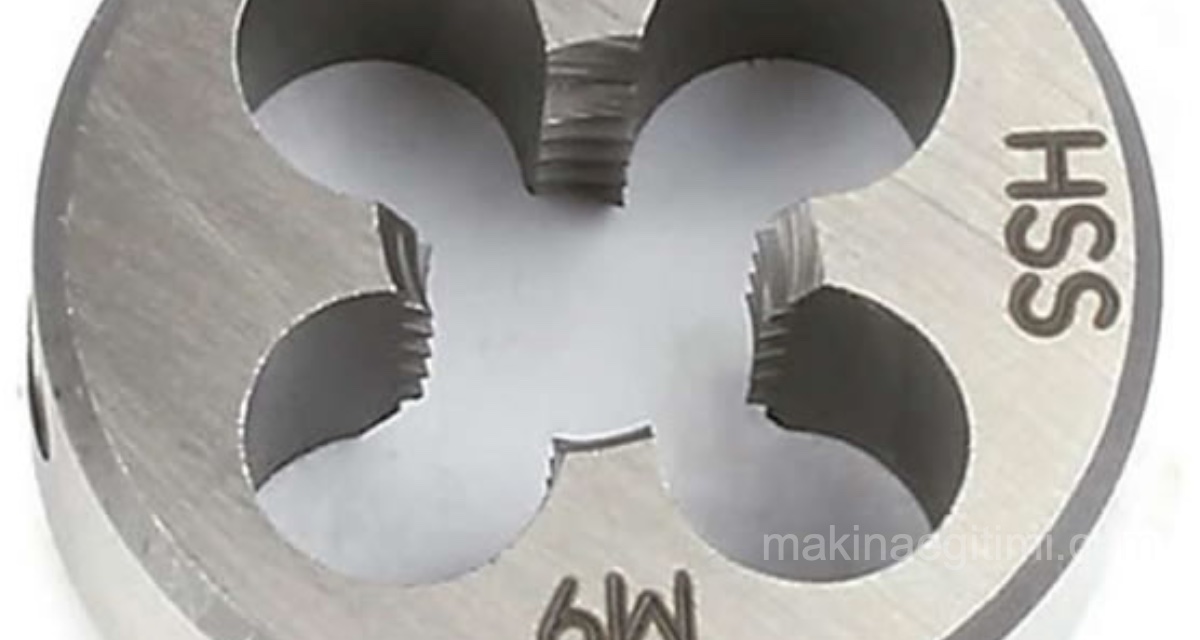
HSS tap (above)

HSS Die Stock (above)
Types of HSS Steels
The types of HSS high-speed steels are:
1 — Those whose main alloying element is tungsten,
2 — Those whose main alloying element is molybdenum.
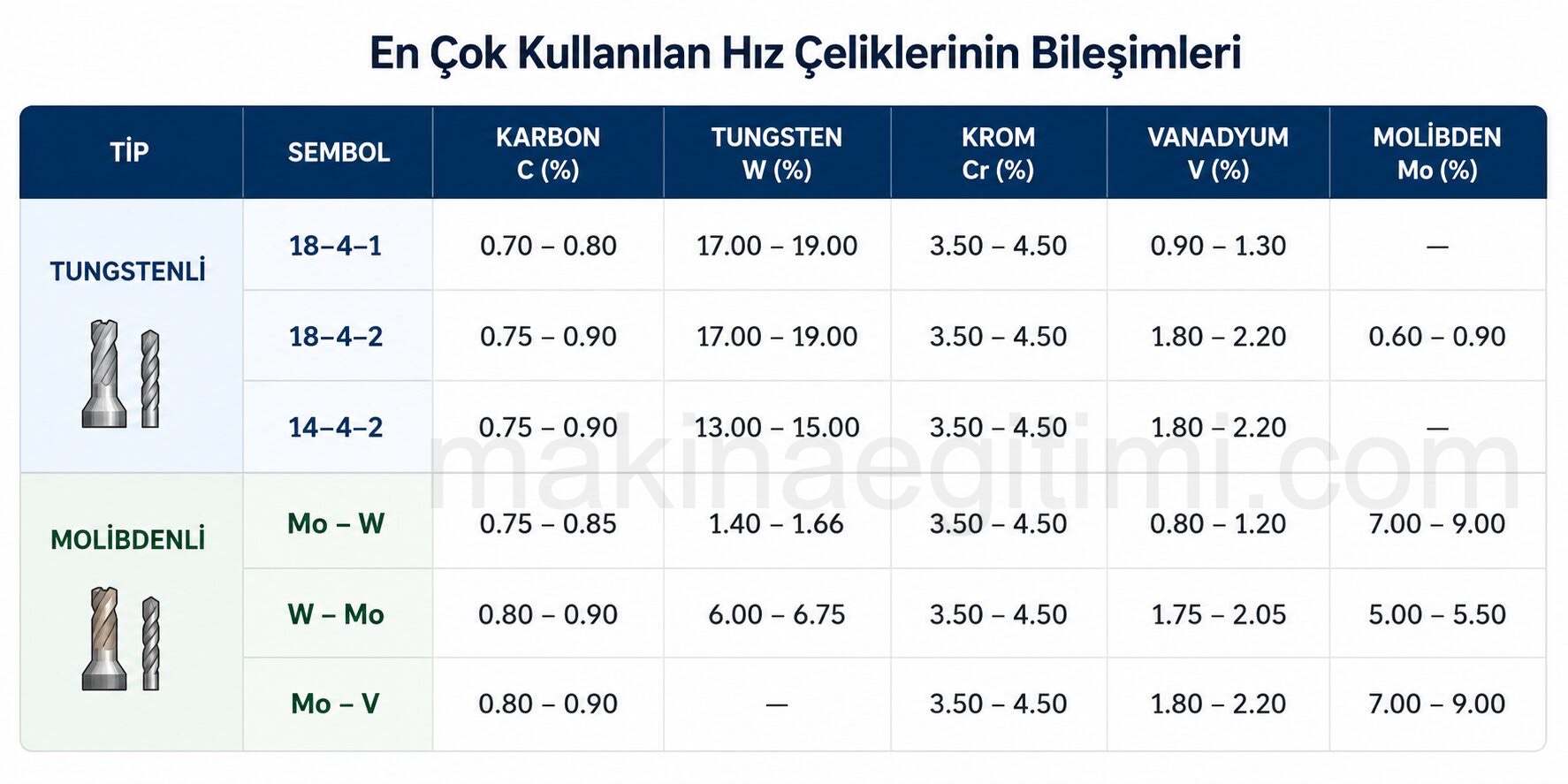
The tungsten type was made first. Molybdenum-based ones weren’t known earlier; they were first brought forward by Americans during World War I due to a tungsten shortage. There’s still no definitive judgment on which of these two groups is better. The most commonly used composition types are shown in the table.
Even if the cutting edges of tools made from these steels approach red-hot temperatures during operation, they remain fit for use.
Whereas carbon tool steels and low-alloy steels lose their temper under these conditions and immediately wear out.
A tool made from speed steel, on the other hand, regains its original hardness if allowed to cool at normal temperature, as long as it wasn’t taken above roughly 590 degrees.
Speed steels are shaped by the same methods as other steels, and are sold on the market as annealed and normalized bars.
Their Brinell hardness in the annealed state is between 200-250.
Carbon and low-alloy tool steels, on the other hand, are between 170-200.
Service Life of HSS Steel
If the cutting edges of tools made from high-speed steel are given a “hard chrome” plating, the tool’s life increases 2-10 times, depending on the machined material and the type and thickness of the chrome plating.
Speed steels also harden in air. This reduces the risk of distortion and cracking. There is still some volume change. Their transformation points are higher than other steels.
Speed steels are among the most widely used machining materials. The main reasons for this are:
1 — They have red-hardness (they retain hardness at red-hot temperatures).
2 — Their wear resistance is higher than other tool steels.
3 — Because of their red-hardness property, the desired shape can be given by grinding without creating a soft surface.
4 — Speed steels are suitable for hardening by “nitriding.” This increases the tool’s life by 50-200%.
5 — Their ability to harden is high.

HSS countersink drill (above)
Cobalt High-Speed Steels:
Adding cobalt to high-speed steels increases the tool’s wear resistance. This makes it possible to machine harder materials more easily and at higher cutting speeds. However, cobalt speed steels are more brittle and more expensive. For this reason, using these steels is suitable in places where working with standard high-speed steels is not economical.
Stellites
Invented by “Haynes” in 1907. “Stellite” is not a steel, but an alloy composed of chromium, cobalt, tungsten, and some iron and carbon.
Their composition is as follows:
12-20% tungsten,
35-50% cobalt,
25-35% chromium, with the remainder being iron and 1.8-2.15% carbon.
Stellites can only be shaped by casting or grinding. They don’t require heat treatment. Their hardness at room temperature is 60-62 Rockwell C, or about 600 Brinell. They’re brittle and crack easily. It’s possible to machine them with carbide tools, but this operation is very difficult.
Related Questions
The alloying elements it contains, such as tungsten and chromium, form special carbides that allow the material to retain its hardness even at high temperature. This property lets HSS keep cutting, unlike ordinary steels which soften and dull when heated.
Vanadium improves the steel’s cutting properties and increases its ability to self-harden in air. This addition helps both keep the tool sharper and make the manufacturing process easier.
Related Posts
 Brinell Hardness Testing Method
 Vickers Hardness Testing Method
 Factors That Make Welding Stainless Steel Difficult
 Electrodes Used for Welding Stainless Steels
 Material Types and Their Properties (per DIN Standard)
 Plain Carbon (Unalloyed) Steels
 Rockwell Hardness Testing Method
 Heat Treatments Applied to Cast Iron