
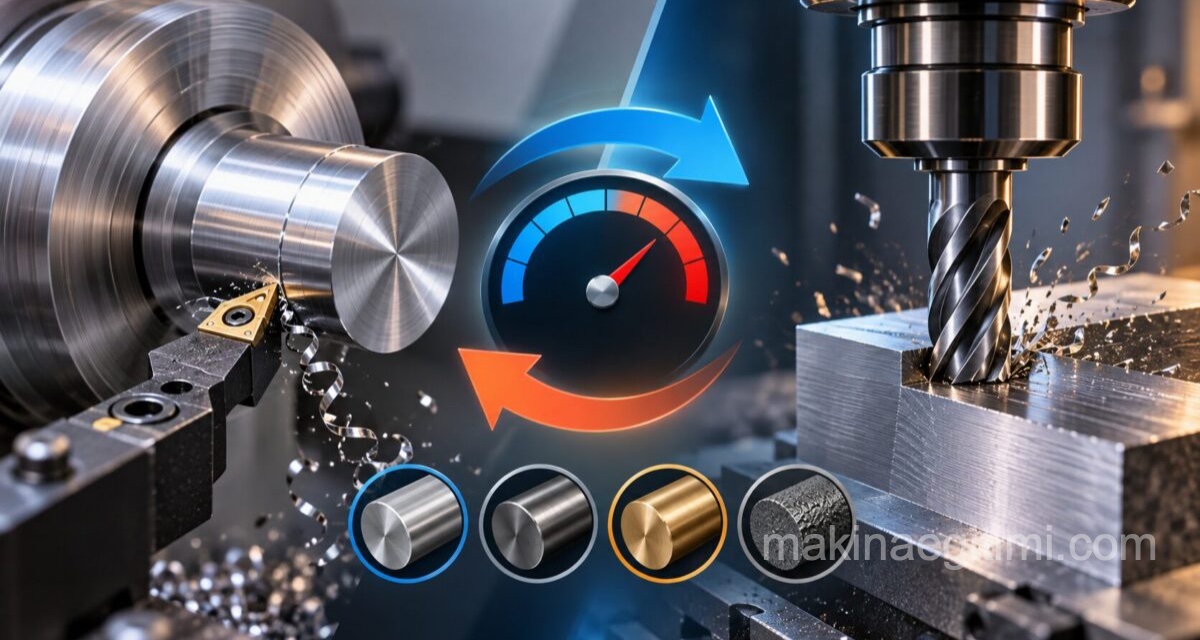
Finding the right spindle speed (n) on a lathe or milling machine directly affects both tool life and surface finish. Too low a speed wastes time and lowers productivity; too high a speed overheats the cutting edge, shortening its life or even breaking it. With the interactive calculator below, you can enter the cutting speed (Vc) and the workpiece or tool diameter (D) to find the correct spindle speed and feed rate (Vf) in seconds.
What Are Cutting Speed and RPM?
Cutting speed (Vc) is the distance the cutting edge travels relative to the workpiece surface per unit time, expressed in meters per minute (m/min). This value depends on the material being machined and the tool material (HSS or carbide) — each material has a cutting-speed range where efficient cutting is possible without prematurely wearing out the tool. Spindle speed (n) is how many revolutions per minute the spindle or tool makes (rpm), calculated from the cutting speed using the workpiece or tool diameter.
How Is Spindle Speed Calculated?
Spindle speed is calculated with the formula n = (1000 × Vc) / (π × D). Here, Vc is the cutting speed (m/min), and D is the workpiece diameter (for turning) or tool diameter (for milling) in mm. For example, to turn a 30 mm diameter workpiece at a cutting speed of 25 m/min: n = (1000 × 25) / (π × 30) ≈ 265 rpm.
The feed rate (Vf) is calculated once the spindle speed is known. For turning, Vf = f × n (f: feed per revolution, mm/rev); for milling, Vf = fz × z × n is used — where fz is the feed per tooth and z is the number of teeth on the tool. Feed rate determines how fast the machine moves along the workpiece and directly affects machining time.
Cutting Speed – RPM Calculator
In the tool below, first choose Turning or Milling mode, then select the material you’re machining from the list to get an automatic cutting-speed suggestion (you can also edit the Vc value manually). Choosing the tool material (HSS or carbide) updates the suggestion accordingly. Once you enter the diameter and feed values, the spindle speed and feed rate are calculated instantly, with the gauge needle and spinning icon reflecting the speed visually.
Values are approximate, for educational reference only; in real production, follow the values recommended by the tool and material manufacturer.
Why Does Cutting Speed Matter?
- Tool life: an excessively high cutting speed wears out the cutting edge quickly, leading to frequent tool changes.
- Surface finish: an incorrect spindle speed can leave chatter marks or roughness on the workpiece surface.
- Efficiency: too low a cutting speed unnecessarily lengthens production time and raises cost.
- Safety: a tool running at excessive speed increases the risk of breakage and flying debris.
The Difference Between Turning and Milling
In turning, the workpiece rotates while the cutting tool stays fixed, so the diameter value belongs to the workpiece. In milling, it’s the opposite — the tool rotates while the workpiece is generally fixed, so the diameter value belongs to the tool itself. This difference changes what D means in the formula, which is why the calculator below has two separate tabs (Turning / Milling), and the milling mode also asks for the tool’s tooth count (z).
Frequently Asked Questions
Cutting speed depends on the material being machined and the tool material used (HSS or carbide). The material list in the calculator above suggests typical educational reference values for common materials; in real production, follow the tool manufacturer’s catalog values.
If the calculated spindle speed exceeds your machine’s maximum, you’ll need to either lower the cutting speed or select the nearest speed step your machine allows. Running beyond the machine’s capacity can damage both the tool and the machine.
Milling tools have multiple cutting teeth, and each tooth cuts separately within one revolution. Since tooth count is a multiplier in the feed-rate formula, a tool with more teeth produces a higher total feed rate at the same feed-per-tooth value.
HSS (high-speed steel) tools are cheaper and tougher, but suited to lower cutting speeds. Carbide tools can operate at much higher cutting speeds and temperatures, increasing production speed, but they’re more brittle and prone to chipping on impact.
Feed rate determines how fast the tool moves along the workpiece and directly affects machining time. Too high a feed rate can damage surface finish and overload the tool; too low a value unnecessarily extends production time.
Finding the right spindle speed and feed rate is the foundation of a machining process that’s both high-quality and efficient in turning and milling operations. Use the calculator above to quickly get a reference value for your own workpiece, then fine-tune it to your machine’s actual capacity.
Related Posts
 How to Calculate Cutting Speed, Feed and Spindle RPM: A Practical Guide With Worked Examples
 Micrometer Reading Examples
 Cutting Large-Lead Helical Flutes on a Milling Machine
 Work Instructions for a Bench Grinder
 Cutting a Square Thread on a Lathe
 Lathe Tool Angles and Their Effect on Surface Quality
 Causes of Cutting Tool Wear in Milling
 Vernier Caliper Simulator