
Close Menu
  • MAKİNELER ve İMALAT
    • Tools & Equipment
    • Computer-Aided Drawing
    • CAD/CAM Education
    • CNC Machine Programming
    • Casting Technologies
    • Electrical & Electronics Technologies
    • Hydraulics & Pneumatics
    • Manufacturing Processes
    • Manufacturing Technologies
    • Occupational Safety
    • Mold & Die Design
    • Solid Modeling
    • Welding Technology
    • Machine Elements
    • Mechanical Trade Drawing
    • Materials Science
    • Automotive & Vehicle Technologies
    • Robotics Technologies
    • Health Technologies
    • Defense & Aerospace Technologies
    • Descriptive Geometry
    • Technical Drawing
    • Software & Hardware Technologies
    • Innovative Manufacturing Methods
  • TEKNOLOJİ ve YAŞAM
    • OTOMOBİLLER ve TAŞIT
      • Vehicle & Engine Knowledge
      • Safe Driving
      • Sürüş Destek Sistemleri
    • Genel Kültür
      • Movies & TV Shows
      • Görsel ve Grafik Sanat
      • Books & Literature
      • Music
      • Sports
      • History
      • History of Technology
    • GÜNDELİK YAŞAM TEKNOLOJİLERİ
    • Hobbies & Entertainment
    • Internet Technologies
    • Health
    • Mobile Technologies
Makine Eğitimi
  • Machines & Manufacturing
    Machine Elements
    Hydraulics & Pneumatics
    Technical Drawing
    Computer-Aided Design & Manufacturing
    Basic Manufacturing Processes
    Manufacturing Processes
    Industry Technologies
    Other Technical Courses
    Motion & Power Transmission
    Simple Machines
    Chains & Sprockets
    Shafts & Journals
    Gears
    Cams
    Couplings
    Belts & Pulleys
    Springs
    Bearings
    Keys
    Fastening Joining
    Retaining Rings
    Screws, Bolts & Nuts
    Cotter Pins
    Flanges
    Welding
    Rivets
    Pins & Bolts
    Washers
    Calculators
    Gear Ratio Calculator
    Spring Constant Calculator
    Belt Pulley Ratio Calculator
    Other Machine Elements
    Slides & Linear Guides
    Brakes
    Flywheels
    Clamps
    Shock Absorbers
    Gaskets & O-Rings
    Seals & Sealing Elements
    Hydraulics
    Introduction to Hydraulics & Principles
    Hydraulic Systems & Applications
    Accumulators
    Filters
    Motors
    Pumps
    Valves
    Pneumatics
    Introduction to Pneumatics & Principles
    Pneumatic Systems & Applications
    Pneumatic Circuit Components
    Valves
    Cylinders
    Silencers
    Motors
    Compressors
    Dryers
    Conditioning Units
    Common Topics & Maintenance
    Hydraulic & Pneumatic Maintenance
    Study Notes, Exams & Tests
    Technical Drawing
    Introduction to Technical Drawing
    Geometric Drawings
    Perspective & Projection
    Orthographic Views
    Dimensioning
    Sectioning
    Assembly & Detail Drawings
    Tolerances
    Surface Finish Symbols
    Mechanical Engineering Drawing
    Screws, Bolts & Nuts
    Pulley Drawings
    Gear Drawings
    Shafts & Journals
    Bearing Drawings
    Pins & Bolts
    Spring Drawings
    Welds in Technical Drawing
    Washers
    Cotter Pins
    Technical Drawing Exercises
    Mechanical Drawing Exercises
    Gear Exercises
    View Extraction Exercises
    Pulley Exercises
    Pin & Bolt Exercises
    Threaded Fastening Exercises
    Descriptive Geometry
    Computer-Aided Drawing
    AutoCAD Drawing Lessons
    Solid Modeling & Animation
    Solid Model Drawing Files
    Solid Model Assembly Examples
    Solid Model Drawing Lessons
    3D CAD Software Reviews
    Solid Modeling Exercises
    CNC Programming
    CAM
    Measurement & Inspection
    Dial Indicators
    Calipers
    Gauges
    Micrometers
    Materials Science
    Steels
    Cast Iron
    Aluminum
    Plastics
    Material Testing & Hardness Measurement
    Occupational Safety
    Workshop Safety
    Safety When Working With Electricity
    Machine Safety Rules
    Hand Operations
    Filing
    Marking
    Cutting Operations
    Reaming
    Tapping
    Threading With a Die
    Drill Bit Sharpening
    Working With Machines
    Basic Turning Operations
    Basic Milling Operations
    Shaper Machine
    Machining
    Turning
    Milling
    Grinding
    Innovative Manufacturing Methods
    EDM (Electrical Discharge Machining)
    Laser Machining
    Waterjet Machining
    3D Printing
    3D Scanners
    Welding
    Rolling
    Casting
    Mold & Die Design
    Mechanical & Hydraulic Presses
    Blanking & Piercing Dies
    Bending Dies
    Drawing Dies
    Plastic Injection Molds
    Extrusion Dies
    Compound Dies
    Progressive Dies
    Blow Molds
    Spinning Dies
    Spray Molds
    Manufacturing of Machine Parts
    Automotive & Vehicle Technologies
    Motor Vehicle Manufacturing
    Raw Material Production
    History of Technology
    Health & Medical Technologies
    Defense & Aerospace
    Robotics Technologies
    Software & Hardware Technologies
    Mechanics - Strength of Materials
    Physics Topics
  • Technology & Life
    Hobbies & Entertainment
    Sports
    Music
    Vehicle & Engine Knowledge
    Vehicle Maintenance & Repair
    Safe Driving
    Driver Assistance Systems
    History
    Movies & TV Shows
    Books & Literature
    Computers & Internet
    Computer Tips
    Software Reviews
    Hardware & Peripherals
    Practical & Safe Internet Use
    Visual & Graphic Art
    Mobile Technologies
    Travel
    Science
    Health
    First Aid Knowledge
    Everyday Technologies
Makine Eğitimi
Home»Books & Literature»What Is Editing? What Does a Book Editor Actually Look At?
30 August 2026

What Is Editing? What Does a Book Editor Actually Look At?

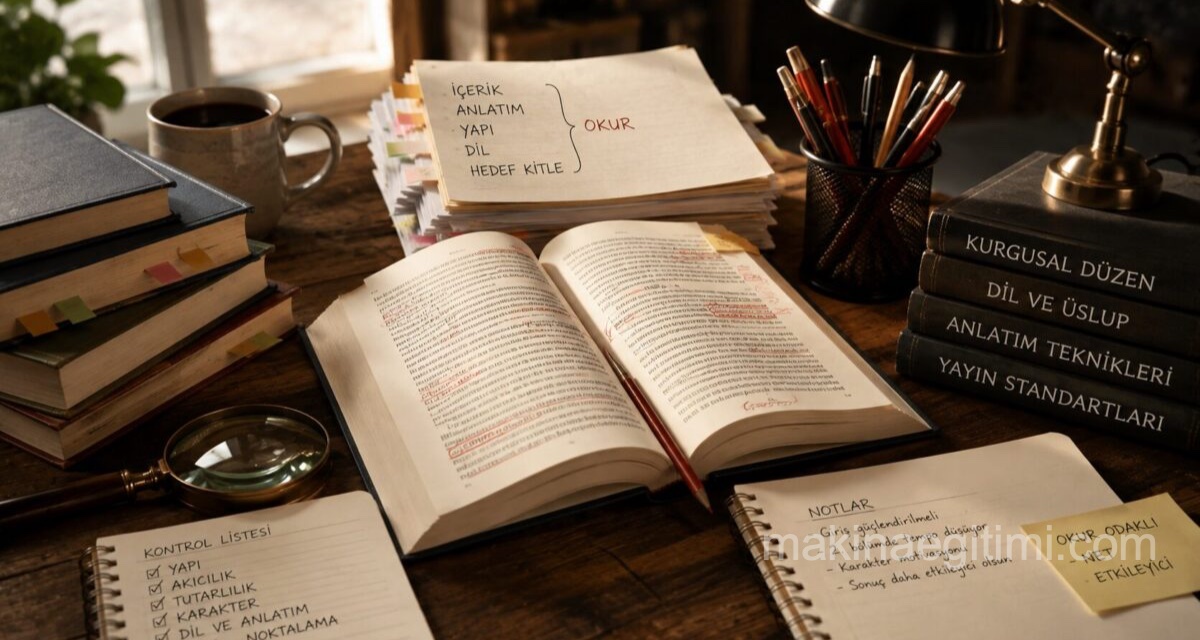
manuscript page with editing notes marked in red pen

Dear readers, today we’ll tell you about editing — the most invisible yet most critical profession behind the scenes in publishing. Most readers ask “What does editing mean?” while assuming the book in their hands came solely from the author’s pen. In reality, the text that travels from a writer’s desk to the printing press passes through many eyes along the way, and the most important of those eyes belongs to the editor.

  • What Does an Editor Actually Do?
  • Content Editing: Looking at the Skeleton of the Story
  • Line and Copy Editing: Looking at the Text Sentence by Sentence
  • Proofreading: The Final Check Before Publication
  • Editor or Copyeditor?
  • What Should a Good Editor’s Relationship With a Writer Look Like?
  • Frequently Asked Questions

What Does an Editor Actually Do?

In its simplest definition, an editor is the person who works with a writer to get their text ready for publication. But that definition doesn’t really capture the true complexity of the job. A good editor tries to preserve the artistic integrity of the text while also keeping an eye on the reader’s expectations and the publisher’s commercial priorities. That’s why editing is described as a field where art, craft, and commerce intersect.

An editor’s job varies depending on the type of book and the publisher’s workflow, but it generally consists of a few main stages. A book editor typically works on the text at three different levels: content, language, and proofreading.

Content Editing: Looking at the Skeleton of the Story

Content editing (also called “developmental editing” at some publishing houses) focuses on the deepest layer of the text. The content editor looks for answers to questions like these:

  • Are the characters consistent, and can the reader believe in them?
  • Are there gaps or contradictions in the plot?
  • Is the pacing right — which sections drag on unnecessarily, and which feel rushed?
  • Does the book’s central theme and message come across clearly to the reader?

At this stage, the editor may intervene directly in the writer’s plot; scenes may be rewritten, characters merged, or even entire sections cut altogether. This is the most demanding and most debated stage of the process, because the editor is trying to strike a balance between the writer’s creative vision and the reader’s expectations.

Line and Copy Editing: Looking at the Text Sentence by Sentence

Once the content is approved, it’s time for line editing (copy editing). At this stage, the editor’s focus shifts from the story as a whole to the sentences themselves:

  • Grammar and punctuation errors
  • Repeated words or phrases
  • Sentence flow and clarity of expression
  • Consistent use of terms and names throughout the book

Proofreading: The Final Check Before Publication

Once the text has gone through typesetting and taken on its page layout, the proofreading stage kicks in. No major changes are made at this point; the goal is to catch spelling errors, typesetting shifts, page-number mistakes, and small details that slipped through earlier. Proofreading is the book’s final quality check before it meets its readers.

Editor or Copyeditor?

In the Turkish publishing industry, the words “editör” (editor) and “redaktör” (copyeditor/proofreader) are sometimes used interchangeably, but they actually refer to different roles. The editor is generally the person who deals with content and structure, working one-on-one with the writer. The “redaktör,” on the other hand, focuses more on grammar, punctuation, and phrasing corrections, performing the technical check before the text reaches its final form. At smaller publishing houses, these two roles are often combined in a single person.

What Should a Good Editor’s Relationship With a Writer Look Like?

Editing isn’t just a technical corrections job — it’s also a relationship of trust. A writer becomes vulnerable the moment they hand their text over to someone else; the editor’s job is to be mindful of that vulnerability while still offering honest, constructive criticism. Many classics of world literature took their final form thanks to this dialogue between writer and editor; in American literature, for example, the way Maxwell Perkins worked with F. Scott Fitzgerald and Ernest Hemingway is one of the best-known examples of how editing can be just as creative a labor as writing itself.

Frequently Asked Questions

Editing is the process of reviewing a writer’s text in terms of content, language, and form to get it ready for publication.

A book editor typically gets involved at three stages: content editing (plot and characters), line editing (sentences and grammar), and proofreading (the final check before publication).

An editor generally focuses on the content and structure of the text, while a copyeditor focuses on technical corrections such as grammar and punctuation; at smaller publishing houses, these two roles are often combined in the same person.

Strong command of language, a broad reading background, the ability to analyze plot, and the ability to build a constructive dialogue with a writer are among the core qualities of a good editor.

Related Posts

mystery novel covers lined up on a dimly lit library shelf Don’t Die Without Reading Them: The 10 Best Mystery and Crime Novels blank notebook and fountain pen with morning light How to Start Writing a Book? Advice Backed by Science Philosophy books for beginners Learning to Think: Beginner’s Books on Philosophy portrait photo of Ernest Hemingway, bearded and pensive Master of the Short Sentence: The Life Story of Ernest Hemingway Kate Bush performing on Top of the Pops in 1978 in a red dress From a Novel to a Number One: The Story of the Song Wuthering Heights period painting depicting the fall of the Bastille In the Shadow of Revolution: 5 Books About the French Revolution black and white portrait photo of Dostoevsky Dostoevsky: A Life From a Death Sentence to the Summit of Russian Literature romantic era painting of a lone figure by a stormy sea The Age of Feeling, Not Reason: The Romantic Movement and Its Pioneers


Share. Facebook Twitter WhatsApp Tumblr Email Telegram Copy Link

Leave A Reply Cancel Reply

How Is a Diesel Particulate Filter Cleaned
How Is a Tire Changed? Changing a Vehicle Tire
  • Contact
  • Terms of Service
  • Privacy & Cookie Policy

Type above and press Enter to search. Press Esc to cancel.