
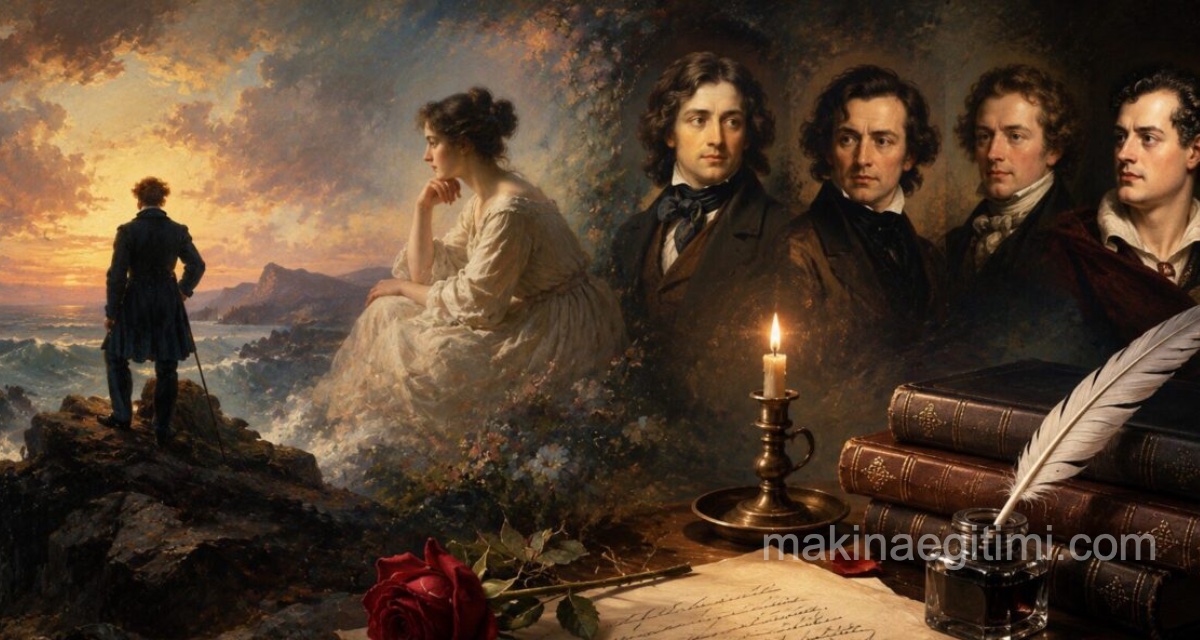
In this article, we’ll cover what the Romantic movement is, what traits define it, and which writers it influenced — from Goethe to Victor Hugo, we’ll tell the story of a literary movement in which emotion triumphed over reason.
Most people who ask “what is the Romantic movement?” confuse it with the everyday sense of the word “romance,” not realizing it was actually a far more fundamental revolution in thought. Romanticism was a rebellion of emotion, imagination, and the individual against an age that worshipped reason and rules.
What Is the Romantic Movement, and How Did It Begin?
Romanticism is a literary and artistic movement that emerged in Germany and England in the late 18th century and spread across all of Europe through the 19th century. It was born as a reaction to the excessive importance the preceding Age of Enlightenment placed on reason, logic, and universal rules. While Enlightenment thinkers viewed the world as a mathematical problem that could be solved, Romantic writers argued that a person’s inner world, emotions, and imagination could never be fully explained by reason.
The social upheaval brought on by the French Revolution also played a major role in the birth of Romanticism. The idea of freedom promised by the Revolution was transformed by artists into a search for individual liberty and self-expression.
What Are the Characteristics of the Romantic Movement?
When asked about the characteristics of Romanticism, a few core elements should come to mind:
- Emotion is superior to reason. For Romantic writers, what mattered wasn’t whether an event was logical, but the feeling it evoked.
- Nature is the mirror of the soul. Stormy seas, dark forests, ruined castles; nature was no longer mere backdrop but an element reflecting the character’s inner world.
- The individual and freedom are placed at the center. Heroes who rebelled against society’s rules and carved their own path were Romantic literature’s favorite figures.
- A longing for the past and the exotic. The Middle Ages, legends, distant lands; Romantic writers fled the ordinariness of daily life and took refuge in the world of imagination.
- Interest in nationalism and folk culture. Folk tales, epics, and local traditions gained renewed value during this period.
The Pioneering Writers of Romanticism
Johann Wolfgang von Goethe
Regarded as one of the most important pioneers of Romanticism, Goethe gave the movement one of its groundbreaking examples with “The Sorrows of Young Werther,” published in 1774. The novel tells the story of a young man driven to suicide by the pain of unrequited love, and it had such a powerful impact on Europe at the time that, following a wave of copycat suicides among young readers, the book was banned in some countries. This phenomenon came to be known in history as the “Werther effect.”
Victor Hugo
The strongest voice of French Romanticism, Victor Hugo carried the movement to its peak both through his poetry and through novels like “The Hunchback of Notre-Dame” and “Les Misérables.” The characters in Hugo’s works — outcast by society, flawed yet deeply emotional — most clearly reflect the importance Romanticism placed on the individual and on feeling.
Lord Byron
One of the most colorful figures of English Romanticism, Lord Byron embodied the movement’s rebellious spirit both through his life and his work. The concept of the “Byronic hero” arose from the type of character he created — charismatic yet tragic, at odds with society. This hero type went on to inspire countless literary and cinematic characters in the centuries that followed.
Mary Shelley
The writer who left her mark on the Gothic branch of Romanticism, Mary Shelley created one of the movement’s most striking explorations of the tension between reason and emotion with “Frankenstein,” published in 1818, questioning the limits of science and humanity’s intervention in nature. The novel is regarded today as one of the earliest examples of both Romanticism and the science fiction genre.
Traces of Romanticism in Turkish Literature
The Romantic movement also made its way into Turkish literature during the Tanzimat era, through Ottoman intellectuals. The passionate, emotional narration in Namık Kemal’s novel “İntibah” and his theatrical works carries traces of French Romanticism. Romantic themes concerning nature, death, and love also appear frequently in the poetry of Abdülhak Hamit Tarhan.
What Is the Difference Between Romanticism and Classicism?
To better understand Romanticism, it helps to compare it with Classicism, the movement that preceded it. While Classicism placed importance on reason, rule, and balance, Romanticism placed importance on emotion, freedom, and individuality. In classical works, characters often remained types, whereas in Romantic works, a character’s inner world and inner conflicts came to the fore. The tension between these two movements formed one of the most fertile grounds for debate in 19th-century European literature.
Frequently Asked Questions
Romanticism was born in Germany and England in the late 18th century and spread across all of Europe through the 19th century.
Johann Wolfgang von Goethe, Victor Hugo, Lord Byron, and Mary Shelley are among the best-known pioneers of Romanticism.
Placing emotion above reason, identifying nature with mood, valuing individual freedom, and a longing for the past are counted among the core characteristics of Romanticism.
Namık Kemal and Abdülhak Hamit Tarhan are important figures who carried traces of Romanticism into Turkish literature during the Tanzimat era.
Related Posts
 Dostoevsky: A Life From a Death Sentence to the Summit of Russian Literature
 Master of the Short Sentence: The Life Story of Ernest Hemingway
 Two Poets Who Lived the Fate They Wrote: Pushkin and Lermontov
 Learning to Think: Beginner’s Books on Philosophy
 Don’t Die Without Reading Them: The 10 Best Mystery and Crime Novels
 What Is Editing? What Does a Book Editor Actually Look At?
 When Fiction Becomes Reality: 6 Novels That Predicted the Future
 From a Novel to a Number One: The Story of the Song Wuthering Heights