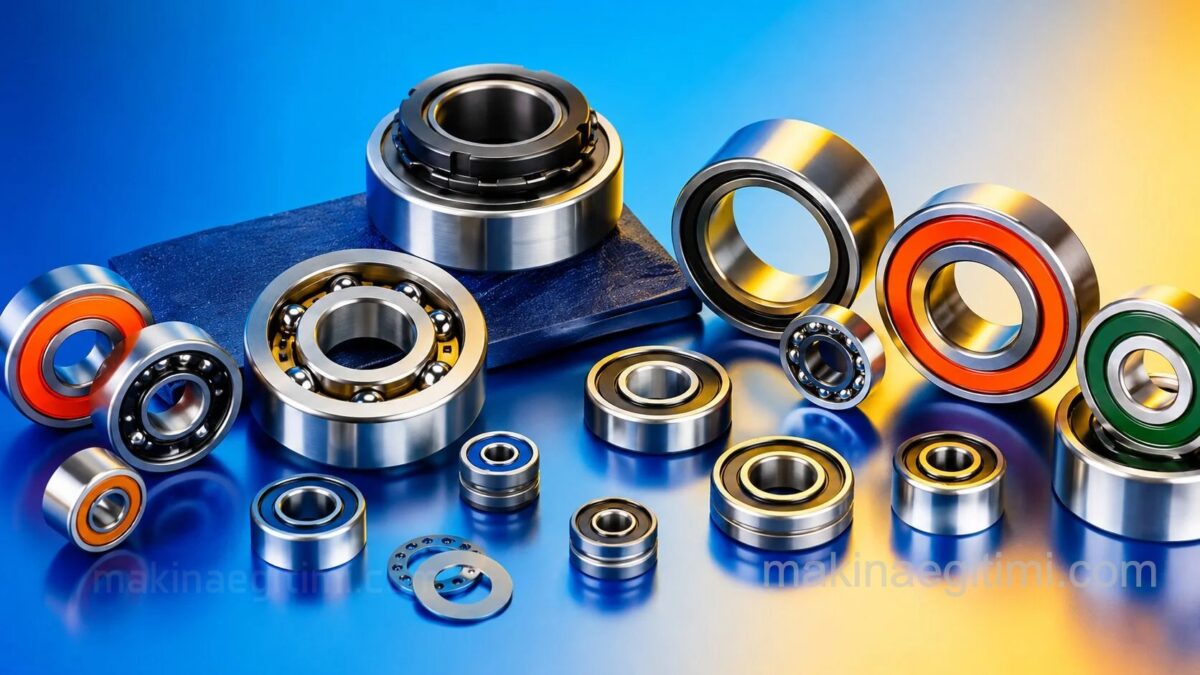
Bearings, as used in mechanical engineering terminology, are support elements that allow relative motion between two members in one or more directions with minimal friction, while resisting motion along the direction of the load. Bearings that support rotational relative motion, with rolling motion between their surfaces, are called rolling-element bearings (rolling bearings).
Bearings that carry radial force are called radial bearings, and those that carry axial force are called thrust (axial) bearings.
Structure of Rolling Bearings
A rolling bearing consists of an inner ring, an outer ring, rolling elements, and a cage.
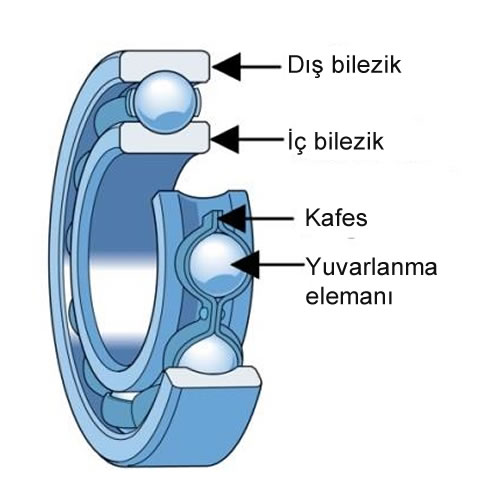
The cage is the element that keeps the rolling elements spaced a set distance apart from each other.
The inner ring is pressed tightly onto the shaft and rotates together with it.
The outer ring fits into a bore made for this purpose in the housing and stays stationary with the housing.
The inner ring’s bore diameter matches the shaft diameter d, and the outer ring’s outside diameter matches the housing bore diameter D.
Advantages and Disadvantages of Rolling Bearings
ADVANTAGES OF ROLLING BEARINGS:
- They don’t produce much friction at startup.
- They can also carry axial loads and take up little axial space. They’re lightweight.
- Their lubrication is simple, oil consumption is low, and maintenance and replacement are easy.
- They’re standardized and readily available on the market.
- DISADVANTAGES OF ROLLING BEARINGS:
- They run noisily at high speeds.
- Their service life decreases as rotational speed increases.
- They take up more space in the radial direction.
- Their damping capability is low.
- They’re expensive since they require tight tolerances.
- Problems can arise during assembly and disassembly.
Low Coefficient of Friction
Rolling bearings have a much lower coefficient of friction than plain (sliding) bearings.
Standard Life Calculation
Bearing life is expressed with the L10 life calculation, meaning the number of revolutions 90% of the bearings will reach.
Chromium Steel Material
Most bearings are manufactured from chromium-alloy steel (100Cr6) for high hardness and wear resistance.
Classification of Rolling Bearings

Rolling bearings are classified according to their rolling element and the load they carry.
By rolling element: ball and roller
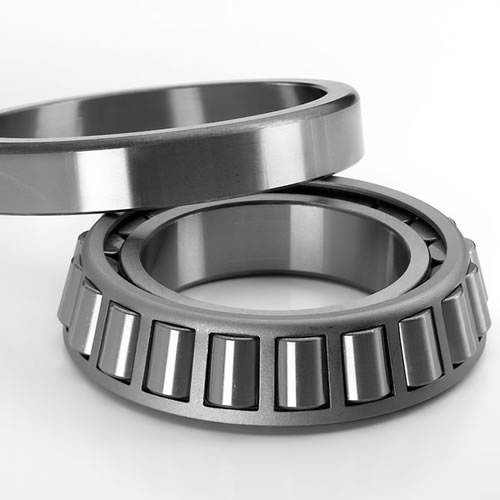
Bearings by the load they can carry: radial; radial-thrust (angular contact); thrust
Types of Radial Bearings
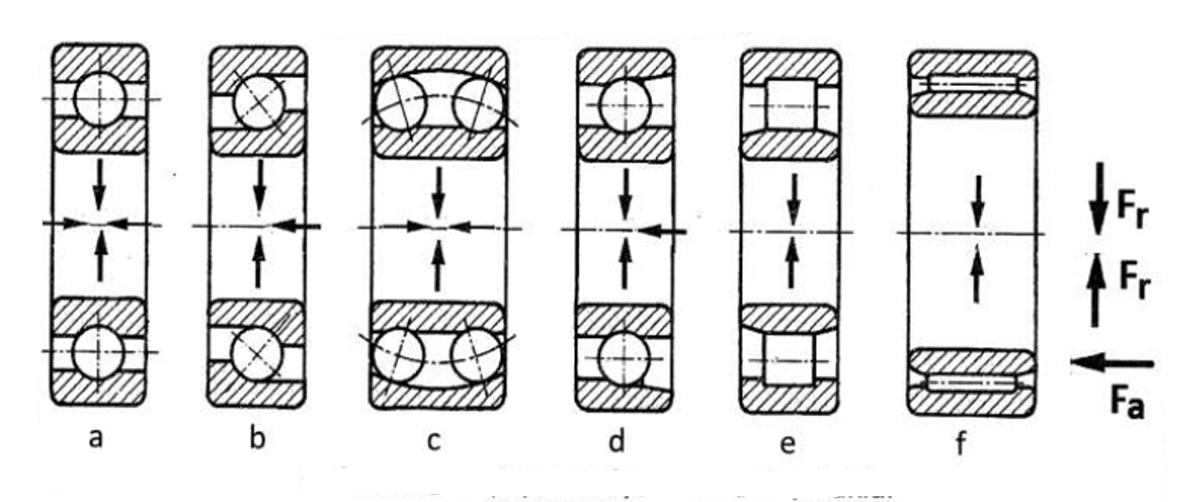
a: single-row deep-groove ball bearing
b: single-row angular contact radial ball bearing
c: double-row self-aligning ball bearing
d: high-load-capacity radial ball bearing
e: cylindrical roller radial bearing
f: needle roller radial bearings.
Fr = Radial force Fa = Axial (thrust) force
The cylindrical roller radial and needle roller bearings in items e and f carry only radial load.
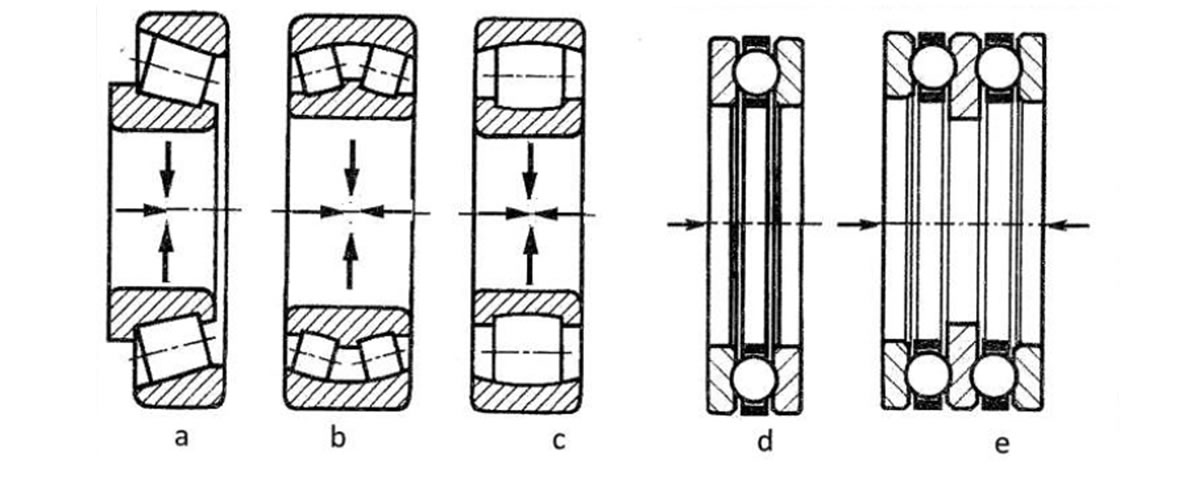
a) tapered roller bearing b) double-row self-aligning roller bearing c) single-row needle roller (sleeve) bearing
d) single-direction thrust ball bearing e) double-direction thrust ball bearing
Bearing Materials
The rings and rolling elements are manufactured from special chromium-alloy bearing steel with high surface pressure strength and resistance to fatigue, corrosion, and wear.
Cages are made of mildly wear-resistant, sufficiently strong steel sheet, and less commonly of materials like bronze, aluminum, brass, or plastic.

Related Questions
Since the inner ring is pressed tightly onto the shaft, it directly follows the shaft’s motion. The outer ring doesn’t move because it sits in a fixed bore in the housing; the balls in between reduce friction between these two surfaces — one moving, one stationary — allowing rotation.
Rolling bearings produce very little friction at startup and are easier to maintain and lubricate than plain bearings. Since they’re also manufactured as standard parts, they can be easily found and replaced on the market.
Related Posts