

The Start-Stop system is a fuel-saving and emissions-reducing technology that automatically shuts off the engine at a red light or during brief stops, then restarts it within milliseconds the moment the driver wants to move again.
Widespread since the mid-2000s, this system is now offered as standard equipment on nearly all new vehicles. In this article we look at how the system works, the special hardware it requires, the conditions under which it deactivates, and its debated advantages and disadvantages.
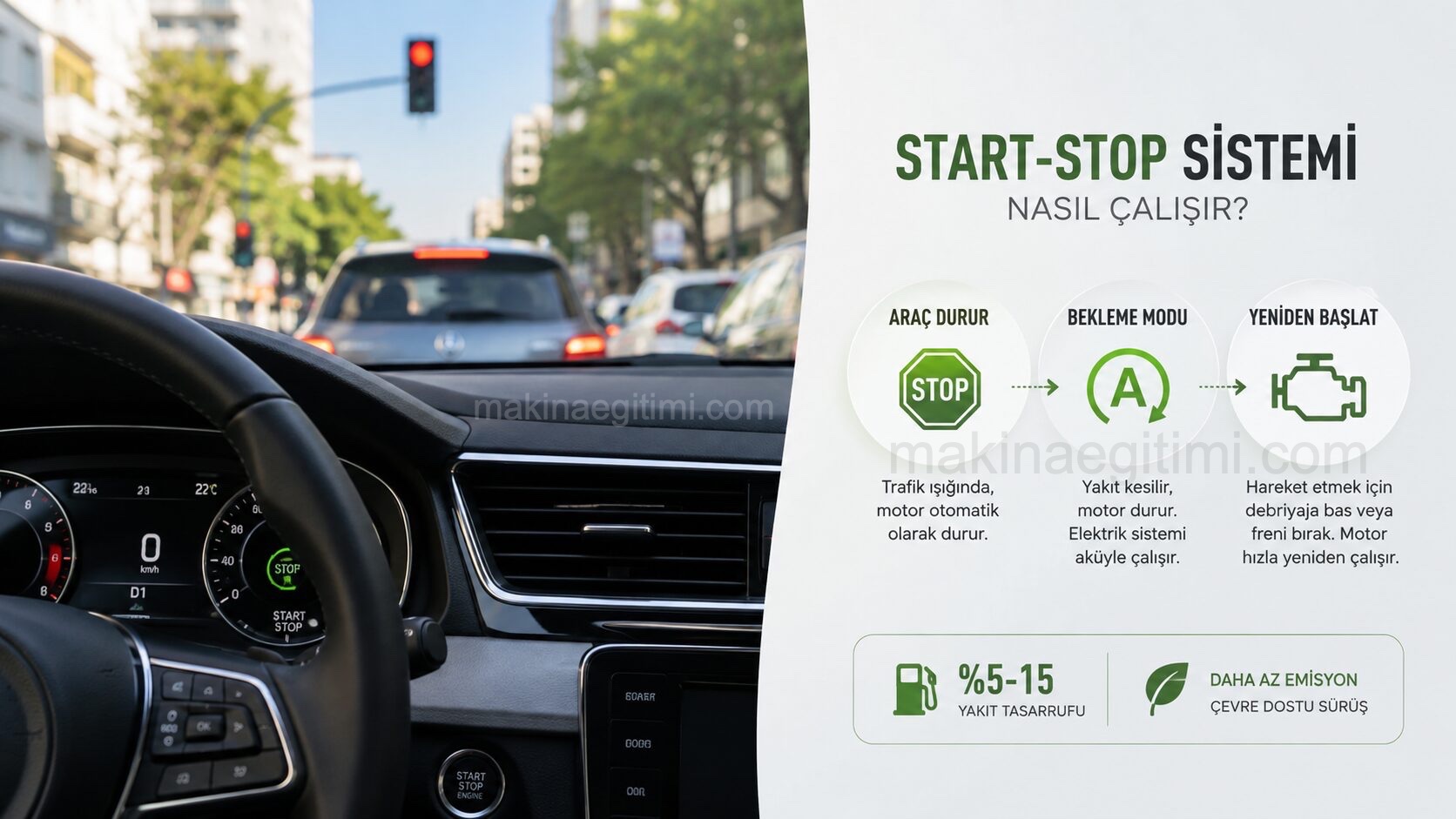
How Does the Start-Stop System Work?
When the vehicle comes to a complete stop (usually at 0 km/h) with the gearbox in neutral and the clutch pedal released (manual transmission) or the brake pedal held down (automatic transmission), the engine control unit evaluates data from numerous sensors — battery state of charge, engine temperature, air conditioning load, steering angle — to decide whether it is safe to stop the engine.
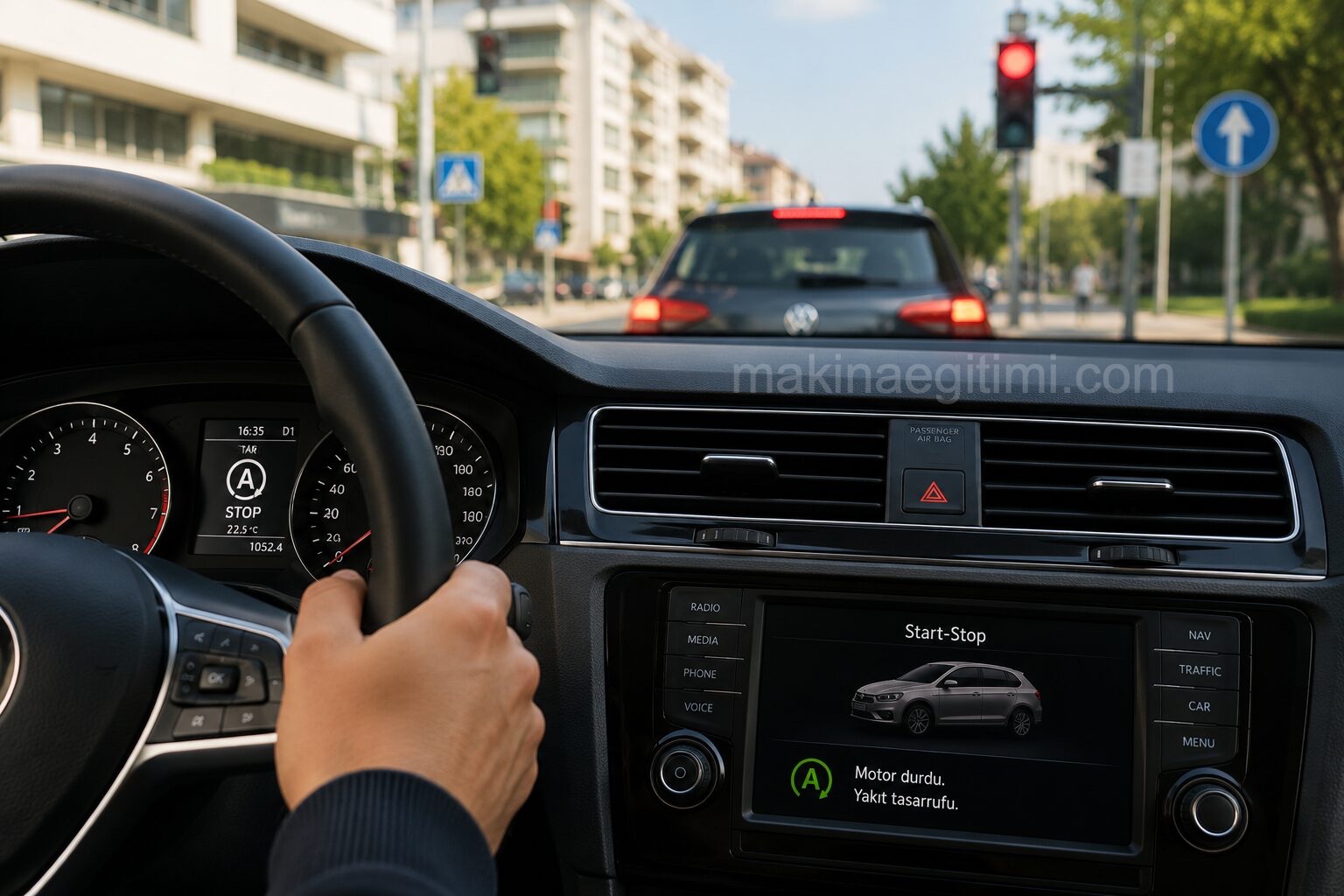
If conditions are suitable, fuel injection and ignition are cut and the engine stops within a few seconds. When the driver presses the clutch and selects a gear again, or releases the brake pedal, the system restarts the engine; on advanced systems this restart can take as little as 300-500 milliseconds, which is far faster than starting with a conventional starter motor (1-2 seconds).
Special Hardware Required

Reinforced Starter Motor
While a standard starter motor is designed for an average of 30,000-50,000 start cycles over the vehicle’s lifetime, in start-stop vehicles this number accumulates much faster in daily use (some drivers experience 30-40 engine stop-start events per day). For this reason, start-stop vehicles use specially reinforced starter motors rated for 300,000-500,000 cycles; these motors are built with stronger gears, upgraded brushes, and more durable ball bearings.
Advanced EFB or AGM Battery
Because the vehicle’s electronics (radio, HVAC fan, headlights, instrument cluster) keep running whenever the engine is stopped, they draw entirely on the battery. A standard lead-acid battery cannot withstand this frequent discharge-charge cycling (deep cycling) and degrades quickly. For this reason, start-stop vehicles use EFB (Enhanced Flooded Battery) technology or the higher-tier AGM (Absorbent Glass Mat) battery technology.
Because the electrolyte is absorbed between glass fiber mats, AGM batteries are more resistant to vibration and can withstand up to 360,000 micro-cycles (start-stop events); a standard battery under these conditions typically wears out within a few months.
Additional Sensors and Control Logic
The system uses a battery sensor (BMS – Battery Monitoring Sensor) that continuously monitors battery temperature, state of charge (SOC), and current flow; when the battery’s state of charge drops below a certain threshold (usually 70-80 percent), the system refuses to stop the engine in order to protect the battery. Data from the steering angle sensor, brake pressure sensor, and the climate control unit are also used to decide when it is safe to stop the engine.
Engine Temperature Requirement
When the engine is cold (usually below 30°C), start-stop does not engage because the catalytic converter has not yet warmed up.
Battery State of Charge
If the battery’s charge level is low (below around 70 percent), the system automatically deactivates so the starter motor is not damaged.
Air Conditioning Load
If cabin temperature is far from the set target (on extremely hot or cold days), the system may avoid stopping the engine for the sake of comfort.
Conditions Under Which the Start-Stop System Deactivates
The start-stop system automatically deactivates, or does not engage at all, under certain conditions:

- If the engine has not yet reached normal operating temperature (usually 60-70°C)
- If the outside air temperature is very low or very high (when cabin comfort demand increases, typically below -5°C or above 30°C)
- If the battery’s charge level or temperature is insufficient
- If the windshield defog/defrost function is active
- If the seatbelt is not fastened or a door is open
- While the steering wheel is turned at a sharp angle (such as during a parking maneuver)
In most vehicles, the driver can also manually disable the system temporarily using a button on the dashboard; however, the system defaults back to active every time the vehicle is restarted.
Advantages and Fuel Savings Figures
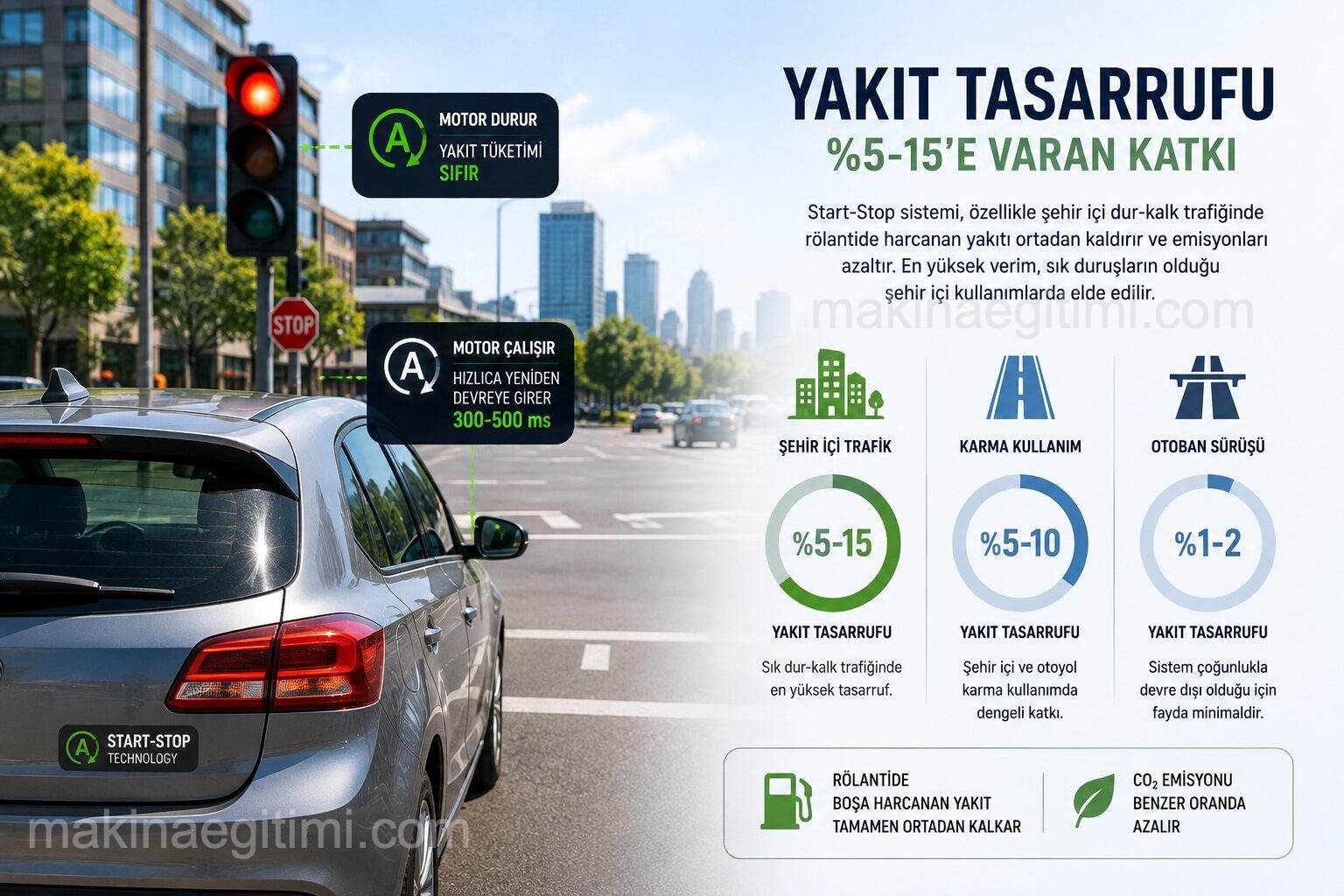
In city traffic, particularly on routes with frequent traffic lights and stop-and-go conditions, the start-stop system can reduce fuel consumption by 5-10 percent, and in some test cycles (especially heavy urban use) by as much as 15 percent. Because fuel wasted at idle is eliminated entirely, CO2 emissions drop by a similar margin. On the highway the system rarely engages, so the benefit is minimal; this is why start-stop’s real payoff shows up in city and mixed driving.
Does the Start-Stop System Damage the Vehicle?
The most common concern about the start-stop system is the extra load it places on the engine and starter motor. Each restart carries a brief risk of “dry friction” between components — particularly the crankshaft and connecting rod bearings — that have not yet reached full oil pressure during the engine’s first few revolutions; this is why manufacturers typically use lower-viscosity synthetic engine oils that lubricate quickly in engines equipped with this system.
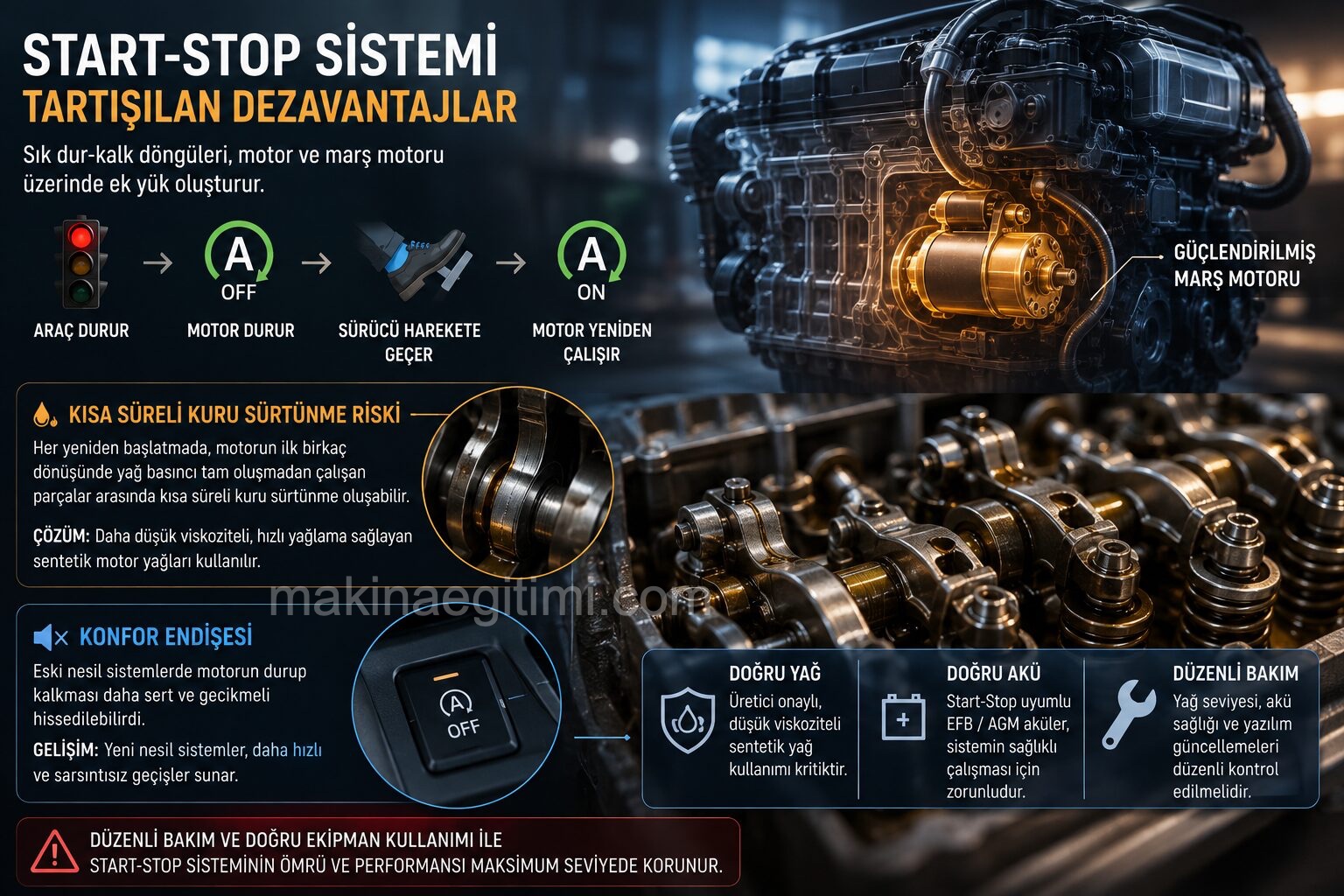
Some drivers also find the engine’s frequent stopping and starting uncomfortable; this transition felt harsher and more delayed on older-generation systems, while newer-generation systems have largely smoothed this sensation out.
Integration with 48V Mild Hybrid Systems
An advanced version of start-stop technology uses a starter-generator (BSG – Belt-driven Starter Generator or ISG – Integrated Starter Generator) integrated into the crankshaft or engine block instead of a conventional starter motor.
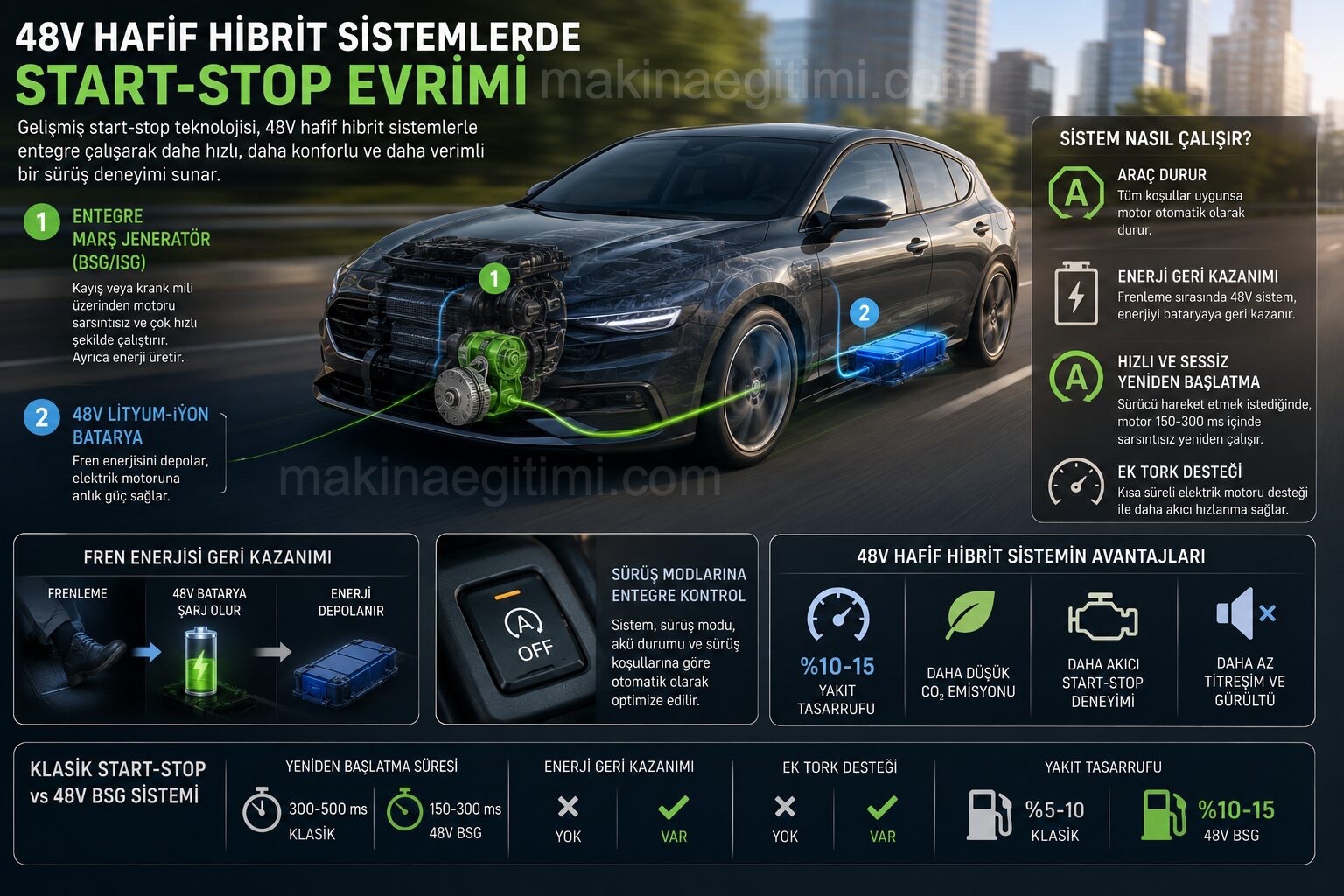
These systems typically run on a 48V architecture and can restart the engine almost imperceptibly, in under 300 milliseconds; they can also recover braking energy (mild regenerative braking) to charge a small lithium-ion or supercapacitor battery, and provide extra torque support (“torque assist”) from the electric motor over short distances. Because this mild-hybrid approach is far less costly than a full hybrid system, it became standard on many manufacturers’ mid-segment models during the 2020s.
Comparison: Classic Start-Stop vs. 48V BSG System
| Feature | Classic Start-Stop | 48V BSG/ISG |
|---|---|---|
| Starting component | Reinforced starter motor | Belt/crank-integrated electric motor |
| Restart time | 300-500 ms | 150-300 ms, smoother |
| Energy recovery | None | Partial regenerative braking |
| Extra torque support | None | Available briefly |
| Fuel savings | 5-10 percent | 10-15 percent |
Electrical Load Management in the Start-Stop System
Since the alternator also stops turning when the engine is off, all electrical consumers running at that moment (HVAC fan, radio, headlights, heated seats) draw directly on the battery. To manage this sudden load shift, the battery sensor continuously monitors current flow and, when the state of charge nears a critical level, sends a signal to the ECU to restart the engine immediately; this is the moment drivers may notice the engine restarting on its own even though they haven’t done anything.
In some higher-end vehicles there is also a special “cold storage evaporator” that stores cooling capacity in the evaporator so the air conditioning compressor’s cooling effect can partly continue while the engine is stopped; this allows cabin temperature to be largely maintained for several minutes even with the engine off.
On extremely hot days, when the air conditioning load is very high, the system may temporarily refuse to stop the engine, prioritizing comfort; this behavior reflects a balance the manufacturer has predetermined between fuel savings and driver comfort.
Maintenance Considerations
Replacing the battery in a start-stop vehicle is a more delicate task than in a standard vehicle; mistakenly installing a standard lead-acid battery causes both rapid battery degradation and the system remaining permanently deactivated.
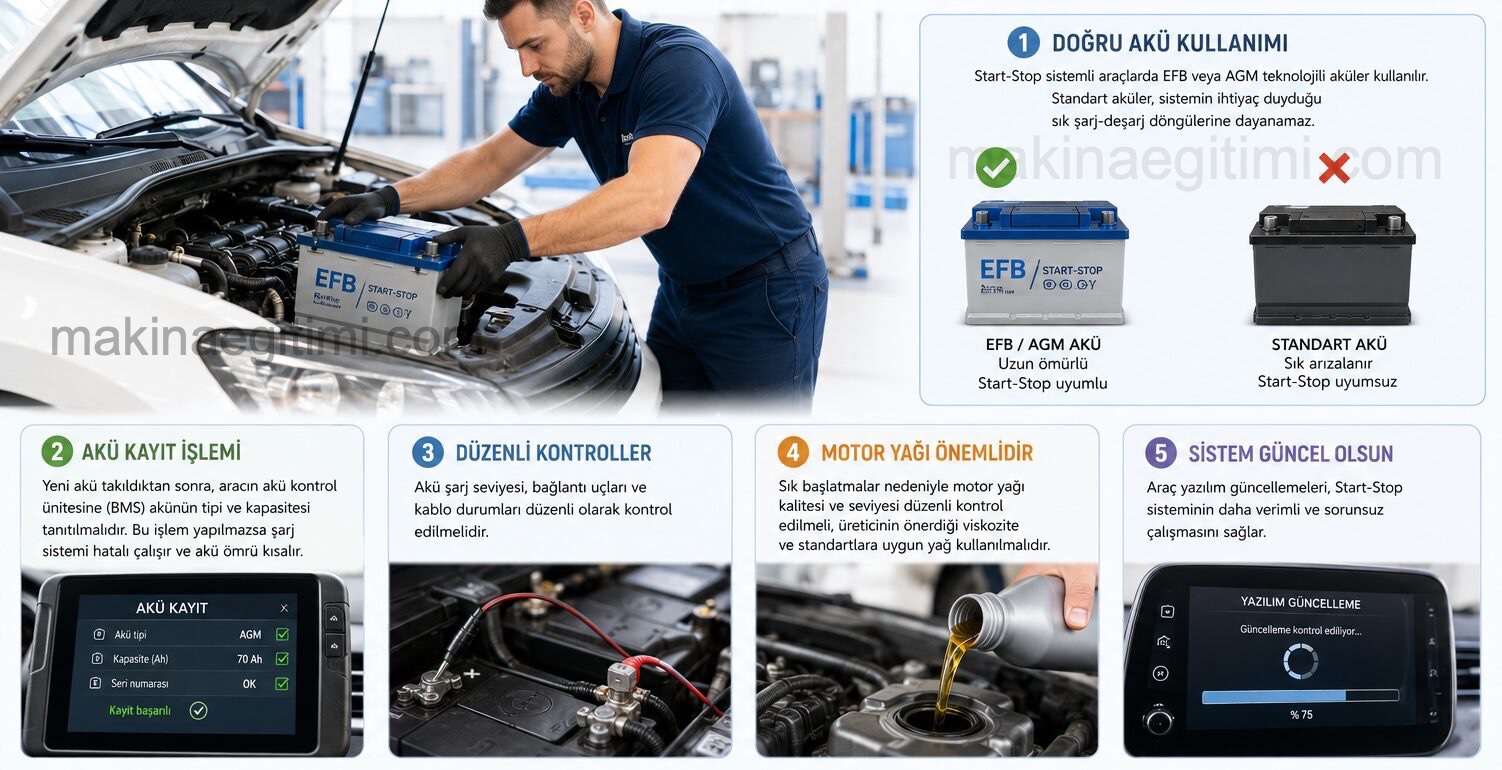
When replacing the battery, most modern systems also require a “battery registration” procedure so the battery control unit recognizes the new battery’s capacity and type; if this step is skipped, the charging system keeps operating based on the old battery’s aging data, which can shorten the new battery’s life.
Regularly checking engine oil level and quality is also slightly more important than in other vehicles because of the frequent starts; a low oil level can prevent adequate lubrication during the critical first seconds of a restart.
Frequently Asked Questions
It would with a standard starter motor, but start-stop vehicles use specially reinforced starter motors rated for 300,000-500,000 cycles.
No, a standard lead-acid battery cannot withstand the frequent discharge-charge cycling; an EFB or AGM battery is required, otherwise the battery degrades quickly.
If engine temperature is insufficient, battery charge is low, the air conditioning load is high, or the outside temperature is extreme, the system automatically avoids engaging for safety reasons.
With the correct oil and maintenance, manufacturers have largely reduced this risk; the low-viscosity synthetic oils developed specifically for the system provide rapid lubrication.
In most vehicles it can only be disabled temporarily; the system defaults back to active every time the engine is restarted.
It provides a faster, smoother restart, can recover braking energy, and offers brief extra torque support, resulting in higher fuel savings.
Related Posts
 What Is the Automatic Start-Stop System, What Does It Do?
 What Is Lane Keeping Assist, How Does It Work?
 Toyota Safety Sense Active Safety System
 Electric Power Assisted Steering (EPS)
 Smart Key or Keyless Entry in Vehicles
 What Is Adaptive Cruise Control (Speed Control System). How Does It Work?
 Roll Stability Control System (RSC) in Vehicles
 What Is Bosch Remote Park Assist, How Does It Work?