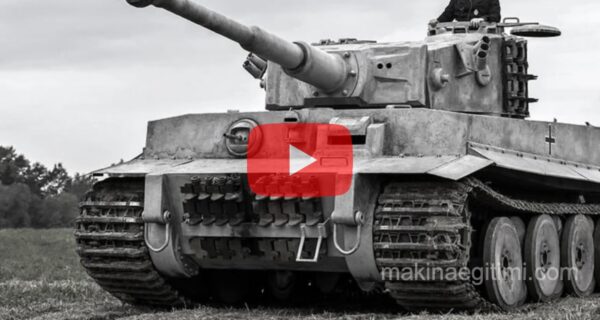
If you asked which armored vehicle is the most iconic from World War II, plenty of historians and military enthusiasts would answer Tiger I without a second thought. Nearly 80 years later, this tank still shows up in books, documentaries, video games, and films. But the story of the Tiger I isn’t just about a powerful war machine — it’s also a story of engineering genius, logistical headaches, and human stories.
Why Was the Tiger I Developed?
In 1941, when the German army invaded the Soviet Union, it ran into an unexpected situation. The Soviets’ T-34 and KV-1 tanks had far stronger armor than the German Panzer III and IV tanks.

German commanders demanded a new heavy tank. The result was the Tiger I, developed by German manufacturer Henschel. The first Tiger tanks reached the front lines in 1942.
Tiger I’s Technical Specifications
| Specification | Value |
|---|---|
| Weight | 57 tons |
| Crew | 5 people |
| Main gun | 88 mm KwK 36 L/56 |
| Top speed | 45 km/h |
| Engine | 700 hp Maybach |
| Armor thickness | 25-120 mm |
| Number produced | Approximately 1,350 |
The Tiger’s biggest advantage was its legendary 88 mm gun. This weapon could knock out many Allied tanks from roughly 2 kilometers away. At the time, most tanks could be hit before they even got close to a Tiger.

The Tiger I’s Weaknesses
The Tank’s Weight and Extreme Fuel Consumption
The Tiger’s biggest enemy often wasn’t enemy tanks at all. Because of its 57-ton weight:
- Crossing bridges was difficult.
- It frequently got stuck in swampy and muddy terrain.
- Fuel consumption was incredibly high.
A Tiger is reported to have burned around 500 liters of fuel per 100 kilometers. There was a joke among German crews: “If the enemy doesn’t get us, our engine will.”
The Rail Transport Problem
The Tiger’s tracks were too wide. Because of this, narrower transport tracks had to be fitted before it could be carried by rail. The process went like this:
- The wide combat tracks were removed.
- Some of the outer road wheels were taken off.
- Narrower tracks were fitted.
- It was loaded onto the train.
Once it reached the front, the whole process had to be reversed. This sometimes took hours.
The Tiger’s Hidden Flaw
The Tiger’s interleaved road wheel system was quite advanced. But it caused a major problem in the Russian winter. Mud, snow, and ice would pack in between the wheels. If it froze overnight, the tank might not be able to move by morning. Crews sometimes had to build fires to thaw the wheels out.
Armor Thickness
The Tiger I’s front armor was 100 mm thick — an extremely difficult level for most Allied tanks of the era to penetrate.
Main Gun
The tank was armed with the 88 mm KwK 36 gun, one of the most effective tank guns of the era.
Production Numbers
Roughly 1,347 Tiger Is were produced in total between 1942-1944; its high cost kept production numbers limited.
The Tiger I’s Impact on World War II
Tiger Fear
A genuine “fear of the Tiger” took hold among Allied soldiers.
An interesting fact:
After D-Day, many British and American soldiers reported every German tank they encountered as a “Tiger.” In reality, most of these were actually Panzer IVs or Panthers.

Historians even gave this phenomenon a name: “Tiger Phobia.”
One of the first names that comes to mind when you say “Tiger” is Michael Wittmann.
During the Battle of Villers-Bocage on June 13, 1944, Wittmann attacked British forces with a single Tiger tank.
In roughly 15 minutes:
- Numerous tanks,
- Armored vehicles,
- Trucks,
- And artillery vehicles
were destroyed.
Wittmann’s Tiger was damaged by the end of the attack and had to be abandoned. A few months later, Wittmann himself was killed in Normandy. This raid is considered one of the most famous tank attacks in history.
A Tiger Gets Captured
After the Battle of Kursk in 1943, Soviet forces captured a working Tiger.
The tank was tested in detail. Soviet reports reached the following conclusions:
- Its front armor was extremely strong.
- Attacking the side armor made more sense.
- Its mobility was lower than expected.
This information contributed to later Soviet tank designs.
Was the Tiger Really Invincible?
No. Some tanks that faced it could give it a real fight. For example:
- The IS-2
- The M26 Pershing
- The Sherman Firefly
Air strikes and artillery fire also posed a serious threat to Tiger units.
The Tiger’s Psychological Impact
The Tiger’s success wasn’t just about its weapons.
- Its massive appearance,
- The roar of its engine,
- And the reputation of its 88 mm gun
created immense psychological pressure on enemy soldiers.
Many Allied soldiers later wrote in their memoirs that encountering a Tiger was one of the most terrifying experiences of their lives.
An Expensive Legend
The Tiger I was technically an extraordinary tank, but it was controversial in terms of wartime economics.
Roughly:
- 1,350 Tiger Is,
- More than 6,000 Panthers,
- More than 49,000 T-34s,
- And around 49,000 Shermans
were produced.
Germany’s complex, expensive Tiger design fell short in numbers as the war went on, up against Allied tanks with the advantage of mass production.
Despite being one of the most powerful tanks of World War II, the Tiger I wasn’t flawless. Its outstanding firepower and thick armor turned it into a legend, but its high cost, mechanical failures, and logistical challenges kept it from changing the course of the war.
Perhaps this is exactly what makes the Tiger I so fascinating: it isn’t just a tank, but a steel symbol of engineering ambition, the pursuit of technological superiority, and the harsh realities of war. Tiger 131, one of only a few working Tigers displayed in museums today and the only Tiger I with a still-functioning engine, continues to keep this legend alive.
Related Video

Frequently Asked Questions
The Soviet Union’s T-34 and KV-1 tanks had far stronger armor than the German Panzer III and IV tanks of the time. To counter this advantage, the German army demanded a new, more heavily armored tank.
This gun could knock out many Allied tanks from as far as roughly 2 kilometers away. Most tanks of the same era couldn’t land an accurate, lethal shot at that range, which gave the Tiger I a huge range advantage.
Related Posts