
Pulley Calculations
We consider pulleys and pulley calculations to be an important topic in machine technology. Pulley calculation is something engineers, technicians, and technologists working in the machine field need to know. That’s why we felt it necessary to cover this topic in our machine elements section as well.
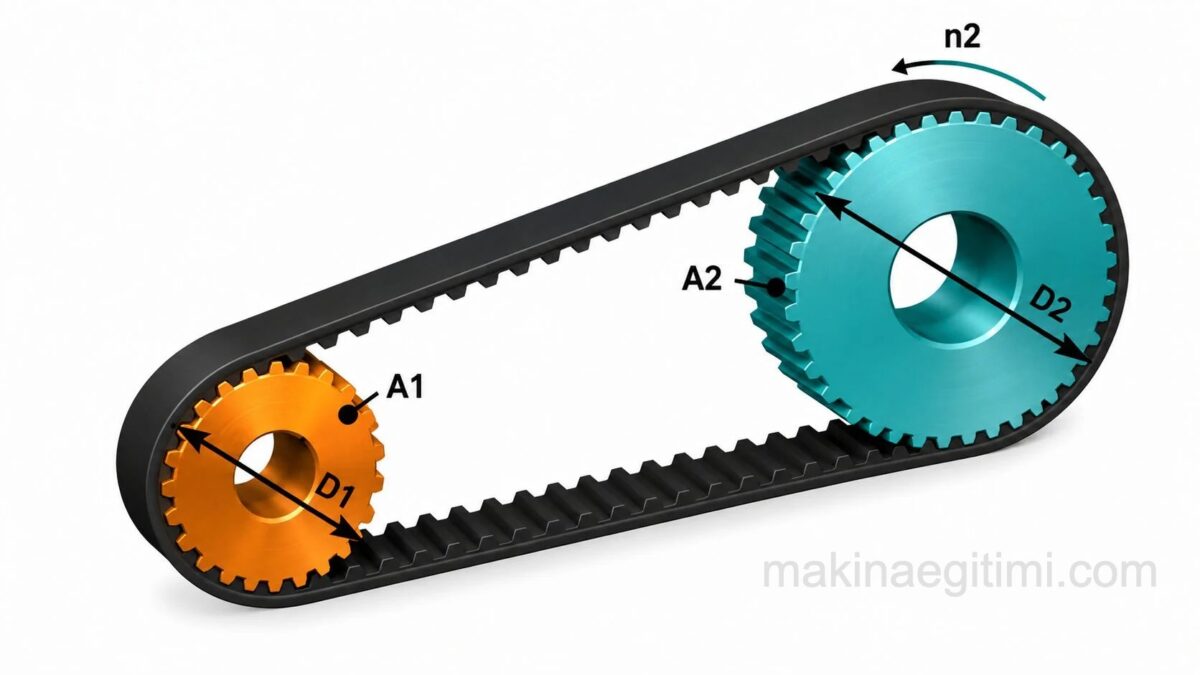
For pulleys that turn each other, the relationship between diameter and rotational speed:
Calculating Pulley Speed:

In a belt drive, some belt slip always occurs. If we assume for a moment that the belt doesn’t slip, the peripheral (surface) speed of the driving pulley will equal the peripheral speed of the driven pulley. Accordingly, the speed of points (A1) and (A2) on the perimeters of the pulleys is equal to the belt speed. So:
Speed of point (A1) on the driving pulley:


Speed of point (A2) on the driven pulley:
Based on the explanation above, we can set the right-hand sides of formulas (1) and (2) equal to each other:
π • D1 • n1 /60 = π • D2 • n2 /60
Simplifying this equation:
D1 • n1 = D2 • n2 …………….. formula 3 is obtained
Rule: In belt-driven power transmission, the diameter of the driving pulley multiplied by its rotational speed equals the diameter of the driven pulley multiplied by its rotational speed.
Equation (3) can also be written as:
D1/D2 = n2/n1
Rule: In belt-driven power transmission, pulley diameters and rotational speeds are inversely proportional.
In equation (4), the ratio (D1/D2) is called the transmission ratio, and the ratio (n2/n1) is called the gear ratio.
Belt Slip in a Belt-Pulley System:
In a belt drive, the peripheral speed of the driven pulley is always slightly less than that of the driving pulley. This is caused by belt slip. Belt slip can range between (0.01 … 0.05), but it’s best kept below (0.02). This is because: if belt slip exceeds this value, the heat generated by the slipping can damage the belt.
In equation (4), let’s isolate the rotational speed (n2) of the driven pulley;
n2= D1.n1 / D2
To find the exact rotational speed of the driven pulley, the belt slip (k) must be taken into account. This gives us:
n2= D1.n1 /D2 – D1.n1/D2 . k which gives us:
n2 = D1.n1 /D2 . (1-k) …………….. 6
In formula (6), the value (1 – k) is called the efficiency of the belt drive. If we denote efficiency with (η), we get formula (7).
n2 = D1.n1 /D2 . η …………….. 7
Belt-Pulley System: Sample Pulley Calculation
A pulley keyed to the shaft of an electric motor has a diameter of (150 mm), and we want to use a belt to drive another pulley with a diameter of (500 mm). Given that the electric motor’s shaft runs at (1500 RPM) and the belt slip is (2%):

A — Find the rotational speed of the driven pulley,
B — Find the rotational speed of the driven pulley assuming the belt drive’s efficiency is (97%).
Related Posts
 Rolling-Element Bearings
 Standard Representation and Dimensions of a Washer
 Metric and Whitworth Thread Systems
 Types of Cotter Pins and Dimensional Standards
 Bevel Gear Strength Calculations
 Motion Transmission with Belt Pulleys
 Shaft Diameter Calculation
 Pivot Pins – What Is a Pivot Pin, Where Is It Used