
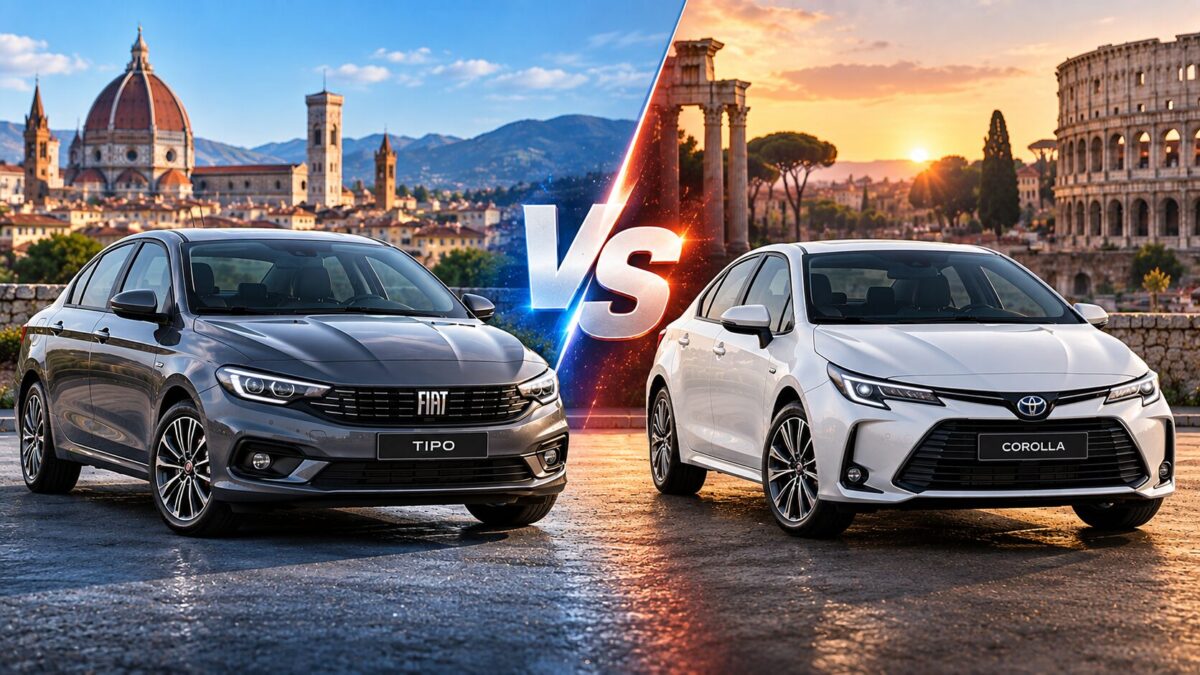
If you are shopping for a sensible, family-sized saloon in Europe, two names keep coming up: the Fiat Tipo and the Toyota Corolla. Interestingly, the saloon versions of both cars sold in Europe share the same birthplace. Both were built in Turkey, the Tipo by Tofaş in Bursa (where it is sold as the Fiat Egea) and the Corolla saloon at Toyota’s Sakarya plant.
Beyond that, the two cars follow very different philosophies. The Tipo is the practical, low-cost option: a big boot, a frugal diesel engine and cheap parts. The Corolla asks you to spend a little more in exchange for hybrid efficiency, more technology and Toyota’s legendary reliability.
In this comparison we look at engines, real-world fuel consumption, CO₂ emissions, LPG conversion, space, equipment, safety, common problems, servicing costs and resale value, and we name a winner in each category.
One important note: Fiat ended production of the Tipo family in June 2026. New examples may still be found in dealer stock in some markets, but for most buyers this comparison will be most useful on the used car market. We focus on the Tipo 1.6 MultiJet diesel and the current Corolla saloon with the 1.5 petrol and 1.8 hybrid engines.

Engines and Performance
Fiat Tipo 1.6 MultiJet (diesel)
Engine: 1,598 cc, 4-cylinder turbodiesel
Power: 130 hp
Torque: 320 Nm at 1,500 rpm
Gearbox: 6-speed manual or 6-speed DCT automatic
0-100 km/h: 9.7 seconds (manual), 9.8 seconds (DCT)
Top speed: 212 km/h
Toyota Corolla 1.5 (petrol)
Engine: 1,490 cc, 3-cylinder, naturally aspirated
Power: 125 hp
Torque: 153 Nm at 4,800-5,000 rpm
Gearbox: Multidrive S (CVT automatic)
0-100 km/h: 11.5 seconds
Top speed: 190 km/h
Toyota Corolla 1.8 Hybrid
Engine: 1,798 cc, 4-cylinder petrol plus electric motor
Total system output: 140 hp
Electric motor torque: 185 Nm
Gearbox: e-CVT
0-100 km/h: 9.3 seconds
Top speed: 180 km/h
On paper, the Corolla Hybrid is the quickest of the three. On the road, though, the Tipo diesel often feels the strongest. Its 320 Nm of torque arrives at just 1,500 rpm, so it pulls effortlessly on motorway inclines and when fully loaded with family and luggage. The Corolla Hybrid feels lively and smooth in town thanks to instant electric torque. The Corolla 1.5 petrol is the weakest link: its modest torque only arrives high in the rev range, so overtaking with a full car requires planning.
Winner: Tipo diesel for long-distance and loaded driving, Corolla Hybrid for urban agility and overall performance. The Corolla 1.5 trails both.
Fuel Consumption: Which Is More Economical?
Official WLTP combined figures:
Fiat Tipo 1.6 MultiJet: around 4.5 L/100 km (diesel)
Toyota Corolla 1.8 Hybrid: 4.5-4.7 L/100 km (petrol)
Toyota Corolla 1.5: 6.1-6.3 L/100 km (petrol)
The official numbers put the Tipo and Corolla Hybrid neck and neck, but real-world results depend heavily on how you drive.
In the city, the Corolla Hybrid is the clear winner. It can creep through traffic on electric power and recover energy under braking, so 4-5 L/100 km is realistic in urban use. The Tipo diesel can climb to 6.5-7.5 L/100 km in heavy stop-start traffic.
On the motorway the picture reverses. At steady cruising speeds the Tipo diesel typically returns 4.5-5.5 L/100 km, while the hybrid’s advantage shrinks at higher speeds and it usually uses slightly more.
Also remember the price difference between diesel and petrol varies from country to country across Europe, so it is worth running the numbers with your local pump prices. The Tipo diesel also needs regular AdBlue top-ups.
Winner: Corolla Hybrid in the city, Tipo diesel on the motorway.
CO₂ Emissions, Taxes and Low Emission Zones
In much of Europe, CO₂ emissions directly affect what you pay in registration tax, annual road tax and, for company car drivers, benefit-in-kind tax. Official WLTP figures:
Toyota Corolla 1.8 Hybrid: 102-106 g/km
Fiat Tipo 1.6 MultiJet: around 116-120 g/km
Toyota Corolla 1.5: 137-143 g/km
The Corolla Hybrid has the lowest emissions of the three, which can translate into noticeably lower taxes in countries with CO₂-based vehicle taxation. The Corolla 1.5 petrol has the highest emissions, so in strongly CO₂-taxed markets it can be the most expensive to tax despite being the cheapest Corolla to buy.
Low emission zones are another factor. The Tipo 1.6 MultiJet meets the Euro 6d-Final standard, which currently gives access to most European low emission zones. However, several European cities have announced plans to tighten rules on diesel vehicles in the coming years. If you live in or regularly drive into a large city, check your local LEZ roadmap before choosing a diesel. Petrol and hybrid cars face fewer long-term restrictions.
Winner: Corolla Hybrid.
LPG Conversion: Which One Suits Autogas?
LPG remains popular in markets such as Italy, Poland and parts of Central and Eastern Europe. Here the two cars differ significantly.
Fiat Tipo 1.6 MultiJet: As a diesel, it cannot be fitted with a standard LPG system. If you want an LPG Tipo, look for the petrol 1.4 Fire 95 hp version on the used market. Its simple port-injection design makes it one of the most LPG-friendly engines around, and factory or aftermarket LPG versions are common.
Toyota Corolla 1.5 Dynamic Force: LPG is possible but complicated. Because this engine uses direct injection, only special direct-injection LPG kits can be used. These systems keep burning a small amount of petrol to protect and cool the injectors, so savings are lower than with a conventional LPG conversion, and installation costs more. Choosing the wrong kit can lead to injector failure and serious engine damage, so always use an experienced installer.
Toyota Corolla 1.8 Hybrid: Some converters offer LPG systems, but it is generally not recommended. The hybrid’s petrol engine switches off frequently in town, which limits the savings, and the conversion may complicate warranty coverage.
Toyota Corolla 1.6 Valvematic (previous generation): With port injection, this is the most LPG-friendly Corolla and a strong choice on the used market.
On LPG, consumption is typically 15-25 percent higher than on petrol by volume, but the much lower price of autogas still delivers significant savings. For any LPG car, regular valve clearance checks are important for long engine life.
Winner: On the used market, the Tipo 1.4 Fire and Corolla 1.6 Valvematic are equally well suited to LPG. With current engines, neither is ideal: the Tipo diesel cannot take LPG, and the Corolla 1.5 can only be converted with costly specialist kits.
Dimensions, Interior Space and Boot
Fiat Tipo saloon
Length: 4,532 mm
Width: 1,792 mm
Height: 1,497 mm
Wheelbase: 2,636 mm
Boot capacity: 520 litres
Toyota Corolla saloon
Length: 4,630 mm
Width: 1,780 mm
Height: 1,435 mm
Wheelbase: 2,700 mm
Boot capacity: 471 litres
The Corolla is longer with a longer wheelbase, giving slightly more rear legroom. However, its low, sloping roofline limits rear headroom for taller passengers. The Tipo’s taller body gives it a more airy feel in the back.
In the boot, the Tipo wins clearly. Its 520-litre load space beats the Corolla by 49 litres, a difference you will notice on family holidays.
Winner: Tipo for boot space and rear headroom, Corolla for rear legroom. Overall, the Tipo is the more practical car.

Comfort Equipment Compared
Equipment and trim names vary between European markets, but the overall pattern is consistent.
Sunroof
Tipo: Not available on the saloon
Corolla: Electric sunroof on mid and upper trims
Heated seats
Tipo: Generally not offered on the saloon
Corolla: Available on top trims
Ventilated seats and heated steering wheel
Tipo: Not available
Corolla: Not available
Electric seats
Tipo: Not available
Corolla: Not available, electric lumbar support on top trims only
Auto-dimming rear-view mirror
Tipo: Upper trims only
Corolla: Standard
Climate control
Tipo: Manual on entry trims, single-zone automatic on higher trims
Corolla: Manual on the entry trim, dual-zone automatic on the rest
Digital instrument cluster
Tipo: Up to 7 inches
Corolla: 12.3 inches on most trims
Infotainment
Tipo: 5, 7 or 10-inch screen depending on trim
Corolla: 8 to 10.5-inch screen, with wireless Apple CarPlay and Android Auto across the range
Drive modes
Tipo: None, apart from a City steering mode
Corolla: Eco, Normal and Sport, plus EV mode on the hybrid
Head-up display and ambient lighting
Tipo: Not available
Corolla: Available on upper trims
Winner: Corolla, by a clear margin. Trim for trim, it offers noticeably more comfort and technology.
Ride, Handling and Refinement
The biggest engineering difference between the two cars is at the rear axle. The Tipo uses a simple torsion beam, while the Corolla has independent double-wishbone rear suspension.
You feel the difference on the road. The Corolla is more composed in corners, settles better over broken surfaces and feels more planted at motorway speeds. The Tipo has a soft-to-medium setup that absorbs bumps reasonably well but shows more body roll when pushed.
Refinement also favours the Corolla. Wind and tyre noise at motorway speeds are among the Tipo’s most criticised traits. The Corolla Hybrid is almost silent when running on electric power around town, although the 3-cylinder 1.5 petrol can sound coarse at high revs.
Winner: Corolla.
Safety
Thanks to the EU General Safety Regulation (GSR), both cars come with a strong set of driver assistance systems as standard.
Fiat Tipo (all trims)
6 airbags
Autonomous emergency braking
Lane keeping assist
Driver drowsiness detection
Traffic sign recognition
Intelligent speed assist
Rear-view camera and rear parking sensors
Toyota Corolla (all trims)
7 airbags, including a driver’s knee airbag
Toyota Safety Sense 3
Pre-collision system with pedestrian, cyclist and motorcyclist detection
Intersection turn assist
Full-speed adaptive cruise control
Lane tracing assist
Driver monitoring camera
Emergency driving stop system
Rear-view camera
The Corolla’s standard full-speed adaptive cruise control, even on the entry trim, is a key advantage that no Tipo saloon offers.
Winner: Corolla.
Common Problems and Reliability
Known issues with the Fiat Tipo 1.6 MultiJet
Diesel particulate filter (DPF) clogging, especially with short urban journeys
EGR valve carbon build-up
Early dual-mass flywheel and clutch wear on manual versions
Low-speed judder on the DCT automatic
AdBlue sensor and pump faults
Interior squeaks and rattles
Known issues with the Toyota Corolla
Idle vibration from the 3-cylinder 1.5 engine
Reported bearing failures on some early 1.5 engines, often linked to incorrect engine oil
“Rubber band” feel from the CVT under hard acceleration
12V battery drain on hybrids left unused for long periods
Clogged hybrid battery cooling fan filter
Overall, the Corolla, and especially the 1.8 Hybrid, has the edge on reliability. The hybrid has no turbocharger, DPF, EGR system, clutch or conventional starter motor, removing many of the classic expensive failure points of a modern diesel. The Tipo diesel is robust when used mainly for long-distance driving, but short-trip urban drivers are exposed to DPF and EGR problems.
Winner: Corolla Hybrid. Between the Corolla 1.5 and the Tipo diesel, it depends on your driving: long distances favour the Tipo, urban use favours the Corolla 1.5.
Servicing Costs, Parts and Warranty
Routine servicing and parts are generally cheaper for the Tipo, and a large independent parts market keeps costs down.
However, the long-term picture can be different. As a modern diesel ages, big-ticket items such as the DPF, EGR valve, injectors, dual-mass flywheel and clutch can wipe out the Tipo’s savings on routine servicing. The Corolla Hybrid avoids most of these components, and regenerative braking means brake pads often last much longer.
Warranty is another strong point for Toyota in Europe. In many European markets, Toyota offers an extended warranty programme (Toyota Relax) that can renew coverage for up to 10 years when the car is serviced at an authorised Toyota workshop. Toyota also offers extended hybrid battery cover through regular hybrid health checks. Terms vary by country, so check with your local Toyota dealer. For used Tipo buyers, the end of production is not a concern for parts, as Fiat parts and service support will continue for many years.
Winner: Tipo for routine servicing and parts costs, Corolla Hybrid for long-term cost predictability and warranty.
Resale Value
Both cars are easy to sell, but the Corolla generally holds its value better across Europe. Toyota’s reputation for reliability keeps demand high, particularly for hybrid models. The Tipo’s lower purchase price makes it an attractive used buy, but depreciation is typically steeper, and concerns about the future of diesel in European cities may weigh on used diesel values over time.
Winner: Corolla.
Scorecard
Performance under load: Tipo
Urban agility: Corolla Hybrid
Urban fuel economy: Corolla Hybrid
Motorway fuel economy: Tipo
CO₂ emissions and taxation: Corolla Hybrid
Low emission zone outlook: Corolla
LPG suitability (current engines): Corolla 1.5, with specialist kits only
Boot space and practicality: Tipo
Comfort equipment: Corolla
Ride and refinement: Corolla
Safety: Corolla
Reliability: Corolla Hybrid
Routine servicing and parts: Tipo
Warranty: Corolla
Resale value: Corolla
Fiat Tipo or Toyota Corolla? Our Verdict
These two cars suit very different buyers.
Choose the Fiat Tipo if:
You cover high annual mileage, mostly on motorways
A large boot is a priority
You want the lowest possible purchase and routine servicing costs
You are happy to give up some comfort features to save money
You want an LPG car (look for the 1.4 Fire petrol on the used market)
Choose the Toyota Corolla if:
You mostly drive in the city (choose the Hybrid)
You want long-term reliability and strong resale value
CO₂-based taxes or low emission zones matter where you live
Safety technology such as adaptive cruise control matters to you
You want a quieter, more comfortable and better-equipped car
In short, the Tipo is a no-nonsense workhorse: cheap to run, roomy and frugal on long journeys. The Corolla is the more mature, safer and more refined car. If your budget allows and you plan to keep the car for many years, the Corolla, particularly the 1.8 Hybrid, is the smarter long-term investment. If budget is your priority and you mainly drive long distances, the Tipo diesel still makes a lot of sense.
The Corolla 1.5 petrol sits in between. It offers the Corolla’s equipment, safety and resale advantages, but its performance, fuel consumption and CO₂ emissions trail both rivals.
Frequently Asked Questions
The Corolla Hybrid uses less fuel in the city, while the Tipo 1.6 MultiJet is more economical on the motorway. The Corolla 1.5 petrol uses more than both.
The Corolla, especially the 1.8 Hybrid, has the stronger reliability record. The Tipo diesel is durable on long journeys but can suffer DPF and EGR problems with frequent short trips.
The Corolla 1.8 Hybrid, at 102-106 g/km WLTP. The Tipo 1.6 MultiJet emits around 116-120 g/km and the Corolla 1.5 137-143 g/km.
On the used market, the Tipo 1.4 Fire and the previous-generation Corolla 1.6 Valvematic are the best LPG choices. The Tipo diesel cannot take LPG, and the current Corolla 1.5 needs a specialist direct-injection kit.
The Fiat Tipo saloon offers 520 litres, compared with 471 litres in the Corolla saloon.
Yes. The Tipo saloon is sold as the Fiat Egea in Turkey, where it was built.
The Tipo has lower routine servicing and parts costs. Over the long term, however, the Corolla Hybrid avoids many expensive diesel-related repairs, so the overall gap can be smaller than it first appears.
